





What are Plastic Injection Molding Services?
Plastic injection molding services utilize the most widely applied precision manufacturing process for plastic components. During production, plastic pellets are melted in injection molding machines and injected into custom plastic molds. When the molten plastic cools and solidifies, complex-shaped plastic parts are formed. All injection molding facilities operate on this principle.
The main advantage of custom plastic injection molding services is their high efficiency and cost-effectiveness in producing plastic products, ranging from dozens to millions of pieces. They are suitable for over 95% of industrial sectors, including automotive and electronics.
Startups, product design companies, prototype developers, and large enterprises can obtain injection molded products through plastic injection molding services, maintaining 99.8% dimensional stability even at 10,000-unit production scales. Customers also receive comprehensive support such as DFM, material selection, and surface finishing.
3 Key Stages of Injection Molding Solutions
Abismould is a trusted brand in plastic injection molding services. We understand how to transform customer designs into precise reality; we know how to ensure stability in high-volume production of millions of units. We know how to minimize trial-and-error costs for clients. To achieve this, we have developed a vertically integrated manufacturing solution for custom plastic parts:
- Through seamless coordination between our in-house mold factory and 90-1600 ton injection molding machines, we achieve ±0.0254mm (±0.001") mold precision and 99.5% defect-free yield in our plastic injection molding services.
- Our proprietary digital quality control system monitors 12 critical process parameters in real-time, reducing material shrinkage variations to within 0.15% and eliminating batch risks.
- Whether prototyping micro-molded components or scaling complex geometries, clients of our plastic injection molding services benefit from 30% reduced time-to-market, 80% fewer design iterations, and 100% zero-trial delivery on first production runs.

This proven and efficient plastic parts manufacturing system is built upon four deeply optimized core stages:

01. Plastic Mold Design
Mold design from the mold factory determines the shape, dimensions, and precision of products. The skills of mold designers can shape injection molded parts in terms of quality and performance through plastic injection molding services.

02. Injection Mold Manufacturing
Mold manufacturing transforms design blueprints into real-life molds. The mold manufacturing capabilities of mold companies can determine mold lifespan, which affects your product's production costs.

03. Plastic Molding Production
Plastic materials are transformed into your products with the help of molds. The ability of plastic molding facilities to control molding parameters determines the quality of final products in plastic injection molding services.

04. Part Post-Processing
Through flash removal, surface treatment, and part assembly, First Mold can make products look better, enhance their performance, and meet customized and special requirements.
Core Advantages of abismould's Plastic Molding Services
Scalable Plastic Injection Molding Services
72-hour prototype turnaround
50+ engineering materials
Zero design lock-in
Certified Injection Quality
99.5% first-pass rate
24/7 production monitoring
100% laser inspection

Precision Plastic Molding Solutions
±0.001" mold tolerance
0.15% shrinkage control
500,000+ cycle durability
Proven Injection Molding Expertise
200,000+ successful cycles through plastic injection molding services
80% reduction in design iterations
Zero mold scrap rate
2.000.000 +
Parts per month
50 +
Mold manufacturing per month
0.005 mm
Mold tolerance
100-1000 tons
Injection molding tolerance
| Project | Specifications | Project | Specifications |
|---|---|---|---|
| Maximum Part Size: | 1600mm x 1400mm x 500mm | Minimum Part Size: | 1mm x 1mm x 5mm |
| Material Range: | Over 200 types including modified plastic materials for plastic injection molding services | Injection Mold Delivery Time: | Fastest delivery within one week |
| Injection Cycle: | 20 seconds for standard structural components | Mold and Injection Departments: | Over 130 specialized employees dedicated to plastic injection molding services |
Best suited for projects requiring:
Volume Scalability: 10,000+ parts with ≤30-day turnaround through plastic injection molding services
Micro Tolerances: Medical/automotive down to ±0.001"
Material Versatility: 50+ resins from ABS to PEEK
Low Unit Cost: 60% savings vs CNC for 10k units with plastic injection molding services
For plastic prototyping or small-batch plastic needs (1-500 pieces), explore our 3D printing services and CNC machining services.
Plastic Injection Molding vs 3D Printing vs CNC Machining
| Standard | Plastic Injection Molding | 3D Printing | CNC Machining |
|---|---|---|---|
| Best Use Case | High-volume production (≥500 parts) through plastic injection molding services | Small-batch prototyping (1-500 pieces) | Medium-volume complex parts (500-5k parts) |
| Production Speed | 30-day delivery (including mold), 50k parts/week | 1-5 days (no tooling required) | 2-3 weeks (programming + machining) |
| Material Options | 50+ engineering-grade resins (glass-filled, flame-retardant, etc.) | 10+ photopolymers/nylons | 100+ metals/plastics (limited by stock scale) |
| Tolerance | ±0.001"-0.005" (mold-dependent) | ±0.005"-0.01" (layer adhesion limits) | ±0.0005"-0.001" (tool wear affects consistency) |
| Sustainability | High material yield (≥95%) | 15-25% resin waste | 60-80% waste recyclability |
Applications Across Industries
Industry-Specific Plastic Injection Molding Solutions
Plastic components represent an economical and versatile choice in product design and manufacturing. In most cases, selecting the lightest, most durable, and most cost-effective materials for manufacturing desired products makes perfect sense.
Plastic injection molding services provide an efficient manufacturing process that plays a crucial role in developing high-quality products across various industries. In many industrial applications, plastic molding can reduce component weight by up to 50%, minimize waste, and enable the formation of complex shapes and custom designs. Whether for high-volume production, small-batch manufacturing, or prototype development, plastic injection molding services deliver cost-effective solutions for consumer goods, automotive components, medical devices, and more.

Automotive Plastic Parts Injection Molding
Tolerance: Sealing surfaces ±0.025mm |
Cycle Time: Large structural components 45 seconds

Medical Plastic Parts Injection Molding
Surface Finish: SPI A-2 (Ra ≤0.025μm) for fluid pathways
| Category | Components |
|---|---|
| Powertrain | Fuel rails, turbocharger nylon tubing, sensor housings, oil pump gears, throttle body assemblies |
| Electrification | Battery module casings, motor end caps, charging port covers, BMS (Battery Management System) enclosures |
| Interior/Exterior | Smart door handles, aerodynamic spoilers, concealed door release mechanisms, HVAC ventilation louvers |
| Chassis | Suspension control arm brackets, brake pedal assemblies, wheel well liners, steering column shrouds |
| Electronics | Radar mounting brackets, LiDAR sensor housings, ECU (Electronic Control Unit) enclosures |
| Category | Components |
|---|---|
| Surgical Tools | Laparoscopic graspers, biopsy needle hubs, orthopedic drill guides, retractor handles |
| Drug Delivery | Insulin pen dose selectors, inhaler turbulence chambers, auto-injector trigger mechanisms |
| Diagnostics | PCR tube strips, centrifuge tube racks, microfluidic chip manifolds |
| Disposables | IV catheter luer locks, blood collection tube caps, surgical drape fasteners |
| Implantables | Hearing aid shells, cochlear implant housings, dental orthodontic clips |

Consumer Electronics Plastic Parts Injection Molding
- Drop Test: 1.5m onto concrete (MIL-STD-810G)

Aerospace Plastic Parts Injection Molding
- Compliance: FAR 25.853 Flammability | ASTM D4169 Transit Simulation
| Category | Components |
|---|---|
| Mobile Devices | Smartphone camera bezels, SIM card tray assemblies, haptic button membranes |
| Audio | TWS earphone charging cases, speaker grille meshes, ANC microphone housings |
| IoT Hardware | WiFi router antenna mounts, smartwatch sensor pods, RFID tag enclosures |
| Connectivity | USB-C port shields, waterproof IP68 junction boxes, board-to-board interconnects |
| Thermal Management | Heat sink fan blades, graphene-filled thermal interface housings |
| Category | Components |
|---|---|
| Fluid Systems | Hydraulic valve spools, pneumatic quick-connect fittings, fuel line check valves |
| Structural | Drone arm joints, satellite bracket assemblies, robotic end-effector fingers |
| Electrical | Terminal insulators, arc-resistant switch housings, busbar support clamps |
| High Temperature | Turbine blade root gaskets, exhaust gas recirculation baffles, bearing cage retainers |
| Overmolding | Vibration dampeners, EMI/RFI shielding enclosures |
Design for injection molding

Draft angle is a taper applied to the vertical walls of the component to be moulded to assist with releasing the part. Walls without draft angle may become stuck in the mould and will have drag marks on their surface. A minimum draft angle of 2 degrees is recommended but larger draft angles may be required on taller features.
To avoid warping and sink marks on the part as the melted material cools down it is important to have uniform wall thicknesses and avoid thick sections if possible. If sections of different thicknesses are required, make the transition as smooth as possible using a chamfer or fillet. This will allow the material to flow more evenly through the mould. A wall thickness between 1.2mm and 3mm is usually a safe value for most materials.

Wall thickness cont.
Thick sections can lead to various issues such as warping and sinking. Reducing the maximum thickness of the design can be achieved by making the thicker sections hollow is essential. To improve the strength of these sections, ribs can be used to create structures that are of equal strength and stiffness but with reduced wall thickness and weight.

When even the maximum recommended wall thickness is not enough to meet the functional requirements of a part, ribs can be used to improve the strength and stiffness of a part. When designing ribs, use a thickness equal to 0.5 x the main thickness, define a height smaller than 3 x the rib thickness and use a base fillet with a radius greater than 1/4 x the rib thickness. Also make sure to add draft angle!

Bosses
Bosses consist of cylindrical projections with holes designed to receive screws and other fasteners and assembly hardware, they are very common in injection moulded parts as they are used as points of attachment or assembly. The outer diameter of the boss should be 2x the nominal diameter of the screw or insert and its inner diameter equal to the diameter of the core of the screw.

Undercuts refer to part features that cannot be manufactured with a simple 2-part mould because material is in the way while the mould opens or during the ejection of the part. Avoiding undercuts all together is usually the best options as they add cost, complexity and maintenance requirements to the mould.
Redesigning the part to remove undercuts or moving the part line can be possible solutions to make the design more feasible.

Round All Edges
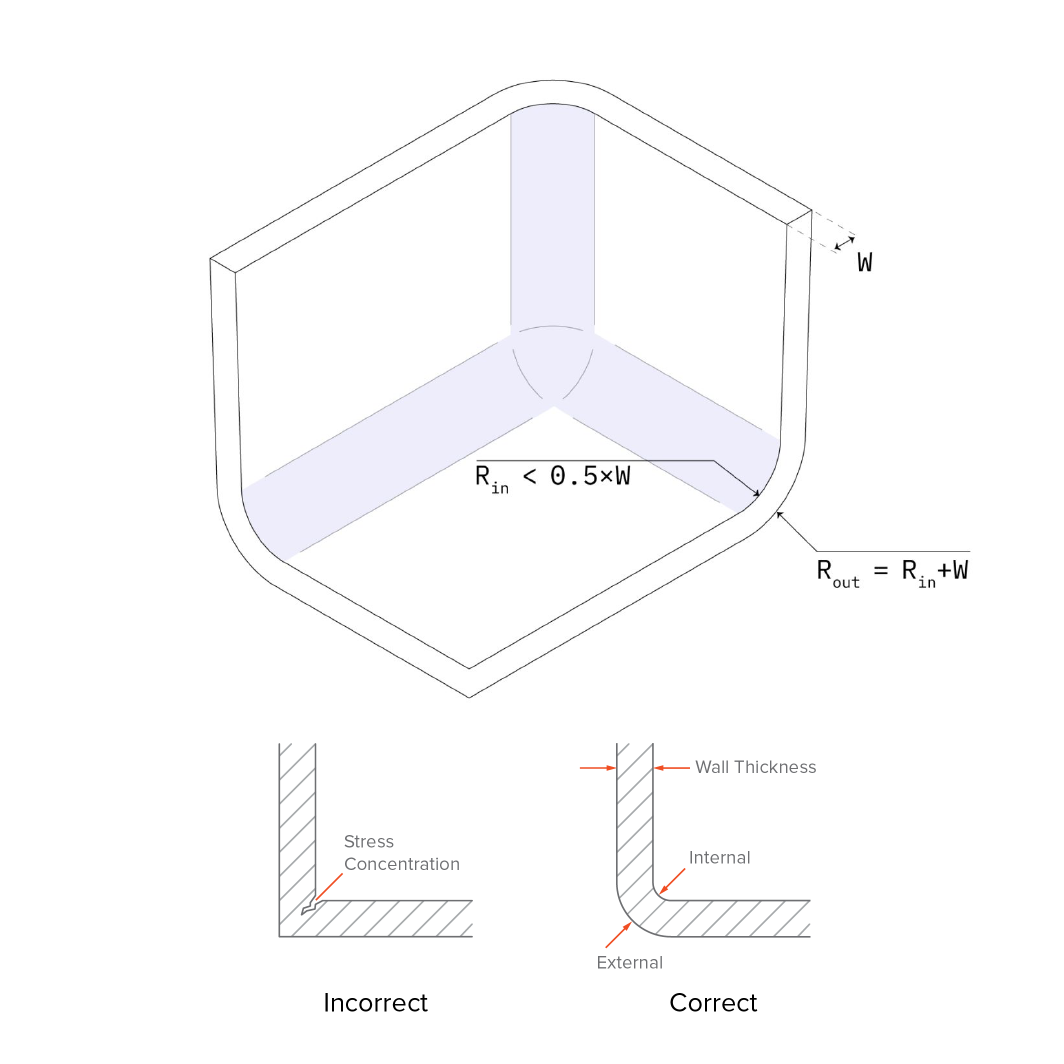
The uniform wall thickness limitations also applies to edges and corners; the transition must be as smooth as possible to ensure good material flow through the mould. For interior edges, use a radius of at least 0.5 x the wall thickness. For exterior edges add a radius equal to the interior radius plus the wall thickness to ensure constant thickness everywhere. This can also help to stop stress concentrating in the sharp corners which can cause weaker parts.

Text is a very common feature that can be useful for logos, labels, warnings and instructions. When adding text choose embossed text over engraved text as it is more economical when creating the mould. Raising the text 0.5mm above the part surface will ensure the letters are easy to read.

Injection moulding typically produces parts with tolerances of +/- 0.25mm. Tighter tolerances can be possible in certain situations but increase the cost of manufacture dramatically.
FAQ

What is the Production Cycle for Standard Injection Molding Services?
Production cycles for injection molding services vary significantly, primarily depending on product complexity.
Consider a simple plastic stationery clip as an example. Plastic mold design requires 1-2 days, while simple mold production takes 1-2 weeks. For small-batch plastic molding (e.g., 1,000 pieces), 1-2 days are needed. Simple quality inspection and post-processing require several hours to half a day. The entire cycle spans 2-3 weeks.
However, for complex automotive engine plastic intake manifolds, precision mold design requires 2-3 months, and complex mold manufacturing takes 3-6 months. For high-volume plastic injection molding services (e.g., 30,000 pieces), several weeks are needed. Comprehensive quality inspection and careful post-processing each require 1-2 weeks. The complete cycle may take 6-12 months or longer.
Therefore, simple products can have cycles as quick as several weeks, while complex products through plastic injection molding services may require several months.
Which Factors Affect Plastic Injection Molding Costs?
Factors influencing injection molded product costs primarily fall into the following areas:
Product Design Complexity: More complex shapes, dimensional precision, and functional requirements increase costs, involving mold manufacturing, injection processes, and material selection in plastic injection molding services. Structural Design: Wall thickness and demolding design affect quality and productivity, with reasonable design helping control costs. Appearance Requirements: High-quality surfaces, colors, and decorative requirements all increase costs.
Mold Factors Mold Type and Quality: Mold cavity numbers, materials, and precision influence mold costs and productivity. Mold Lifespan and Maintenance Costs: Short lifespan or high maintenance costs increase overall expenses.
Injection Production Material Costs: Material prices and waste rates constitute important cost components in plastic injection molding services. Production Batch Size and Efficiency: Batch size and production efficiency significantly impact per-unit product costs.
Post-Processing and Packaging Post-Processing Costs: Processing techniques and quality requirements determine post-processing expenses. Packaging Costs: Materials, design, quantity, and methods all influence packaging costs.
How Do You Manage Product Consistency in Large-Scale Plastic Injection Molding Solutions?
Our company ensures product consistency during high-volume plastic injection molding services through the following methods:
Raw Material Management
As an excellent injection molding company, First Mold maintains fixed raw material suppliers.
We conduct material testing on every batch of incoming raw materials and store them scientifically.
Mold Management
First Mold's mold design and manufacturing are controlled by relevant standard documents, ensuring quality in critical processes.
We have our own mold facility. We regularly maintain molds to reduce variations.
Management During Injection Molding Production
We strictly control process changes. Any modifications require thorough verification before adoption.
We conduct multiple internal trial moldings to achieve optimal parameter settings for injection machines. Additionally, dedicated personnel monitor the production process.
What Factors Should Be Considered During the Product Design Process?
Product designers or design companies can consider the following points when designing plastic products:
Product Structural Design
Demolding Design: Set reasonable draft angles (0.5°-1.5° for external surfaces, 1°-2° for internal surfaces). Avoid undercut structures whenever possible and utilize special mold structures like slide cores.
Wall Thickness Design: Maintain wall thickness as uniform as possible, preferably between 1mm and 4mm. Design ribs reasonably (rib thickness should be 0.5-0.7 times the product wall thickness with moderate height) to avoid issues like uneven cooling, sink marks, warping, or deformation.
Assembly Structure Design: Consider mold manufacturability and injection feasibility when designing assembly structures. Pay attention to snap-fit dimensions, strength, demolding direction, and assembly clearances (approximately 0.1-0.3mm) to prevent interference or loosening.
Mold Design Considerations
Parting Line Design: Select the product's largest contour as the parting line, ensuring the product remains on the moving side after mold opening for easy ejection, reducing parting line impact on product appearance.
Gate Design: Position gates in thicker wall areas of the product. Choose appropriate gate types (such as side gates, pin gates, submarine gates, etc.) based on product appearance and dimensions. Properly determine gate dimensions to avoid issues like short shots or flashing.
Cooling System Design: Design cooling channels close to cavity surfaces with uniform distribution, approximately 10-20mm from cavity surfaces. This ensures uniform product cooling and prevents internal stress and deformation caused by uneven cooling.
Material Selection and Performance Considerations
Material Flowability: Select materials with appropriate flowability based on product shape and structure. Melt Flow Rate (MFR) serves as an excellent measurement standard. For complex or thin-wall products, choose high-flowability materials like PP or PA.
Material Shrinkage Rate: Consider material shrinkage rates and allow shrinkage margins. Different materials have varying shrinkage rates. For example, ABS shrinkage ranges between 0.4% and 0.7%.
Material Mechanical and Chemical Properties: Select materials based on product usage environment and functional requirements, considering factors like material strength, toughness, chemical corrosion resistance, and compatibility when different material components contact each other through plastic injection molding services.
Can I Visit Your Factory to See the Plastic Injection Molding Services for Industrial Parts?
We warmly welcome you to visit our factory and strongly encourage you to come see our equipment for better understanding! Our company will have dedicated colleagues accompany you throughout the entire visit.
Your tour will begin at the raw material inspection area, then proceed through the mold design office, CNC mold manufacturing workshop, mold storage facility, injection molding production floor, and parts inspection area. This way, you can gain comprehensive insight into the plastic injection molding services we provide for industrial components.
Naturally, each workshop contains production areas where we maintain confidentiality agreements with clients. These areas are not open to public access. You can visit https://www.abismould.com/contact-us to learn in advance how to reach our company. Please communicate with us beforehand regarding specific visit timing. Abismould ensures you receive a satisfactory factory tour experience.