





What is MFR?
MFR (Melt Flow Rate) measures how much thermoplastic polymer flows through a standardized die in 10 minutes under controlled temperature and pressure. Expressed in grams per 10 minutes (g/10 min), this metric indicates a polymer's viscosity and molecular weight, making it essential for material selection in manufacturing processes like injection molding.
Why MFR Matters in Polymer Processing
Variations in MFR values between incoming material batches can have detrimental effects on productivity and quality. When processors receive materials with unexpected MFR values, several costly problems emerge. Material exceeding the expected MFI can result in flashing of an injection mold, leading to increased reject rates and hours or days of cleaning the mold, resulting in lost production.
The relationship between MFR and molecular weight creates a fundamental trade-off in polymer selection. Higher molecular weight polymers have lower MFR values and provide better product performance, including improved impact resistance, fatigue performance, environmental stress-crack resistance, and barrier properties. However, these stronger materials flow less easily during processing.
In injection molding, materials with low viscosity and high MFR flow more freely when melted, while materials with high viscosity and low MFR are harder to work with. This creates a critical decision point: manufacturers must balance processability against part performance requirements.
The Science Behind MFR Testing
Standard Test Methods
Two primary international standards govern MFR testing: ISO 1133 and ASTM D1238, which describe similar but not identical test procedures. Both standards specify two basic testing procedures that measure polymer flow in different ways.
Procedure A involves manually cutting and weighing extruded material strands at constant time intervals. The strand sections are weighed using a laboratory balance, and the resulting mass per unit time is given in g/10 min. This method requires an operator to remain with the machine throughout testing, collecting and weighing strands.
Procedure B measures volumetric flow rather than mass. When determining the Melt Volume Rate (MVR) according to procedure B, the extruded volume per unit of time in cm³/10 min is calculated from the distance the piston travels per unit of time. This semi-automatic approach achieves higher accuracy within shorter measurement times and piston displacements.
The key differences between ISO 1133 and ASTM D1238 include test temperature ranges, melting times (5 minutes for ISO versus 7 minutes for ASTM), and die diameter options. ISO 1133 provides options for die diameters of 2.095 mm, 1.18 mm, and 0.64 mm, while ASTM D1238 specifies only 2.095 mm. These variations mean results should always be reported with complete test conditions.
The Testing Process
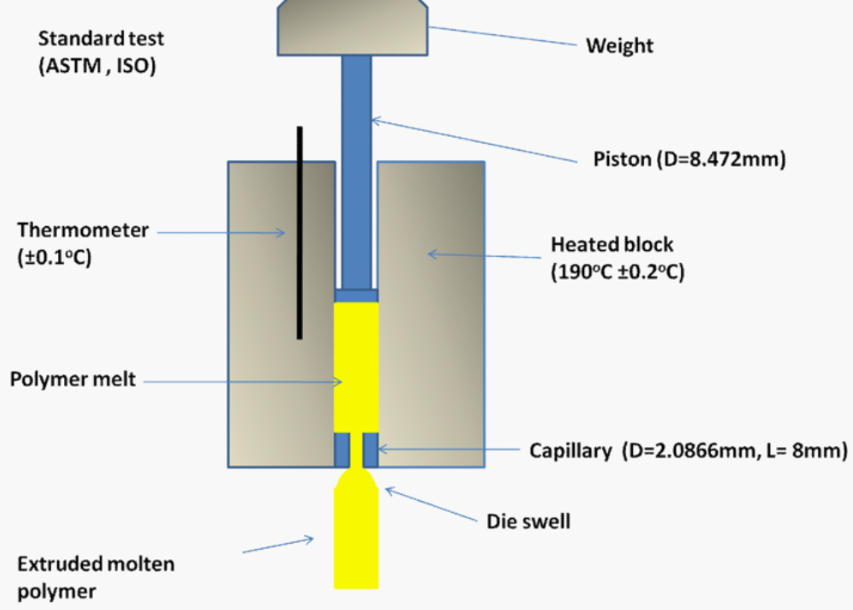
The melt flow test recreates and simplifies the extrusion molding process. A sample is poured and melted in a heated cylinder, then extruded from a die. The basic equipment consists of a temperature-controlled cylindrical annulus through which polymer melt is extruded by pressurization with a weight-loaded piston.
For standard testing, approximately 4 to 5 grams of polymer sample in pellet or powder form is charged into the heated cylinder. After preheating for a specific period, a constant load is applied to the melted sample and extruded from a die at the base of the cylinder. Testing begins when the piston's lower reference mark reaches the cylinder top, with the piston head 50 mm above the top surface of the die.
MFR and Molecular Weight: The Critical Relationship
The relationship between MFR and molecular weight follows a predictable inverse pattern. For polymer melts, the zero-shear viscosity has a relationship to the weight-averaged molecular weight. Given the inverse relationship between MFI and viscosity, research has shown empirically for linear polymers that MFR correlates to molecular weight through a power relationship.
Studies on linear low-density polyethylene found that the exponent in this relationship ranges from 3.4 to 4.6. This means small changes in molecular weight produce large changes in MFR values. The authors cautioned that this relationship becomes less reliable with polymers having variability in branching and polydispersity index.
This molecular weight connection explains why MFR appears on virtually every polymer data sheet despite criticism from academics about its limitations. For many polymer families including polycarbonate, acetal, and polystyrene, MFR may be the only value that varies significantly from grade to grade within a particular product offering.
Practical Implications for Part Performance
Lower molecular weight polymers with higher MFR values flow easily but sacrifice mechanical properties. The first property to suffer when molecular weight declines is the ability to elongate, usually perceived as brittle behavior and most easily detected using impact tests.
Empirical studies of failed products have helped material suppliers develop guidelines using MFR as a relative indicator of molecular weight preservation. For unfilled materials, if the MFR of a molded part increases by no more than 30 to 40 percent from the MFR of the pellets, the processor is considered to have done a good job preserving material integrity during processing.
For glass-filled materials, interpretation becomes more complex. The addition of glass fibers increases melt viscosity and decreases MFR even if the polymer's average molecular weight remains unchanged. For example, unfilled polycarbonate with an MFR of 10 g/10 min drops to 7.5 g/10 min at 10% glass fiber loading and about 4 g/10 min at 20% loading.

MFR Requirements for Different Manufacturing Processes
Manufacturing process requirements create distinct MFR specifications across different polymer processing techniques. Each method operates at different shear rates and requires specific flow characteristics.
Injection Molding Applications
Injection molding typically requires higher MFR values ranging from 10 to 30 g/10 min. High-flow materials enable filling of demanding flow paths in complex molds, particularly important for thin-walled components or intricate part geometries. In injection molding service operations, materials with high MFR reduce cycle times and allow for more detailed part features.
The high shear rates experienced during injection molding, which can exceed 100,000 s⁻¹, make material flow behavior critical. Materials must flow quickly enough to fill the cavity completely before cooling begins, preventing short shots or incomplete filling. This makes MFR a key selection criterion when working with an injection molding service provider.
However, processors must recognize that MFR represents a single point at very low shear rates (typically 7 to 36 s⁻¹), which doesn't fully capture behavior during actual injection molding. More advanced characterization using capillary rheometers provides viscosity data across a range of shear rates, offering better predictions of processing performance.
Extrusion and Blow Molding
Extrusion processes typically use materials with lower MFR values, commonly in the range of 0.3 to 12 g/10 min depending on the specific application. Lower MFR materials provide higher melt strength, making it easier to control the shape of extruded profiles and prevent die swell.
Blow molding requires even lower MFR values, typically 0.2 to 0.8 g/10 min. The higher melt strength from lower MFR helps maintain parison shape and ensures uniform material distribution during the blowing process, critical for producing quality hollow parts without thin spots or blowouts.
MFR Testing Accuracy and Variables
Several factors can significantly affect MFR test results, making careful control of testing conditions essential for meaningful comparisons.
Moisture Sensitivity
Hygroscopic polymers like PET and nylon absorb atmospheric moisture, which can drastically alter MFR measurements. These materials must be pre-dried according to manufacturer specifications before testing. Water contamination can lead to poor performance and cause jetting, leaving flow marks around the gate area and increasing reject rates.
For moisture-sensitive materials, intrinsic viscosity testing offers an alternative. This method dissolves the polymer in an appropriate solvent, eliminating moisture effects on results. ISO 1133-2 specifically addresses materials sensitive to time-temperature history or moisture, prescribing stricter temperature control and time sequencing.
Operator Technique and Equipment Precision
Test results can vary among different operators due to differences in their techniques. Factors affecting consistency include sample packing uniformity, precise temperature control, accurate weight loading, and proper cleaning between tests.
Studies comparing tests with and without load cell compacting revealed significant repeatability differences. Tests using load cell compacting achieved standard deviation as low as 2%, while those without load cells showed standard deviation close to 5%. The load cell prevents sample swelling during pre-heating, particularly important when testing under low-load conditions.
Even the smallest residue or impurities on the die, extrusion barrel, or piston can lead to considerable deviations. Impurities change the glide properties of the polymer on equipment walls, reduce the gap between piston and barrel, or reduce the cross-section of the die hole.
Advanced MFR Applications
Flow Rate Ratio (FRR)
Beyond simple MFR measurements, the Flow Rate Ratio provides insight into molecular weight distribution. FRR compares two melt flow rates measured at different gravimetric weights for the same material. This ratio indicates how rheological behavior changes with applied stress, reflecting the breadth of molecular weight distribution.
Materials with broader molecular weight distributions show greater changes in flow behavior between different test weights. This information helps predict processing behavior more accurately than single-point MFR values alone.
MFR Modification Through Additives
When specific applications require different flow characteristics than available base resins provide, flow modifiers can adjust MFR without completely reformulating materials. For example, adding 3% of specialized modifiers to HDPE can raise MFR from 11 g/10 min to 24 g/10 min, while 5% addition increases it to 31 g/10 min.
These modifications offer several advantages: enhanced processability in injection molding and extrusion, improved polymer blend compatibility, and cost reduction through optimization of material performance. This approach proves particularly valuable in recycling operations where mixed materials with varying MFR values need standardization.
Material Selection for Injection Molding Service
When working with an injection molding service provider, MFR becomes a critical specification in the material selection process. The choice between high-MFR and low-MFR materials within a polymer family creates trade-offs that impact both manufacturing efficiency and part performance.
High-MFR Materials (20-70 g/10 min)
High-flow materials excel in applications requiring complex geometries, thin walls, or high-cavitation molds. They reduce injection pressure requirements, enabling faster cycle times and lower energy consumption. These materials work particularly well for small, intricate components where complete mold filling presents challenges.
The downside involves reduced mechanical properties. High-MFR polycarbonate at 15 g/10 min will show lower impact resistance than material at 5 g/10 min, even though standard notched Izod testing may not reveal the difference. For parts subjected to impact loads or stress over time, this property reduction can lead to field failures.
Low-MFR Materials (2-10 g/10 min)
Lower MFR materials provide superior mechanical properties, making them ideal for load-bearing components or parts requiring long-term durability. The higher molecular weight translates directly to improved impact resistance, better creep resistance, and enhanced fatigue performance.
Processing these materials requires higher injection pressures and temperatures, potentially increasing cycle times and energy costs. Mold design becomes more critical, with attention to gate sizing, runner diameter, and venting to ensure complete filling without excessive stress on the polymer.
Quality Control and Batch Consistency
Regular MFR testing serves as a critical quality control measure for incoming materials. Batch-to-batch variations in polymers are common and can have costly implications if undetected before production begins.
Testing protocols should include verification of incoming material against specification ranges before production. When material from a new batch shows MFR deviation beyond acceptable limits, investigation and potential rejection prevents downstream problems. Documentation of MFR values for each production lot enables traceability if quality issues emerge later.
For critical applications, processors may conduct MFR testing on molded parts to verify that processing hasn't excessively degraded the polymer. Comparing part MFR to pellet MFR reveals whether excessive temperatures, residence times, or mechanical stress have reduced molecular weight during molding.
Common Pitfalls and Limitations
MFR testing has inherent limitations that processors must understand to avoid misinterpretation. The test measures flow under static conditions with a single, low shear rate. Actual processing involves dynamic flow through complex geometries at dramatically higher shear rates.
This disconnect means MFR doesn't directly predict processability. A material might show excellent MFR values but exhibit poor performance during actual molding due to shear-thinning behavior or other rheological characteristics not captured by the test.
Comparisons between materials are only valid within the same polymer family tested under identical conditions. MFR values cannot be compared across different polymer types, and even within a family, test conditions (temperature and load) must match exactly.
For filled materials, MFR changes during processing reflect both polymer degradation and filler effects. Glass fiber breakage during molding increases MFR independent of any molecular weight change in the polymer itself, making interpretation complex.

Frequently Asked Questions
How does MFR relate to injection molding cycle time?
Higher MFR materials generally allow faster injection speeds and shorter fill times, which can reduce overall cycle time. However, cycle time depends on many factors including part geometry, wall thickness, cooling time, and mold design. While high-MFR materials fill molds more quickly, the cooling phase often determines cycle time for thick-walled parts.
Can MFR predict part strength?
MFR indicates relative molecular weight, which correlates with mechanical properties within a polymer family. Lower MFR generally means higher strength and better impact resistance. However, MFR alone cannot predict absolute strength values, and other factors like crystallinity, additives, and processing conditions also affect final part properties.
Why do different polymer grades have different MFR test conditions?
Different polymers require different test temperatures and loads based on their melting points and viscosity characteristics. Polyethylene is tested at 190°C with 2.16 kg load, while polypropylene uses 230°C. These standardized conditions ensure meaningful comparisons within each polymer family while accounting for inherent material differences.
How often should MFR testing be performed?
Frequency depends on application criticality and material consistency history. At minimum, test each new material lot before production. For critical applications or materials with known variability, test more frequently. Some operations test daily or per shift. Establish a testing protocol based on your quality requirements and material behavior history.