





What is Parting Line?
A parting line is the border where two halves of an injection mold meet during manufacturing. This seam appears on finished plastic parts as a visible line marking the separation between the mold's core and cavity sections.
Understanding Parting Lines in Injection Molding
The parting line forms because injection molds consist of two primary components that must separate to release the finished part. The cavity forms the exterior features while the core creates interior and undercut features. When these halves close together and molten plastic fills the cavity, the parting line is created where the two halves of the die meet, and gates, overflows, and vents connect to the casting at this location.
The importance of parting line placement extends beyond aesthetics. The location determines the direction of mold opening and consequently the direction in which features must be drafted for easy ejection. For manufacturers utilizing an injection molding service, understanding these fundamentals helps optimize both part design and production efficiency.
Why Parting Lines Matter
Every injection molded component has a parting line-it's an unavoidable aspect of the manufacturing process. Since contact between mold modules cannot be completely gap-free, a seam appears on the plastic part where the parting surfaces meet. The challenge lies not in eliminating this feature but in strategically positioning it to minimize visual impact and functional interference.
The parting line influences three critical aspects of production: draft requirements, flash formation, and manufacturing costs. Draft runs in opposite directions on each side of the parting line, meaning designers must account for how mold halves separate when determining feature angles. Additionally, flash forms at the parting line when pressure from injected metal tries to force die halves apart, potentially affecting dimensional accuracy and requiring secondary finishing operations.
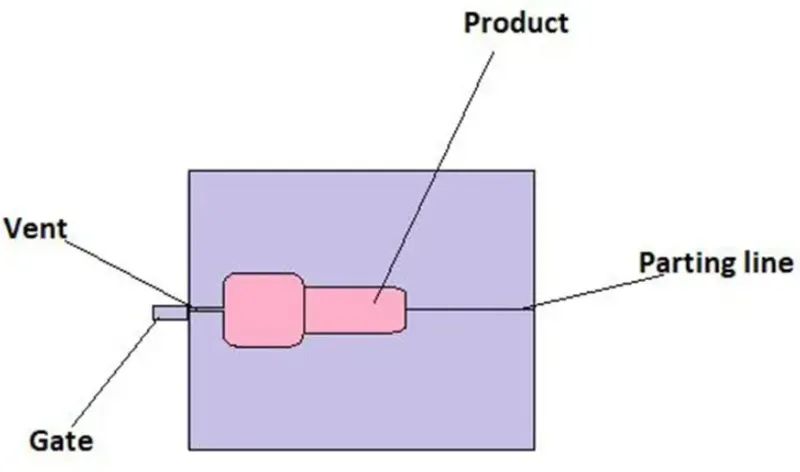
Types of Parting Lines
Different part geometries require different parting line configurations. The five main types each serve specific design requirements and manufacturing constraints.
Vertical Parting Lines
Vertical parting lines run perpendicular to the mold's opening direction, making them ideal for simpler geometries and straightforward designs. This is the most commonly used type because it's efficient and cost-effective. Consider a plastic cup or simple container-the vertical parting line typically runs down the center, allowing both mold halves to separate cleanly without complex mechanisms.
Best Applications: Basic geometries like cylinders, boxes, and simple consumer products where the parting plane can be flat and perpendicular to the opening direction.
Stepped Parting Lines
Stepped parting lines are employed when one half of the mold experiences significant force or pressure during injection, ensuring mold halves remain aligned even under uneven pressure distribution. This configuration creates a staircase-like pattern at the mold separation point.
Since one side of the cavity bears greater force with stepped parting lines, an injection eccentric force is generated on both sides, causing potential relative sliding between core and cavity. To address this, manufacturers often arrange two cavities symmetrically to balance injection forces.
Best Applications: Thick-walled parts, complex industrial components, and designs with varying thicknesses that create pressure imbalances during molding.
Curved Parting Lines
Curved parting lines follow the contours of parts with non-linear shapes. They require precision mold design to follow part contours, ensuring accurate molding and reducing visible parting lines on curved surfaces. A drill housing trigger area or automotive trim piece might require this configuration to maintain aesthetic continuity.
Best Applications: Complex parts with rounded surfaces, automotive components, tool handles, and molded enclosures where the parting line must trace irregular contours.
Beveled Parting Lines
Beveled parting lines are designed with sloped edges, making them ideal for reducing flash on the final product. The angled interface between mold halves creates better sealing characteristics than sharp transitions, though it adds complexity to mold fabrication.
Best Applications: Parts with sloped surfaces or designs requiring smooth transitions between mold halves, particularly where flash minimization is critical.
Comprehensive Parting Lines
Comprehensive parting lines combine vertical, beveled, curved, and stepped elements to accommodate complex part designs with intricate features requiring different parting line types. This approach offers maximum design flexibility but demands expert mold engineering.
Best Applications: Medical devices, advanced automotive components, and highly engineered consumer products with varied surface textures and geometries.
Design Considerations for Optimal Placement
Strategic parting line placement requires balancing multiple factors during the design phase. The right decisions here significantly impact manufacturing efficiency and part quality.
Draft Angle Requirements
Draft angles-the slight tapers added to vertical walls-work in conjunction with parting line placement. The standard rule applies 1 degree of draft per 1 inch of depth, though adding an additional 1 to 2 degrees ensures smoother demolding. The parting line determines where draft angles change direction, creating a transition point that affects both ejection and surface finish.
Aesthetic Positioning
For straightforward geometric designs with radiused or rounded edges, the parting line must trace the path along which a tangent to the surface is parallel to the mold opening direction. Placing the line across smooth surfaces creates obvious seams from any mold mismatch, potentially requiring tighter tolerances and increasing milling costs.
The solution? When the parting line is placed along a sharp edge, the seam becomes camouflaged, and undesired manufacturing, functionality, and cosmetic issues are avoided. This principle applies across consumer products where appearance matters-from electronic enclosures to household items.
Functional Requirements
Incorrect parting line placement can weaken parts or create stress concentrations that may lead to failure under load. For components requiring precise dimensional control, keeping critical dimensions on one side of the parting line reduces tolerance stack-up. When flash occurs it increases parting line thickness, altering dimensions measured across the parting line.
For high-precision applications, position critical features entirely within one mold half. This approach eliminates the risk of mismatch between halves affecting functional dimensions.

Common Parting Line Problems and Solutions
Understanding potential issues helps designers and manufacturers proactively address quality concerns in injection molding service applications.
Flash Formation
Flash-excess material that escapes between mold halves-is the most common parting line defect. Environmental contaminants like dust and debris can keep molds open, allowing excess material to leak out and cause flash defects. Additionally, older, worn-out tooling leads to leakages resulting in flashing due to parting line mismatch.
Prevention Strategies:
Maintain meticulous mold cleanliness through regular maintenance schedules
Ensure at least 3 tons of clamp force for every square inch of the part's projected area on the parting line
Verify proper mold alignment through spotting procedures
Optimize injection pressures and speeds to minimize cavity pressure
Remediation Methods:
If flash occurs despite preventive measures, several removal techniques are available. Cryogenic deflashing is the most effective method, involving cooling parts using liquid nitrogen to a temperature where flash is easily removable without affecting the part finish. Other options include hand trimming, vibratory tumbling, media blasting, and hot air melting for thin flash.
Parting Line Mismatch
Mismatch occurs when mold halves don't align properly, creating stepped surfaces rather than smooth transitions. Any misalignment between two mold halves creates a mismatch at the parting line, resulting in more than just a visible line but an actual step affecting part dimensions.
Solutions:
Implement accurate machining practices with tight tolerances
Add alignment features like guide pins and bushings to mold design
Use pressure-sensitive paper to verify even clamping along the parting line
Regularly inspect and maintain mold components for wear
Inadequate Venting
The air contained in the tool needs an escape route, otherwise the melt will compress and trap air inside the cavity. Insufficient venting increases cavity pressure, potentially forcing mold halves apart and causing flash.
Design Guidelines:
Space vents 1 to 2 inches apart along the parting line
Adjust vent depth based on plastic material viscosity
Regularly clean vents to prevent blockage from accumulated residue
Position vents strategically where air naturally flows during filling
Parting Line Best Practices
Implementing proven design principles ensures optimal outcomes in injection molding projects.
Simplicity First
The simplest and strongest parting line is one that exists on a single, flat plane. While complex part geometries may require intricate parting line configurations, designers should prioritize simplicity wherever possible. Simple parting lines reduce mold costs, minimize maintenance requirements, and decrease the likelihood of manufacturing defects.
Consider the A-Side and B-Side
The A side is usually where the show surface of the part will be, and when opening the mold, the part stays on the B side for removal. This distinction matters because ejector pins contact the B-side, potentially leaving marks. Position cosmetically important surfaces on the A-side while placing functional surfaces that tolerate ejector pin marks on the B-side.
Material Shrinkage Factors
Most materials shrink as they cool in the mold, which can be used to advantage when designing the mold and ensuring the part stays on one side when opening. Understanding material-specific shrinkage rates helps predict how parts will behave during ejection and informs draft angle and parting line decisions.
Dimensional Accuracy
For critical dimensions, it's important to have measurements in only one die half to reduce dimensional tolerance. This principle minimizes the cumulative effect of manufacturing variations between mold halves.
Working with Injection Molding Service Providers
Collaboration between designers and manufacturing partners optimizes parting line placement and overall part quality.
Design for Manufacturability (DFM)
DFM analysis is essential for both avoidance and reduction of flash, with plastic injection molding rules advocating positioning the parting line along the component's edge rather than on flat surfaces. Modern injection molding service providers offer DFM analysis that simulates results, depicts flow characteristics, and predicts common difficulties like warpage, flash, and heat flux.
When submitting designs, expect feedback on:
Optimal parting line location based on part geometry
Draft angle requirements for successful ejection
Potential flash zones requiring attention
Cost implications of complex parting line configurations
CAD Tools and Analysis
If you send an undrafted 3D CAD model, Protolabs will determine where the parting line should be, though designers might want to think about it for one simple reason: designers and molders look at parts differently. While molders focus on correct molding, designers concentrate on post-mold functionality.
Advanced CAD applications can suggest optimal parting line placement, but human expertise remains invaluable for balancing aesthetic, functional, and manufacturing requirements.
Advanced Parting Line Techniques
For complex applications requiring specialized solutions, advanced techniques offer enhanced capabilities.
Flash-Free Molds
For mission-critical applications where absolutely zero flash is permissible, flash-free molds can be designed and built. These precision tools maintain extremely tight tolerances between mold halves, virtually eliminating gaps where material could escape. While expensive, flash-free molds suit medical devices, aerospace components, and other applications where even minimal flash is unacceptable.
Liquid Silicone Rubber (LSR) Considerations
LSR flows into the mold as liquid and will fill gaps as small as 0.0002 inches, which can result in flash. LSR molding requires additional preparation to prevent flash compared to thermoplastic molding. Parting lines on LSR parts should not be placed on sealing surfaces, and simplifying and minimizing parting lines helps produce cleaner parts quickly.
Multi-Cavity and Family Molds
In multi-cavity or family molds, flash is often caused by improper balance of melt flow. These configurations require careful gate design and runner balancing to ensure uniform cavity filling and pressure distribution. Parting line design becomes more complex as multiple parts share mold halves.

Frequently Asked Questions
Can parting lines be completely eliminated?
No, parting lines cannot be completely eliminated from injection molded parts. A parting line is the line or seam of separation on the part where two mold halves meet, and it cannot be avoided. However, strategic placement along sharp edges or hidden features can make them essentially invisible.
How does parting line location affect mold cost?
Parts with elaborate contours often have more cost associated with the mold, since the parting line usually needs to follow along this contour. Simple, flat parting lines are less expensive to machine and maintain than complex curved or stepped configurations.
What's the difference between a parting line and a parting surface?
The parting surface is the three-dimensional interface where mold halves meet, while the boundary where the parting surface intersects the plastic part's surface is called the parting line. The parting line is what you see on the finished part, while the parting surface is the mold design feature creating it.