





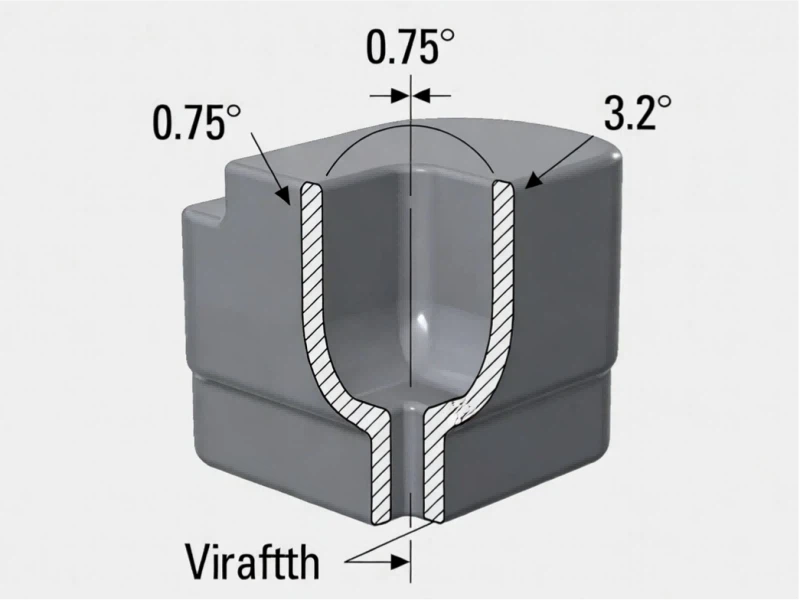
Last quarter, one of our medical device clients came to us after three failed prototyping rounds with another supplier. The original design specified vertical walls, and every attempt ended with parts stuck in the mold or surface scratches that failed inspection. We added 0.75° of taper to the critical surfaces, adjusted the cooling channel layout, and the first production run cleared QC with a rejection rate under 2%. Most people looking at the finished part would never notice the taper. The accounting team definitely noticed the difference in rework costs.
Draft angle in injection molding is the slight taper applied to vertical surfaces so parts release cleanly from the mold. The baseline recommendation is 1.5° to 2° for depths up to two inches. You will find that number in every design guide. What you will not find is an explanation of why it stops working the moment you introduce textured surfaces, high-shrinkage materials, or cooling channels that were not designed with ejection in mind.
The Cost Mechanics Most RFQs Miss
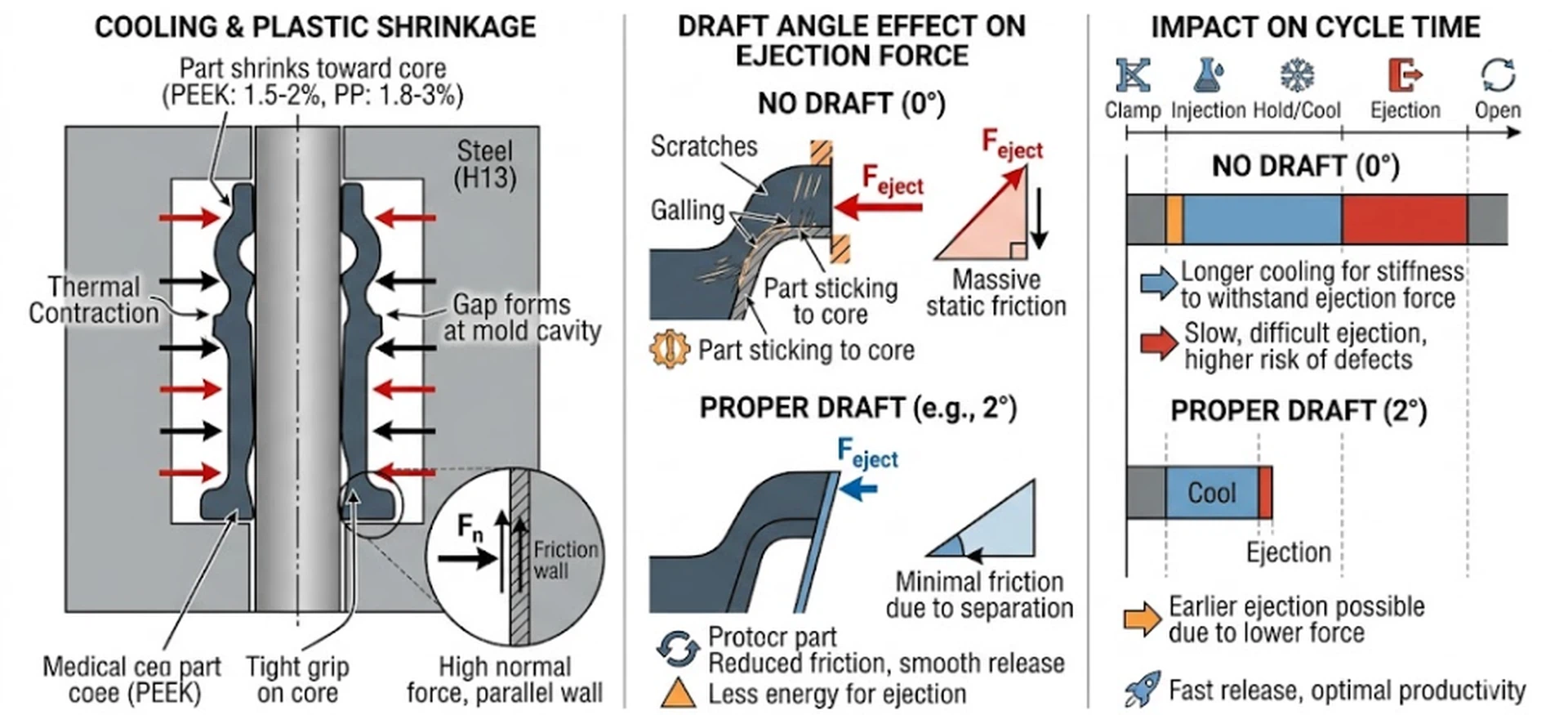
Shrinkage is the core issue. When molten plastic cools inside a cavity, it contracts toward the core. Polypropylene shrinks 4-5%; glass-filled nylon behaves differently; PEEK brings its own complications with high stiffness. This shrinkage creates friction that resists ejection. Without adequate draft, ejection force spikes, and that force shows up in your cycle time, your scrap rate, and your mold maintenance schedule.
Proper draft can reduce ejection force by up to 60%. The real savings come from what that reduction enables: faster cycles, fewer ejector pins competing for core volume with cooling channels, and longer intervals between mold polishing. At volumes above 50,000 units annually, even a five-second cycle reduction compounds into significant cost savings. But only if the draft angle and cooling layout are designed together. We have seen clients lose most of that potential by optimizing one without the other.
One sensor housing in PEEK ran 18% rejection with 0.8° draft. Material stiffness made ejection difficult, and the mold needed unplanned polishing at 35,000 cycles. After increasing draft to 1.2° and adjusting ejector timing, rejections dropped to under 3%, and the mold ran past 120,000 cycles before its first scheduled maintenance. The per-part cost improvement justified a second production line.
Where the Textbook Numbers Stop Working
The "1° per inch" rule gets repeated until it functions as industry law. It also misses critical variables that will cost you money if you do not catch them early.
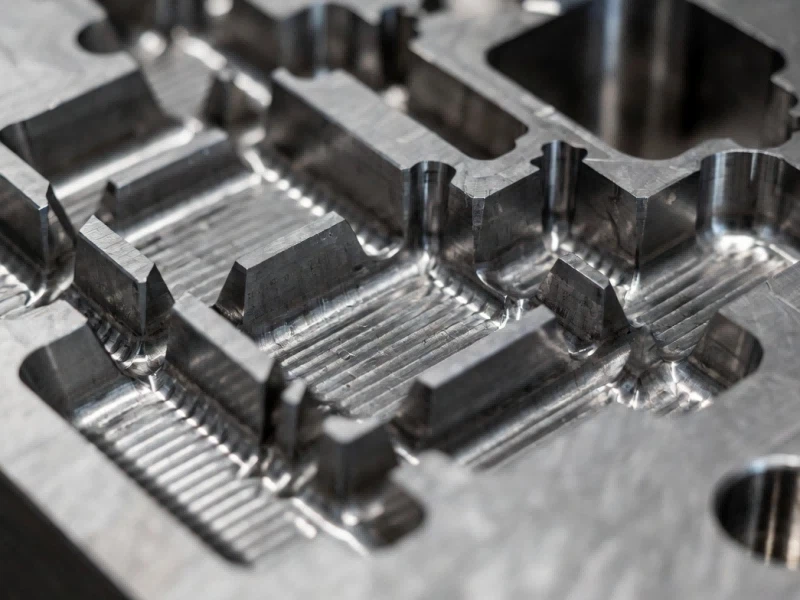
Textured surfaces create micro-undercuts that act like tiny anchors holding the part in place. Our standard is 1.5° additional draft per 0.001 inch of texture depth. A light PM-T1 texture needs 3° minimum; heavy textures can demand 5° or more. Here is what most guidelines skip: the texture depth your designer specified and the texture depth actually cut into the mold steel rarely match exactly. We measure actual texture depth on every tool before first article because a 0.0005" discrepancy can mean the difference between clean ejection and drag marks across your entire run.
Glass-filled plastics are abrasive and wear mold surfaces faster, typically needing 2-3° draft. Self-lubricating materials like nylon can theoretically run with near-zero draft. We still recommend 0.5-1° for production consistency. In a prototype run, sticking once or twice gives you useful data. In a 50,000-unit monthly production, that same sticking becomes a line stoppage and a conversation with your customer about delivery delays.
What You Receive Before Committing to Tooling
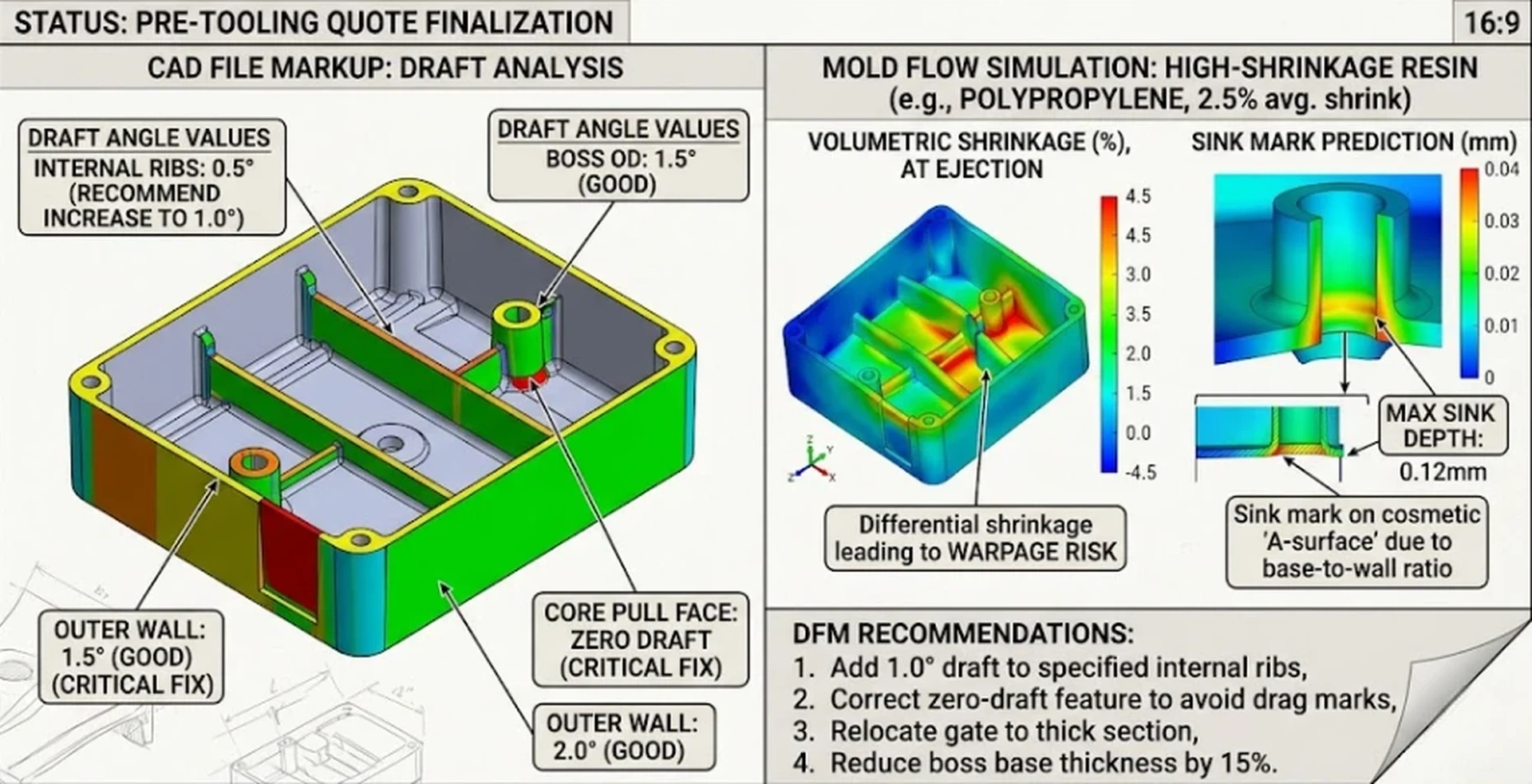
Most RFQs we receive have draft angles specified by the product design team, not validated against actual molding conditions. That sequence causes a significant portion of tooling rework costs.
Our DFM review flags draft-related risks before tooling quotes finalize. What you receive is a marked-up version of your geometry with specific draft values noted at each critical surface, cross-referenced against your material's shrinkage profile and your specified texture codes (SPI, VDI, or Mold-Tech). This is not a generic checklist. It is a document you can hand directly to your engineering team showing exactly where your current design will cause ejection problems and what angle resolves each one.
For high-shrinkage materials like PP, we model the ejection force profile using Mold Flow simulation and identify where standard draft will not be sufficient. For parts requiring near-zero draft, we evaluate alternatives early: collapsible cores with clear documentation of the witness marks they leave, material substitution options, or post-mold machining. Each path has cost and timeline implications better discussed at quote stage than discovered during first article.
Simple test for your current supplier relationship: if you upload a CAD file and receive a price without a DFM report, draft angle problems will surface at first article inspection. By then, you are committed to a tool that may need modification or replacement.
When Zero Draft Appears in Your Requirements
Engineering teams sometimes request zero draft for functional reasons. These requests are not automatically unreasonable, but they require scrutiny beyond checking a feasibility box.
A zero-draft cylinder with an O-ring seal faces a fundamental conflict: the draft needed for clean ejection may compromise the seal interface. We worked on a PP cylinder application where even 0.2° would have prevented the O-ring from seating properly. The solution required material substitution and specialized ejection timing, significantly more complex than standard tooling but achievable with proper upfront planning.
When a supplier agrees to zero draft without presenting alternatives, they may simply be deferring a problem to the production floor. We put the tradeoffs in writing at quote stage: the tooling cost difference between zero draft and 0.5° is typically 40-70%, and we show you exactly where that cost comes from. You decide with numbers in front of you.
For teams working on textured-surface projects, high-shrinkage materials, or prototype-to-production transitions, upload your CAD files and we will return DFM feedback within 24 hours showing exactly where your draft angles stand.