





What is Mold Cavity?
A mold cavity is the precisely engineered hollow space within an injection mold that shapes molten plastic into the final product's exterior form. Working opposite to the core, which creates internal features, the cavity defines the outer surface geometry, texture, and dimensional accuracy of manufactured parts.
Understanding Mold Cavity Structure
The cavity represents the stationary, female portion of an injection mold assembly. When molten material enters the mold through the gate system, it fills the space between the cavity and core surfaces, taking their exact shape before cooling and solidification.
The Cavity-Core Relationship
The cavity forms the external shape while the core creates internal features like holes and recesses. This complementary relationship determines everything from dimensional accuracy to surface finish quality. The cavity typically resides on the fixed platen side of the molding machine, remaining stationary throughout the injection cycle.
During cooling, plastic naturally shrinks onto the core side, which is why ejector systems are positioned there. This shrinkage behavior makes cavity placement critical for proper part ejection and quality.
Material Selection for Cavity Construction
Cavity inserts typically use hardened steels like NAK 80, S136, 1.2344, or H13. Material choice depends on several factors:
Production Volume: High-volume production demands wear-resistant steels that can withstand millions of cycles. Class 101 molds handle over one million cycles, while Class 105 molds suit prototyping with up to 500 cycles.
Surface Requirements: Parts requiring polished finishes need cavity materials that maintain mirror-like surfaces through repeated thermal cycling and ejection forces.
Thermal Conductivity: Efficient heat dissipation affects cycle times and part quality. Aluminum alloys offer superior thermal conductivity but less durability than steel options.

Types of Mold Cavity Configurations
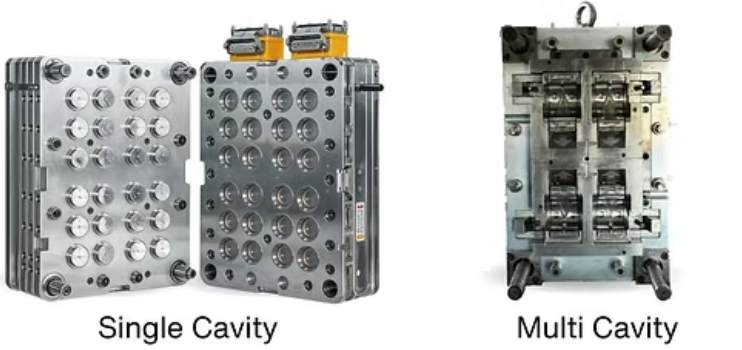
Single Cavity Molds
Single cavity designs produce one part per injection cycle. These molds suit micro injection molding and low-volume production where precision outweighs throughput.
Advantages:
Lower initial tooling investment
Simpler maintenance requirements
Better process control for complex geometries
Ideal for large parts requiring extended cooling
Limitations:
Higher cost per part at volume
Slower production rates
Less efficient material usage
Multi-Cavity Molds
Multi-cavity molds contain multiple identical cavities producing several parts simultaneously in each cycle. In 2024, demand for high-volume multi-cavity injection molding continues growing as production requirements increase.
Performance Considerations:
Even with geometrically balanced runner systems, multi-cavity molds can experience the Beaumont Effect, where shear-induced melt temperature variations cause inconsistent filling between cavities. This phenomenon creates density, shrinkage, and warpage differences despite balanced geometry.
Proper design requires symmetric cavity arrangement to minimize imbalances during injection, with equal spacing to distribute mechanical stress evenly.
Family Molds
Family cavity molds produce different but related components in a single cycle, with parts designed to assemble into complete products. This approach suits products requiring multiple coordinated components, eliminating manual assembly of individually molded pieces.
Critical Design Factors for Mold Cavities
Surface Finish and Texture
The cavity surface directly determines the molded part's exterior finish, from highly polished glossy surfaces to textured matte appearances. Achieving consistent surface quality requires:
Precision machining to eliminate tool marks
Proper polishing protocols for cosmetic surfaces
EDM texturing for specific surface patterns
Protection from corrosion and contamination
Draft Angles for Ejection
Draft angles, the slight taper on vertical faces parallel to mold opening direction, enable clean part ejection without damage. Industry standard calls for at least 1 degree of draft per side for every inch of cavity depth.
Without sufficient draft, parts stick to cavity walls, causing:
Drag marks and surface damage
Premature ejector pin wear
Extended cycle times
Increased reject rates
Venting Requirements
Proper venting prevents trapped air from causing burn marks, voids, incomplete filling, or ejection problems. Vents should be positioned at fill pattern endpoints and along parting lines, typically 0.01-0.03 mm deep for most materials.
Inadequate venting can ignite trapped gases, creating visible discoloration on finished parts.
Cooling Channel Integration
Temperature control through cooling channels ensures uniform cooling and prevents warping or deformation. Efficient cooling directly impacts:
Cycle time reduction
Dimensional stability
Residual stress minimization
Part quality consistency
The Role of Cavity Pressure in Quality Control
Cavity pressure, measured by sensors along polymer melt flow paths, indicates quality of molded components by tracking pressure that overcomes polymer melt resistance. This real-time monitoring enables:
Process Optimization: Identifying optimal pack and hold pressures for complete cavity filling without flash or sink marks.
Consistency Validation: Ensuring shot-to-shot repeatability by monitoring pressure profiles during production runs.
Predictive Maintenance: Detecting gradual changes that indicate mold wear, venting issues, or material inconsistencies before quality problems emerge.

Common Cavity-Related Defects and Solutions
Flash Formation
Flash occurs when molten material escapes beyond the cavity boundaries, typically at parting lines. Root causes include:
Insufficient clamping force
Worn cavity surfaces creating gaps
Excessive injection pressure
Improper parting line design
Solution: Optimal parting line placement along natural edges hides flash potential while simplifying mold construction.
Short Shots and Incomplete Filling
When parts emerge from the cavity incompletely formed, the issues often trace to:
Restricted gate sizing limiting material flow
Premature material solidification
Insufficient injection pressure
Complex cavity geometry creating difficult-to-fill regions
Warpage and Dimensional Instability
Parts with non-uniform wall thickness or poor cooling distribution frequently warp after ejection. Complex cavity dimensions can cause weld lines, inadequate venting, and undesirable deformations affecting both function and appearance.
Injection Molding Service Integration
Modern injection molding service providers leverage advanced cavity design principles to optimize manufacturing outcomes. The global injection molding market reached USD 298.7 billion in 2024, projected to grow to USD 462.4 billion by 2033 at a 5.0% CAGR.
This growth reflects increasing demand for precision cavity manufacturing across sectors:
Automotive: Lightweight structural components requiring tight tolerances and aesthetic surfaces.
Medical: Biocompatible devices needing cleanroom-compatible cavity materials and validation protocols.
Packaging: Packaging accounts for 32.2% of injection molding applications in 2024, driven by demand for lightweight, durable, and cost-effective solutions.
Electronics: Precision micro-cavities for miniaturized components and housings requiring exceptional dimensional accuracy.
When selecting injection molding service partners, cavity design expertise directly impacts production success. Experienced providers understand material shrinkage compensation, gate placement optimization, and cooling system design-factors that determine whether parts meet specifications consistently.
Advanced Cavity Manufacturing Techniques
CNC and EDM Machining
Cavity inserts are primarily manufactured using CNC machining for general geometry and EDM for areas CNC cannot reach, such as sharp corners, ribs, and bosses. This combined approach enables:
Complex three-dimensional cavity shapes
Precise tolerance control (±0.015mm for insert dimensions)
Consistent surface finish quality
Intricate detail reproduction
Multi-Cavity Layout Optimization
Advanced CAD software and flow simulations help achieve cavity layouts balancing performance, material efficiency, and cost-effectiveness. Modern design tools predict:
Fill pattern progression
Pressure distribution across cavities
Temperature gradients during cooling
Stress concentration areas
Cavity Design Best Practices
Minimize Complexity: Simpler cavity geometries reduce manufacturing costs and improve reliability. Reserve complex features for truly necessary applications.
Account for Material Behavior: Crystalline materials like polypropylene shrink 1.5-3%, while amorphous materials like ABS shrink only 0.2-0.7%. Cavity dimensions must compensate for these differences.
Standardize Tolerances: Standard injection molding achieves ±0.1mm tolerances; tighter specifications increase costs exponentially without proportional benefit.
Prioritize Ejection Clearance: Design cavity depth and undercuts considering ejector pin positioning and stroke requirements.
Plan for Maintenance: Accessibility for cleaning, polishing, and repair extends cavity service life and maintains quality standards.
Frequently Asked Questions
What's the difference between cavity and core in injection molding?
The cavity forms the part's external surface and remains stationary, while the core creates internal features and typically moves during ejection. Parts shrink onto the core during cooling, which is why ejector pins are located on the core side.
How many cavities should my mold have?
This depends on production volume, budget, and part complexity. Single cavities suit low-volume or highly complex parts, while multi-cavity molds optimize high-volume production despite higher initial costs. The break-even point typically occurs between 10,000-50,000 parts.
Why do parts stick to the cavity instead of the core?
Improper draft angles, rough surface finish, or reversed cavity-core placement can cause adhesion. Parts should naturally shrink onto the core side where ejection systems are positioned. If sticking occurs, review draft angles and surface polish quality.
How do I prevent flash at the cavity parting line?
Ensure adequate clamping force, maintain proper cavity surface condition, avoid excessive injection pressure, and verify parting line contact surfaces remain flat and undamaged. Regular maintenance prevents gap formation.
Selecting the Right Cavity Configuration
Production requirements ultimately dictate optimal cavity design. Consider these decision factors:
Volume Projections: Annual part requirements determine whether single or multi-cavity tooling provides better economics.
Quality Standards: Medical and aerospace applications may require single-cavity precision, while consumer goods benefit from multi-cavity efficiency.
Budget Constraints: Initial tooling investment versus per-part cost over the product lifecycle.
Timeline Requirements: Single cavities typically launch faster, while multi-cavity tools require longer development but reduce unit production time.
The cavity represents far more than a simple hollow space-it embodies the intersection of material science, precision engineering, and manufacturing economics. Whether producing prototypes or millions of parts annually, proper cavity design and manufacturing remains fundamental to injection molding success.
Modern injection molding service providers combine decades of cavity design expertise with advanced simulation tools, ensuring first-time-right tooling that meets demanding specifications while optimizing production efficiency and cost-effectiveness.