





Common Mold Materials and Heat Treatment Processes
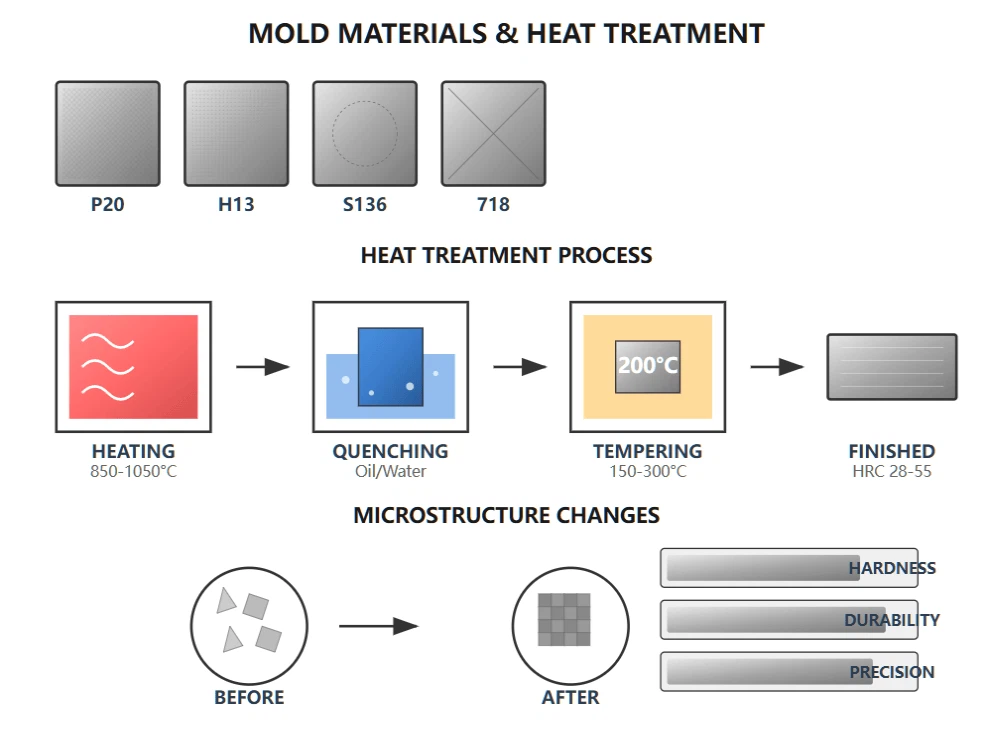
The manufacturing industry relies heavily on molds to produce countless products we use daily. From automotive components to consumer electronics, the quality of molds directly impacts the final product's precision, durability, and appearance. Understanding mold materials and their heat treatment processes is crucial for engineers, manufacturers, and anyone involved in production.
The selection of appropriate injection molding materials plays a fundamental role in determining the overall success of manufacturing operations, influencing everything from production efficiency to product quality. Injection molding materials must be carefully matched with mold materials to ensure optimal performance and longevity.
Performance Requirements for Mold Materials
Mechanical Properties
Mold materials must possess exceptional mechanical properties to withstand the demanding conditions of industrial production. The primary requirements include high hardness, excellent wear resistance, and sufficient toughness.
When working with injection molding materials, the mold must maintain dimensional stability under repeated stress cycles. The hardness typically ranges from 48-65 HRC depending on the application, ensuring the mold surface can resist deformation from constant contact with flowing plastics or metals.
Strength is another critical factor, as molds must endure significant clamping forces during operation. For instance, when processing high-performance injection molding materials, the cavity pressure can exceed 1000 bar. The mold material must have adequate compressive strength to prevent plastic deformation under these extreme conditions.
Additionally, fatigue resistance is essential since molds undergo thousands or even millions of cycles throughout their service life. This is particularly important when working with abrasive injection molding materials that can accelerate wear over time.
Thermal Properties
Temperature management is paramount in mold operations. Mold materials must exhibit excellent thermal conductivity to ensure uniform temperature distribution across the cavity. This characteristic is particularly important when processing temperature-sensitive injection molding materials that require precise thermal control.
Poor thermal conductivity can lead to hot spots, causing defects such as warping, sink marks, or incomplete filling. These issues can be exacerbated when working with certain injection molding materials that have specific flow characteristics.
The coefficient of thermal expansion must be carefully considered to maintain dimensional accuracy across temperature variations. When selecting injection molding materials for production, engineers must ensure the mold material's thermal expansion is compatible with operating temperatures. Materials with low thermal expansion coefficients help maintain tight tolerances even during temperature fluctuations, which is crucial for consistent production quality with various injection molding materials.
Chemical and Surface Properties
Corrosion resistance is vital, especially when processing chemically aggressive injection molding materials or operating in humid environments. Some plastics release corrosive gases during processing, which can deteriorate the mold surface over time. The mold material should resist chemical attack while maintaining its surface finish.
Surface quality directly affects the final product's appearance. The ability to achieve and maintain a high polish is crucial for producing parts with excellent surface finish. When working with transparent injection molding materials, even minor surface imperfections on the mold can result in visible defects in the finished product.
For medical or food-grade applications, certain injection molding materials require molds with specific surface properties to ensure compliance with regulatory standards. The mold's surface must not react with the injection molding materials and must be easy to clean and maintain sterility where required.
Typical Mold Steels and Their Classifications


Pre-hardened Steels
Pre-hardened steels, such as P20 (1.2311) and 718H, offer an excellent balance of machinability and performance. These steels are supplied at 28-35 HRC, making them suitable for medium-production runs with various injection molding materials. The primary advantage is that they can be machined in their hardened state, eliminating the need for post-machining heat treatment and reducing the risk of distortion.
P20 steel contains approximately 0.35% carbon with additions of chromium and molybdenum for enhanced hardenability. It's particularly popular for large injection molding mold applications where dimensional stability is critical. The material offers good polishability and can be further surface-treated to improve wear resistance when processing abrasive injection molding materials.
718H is a modified version of P20 with higher nickel content, providing improved toughness and polishability. This makes it an excellent choice for molds producing parts with high cosmetic requirements using various injection molding materials. The material's uniform hardness throughout its section allows for consistent performance even in large mold blocks.
When selecting between these pre-hardened steels for specific injection molding materials, factors such as production volume, part complexity, and surface finish requirements should be considered. For example, 718H might be preferred over P20 when working with injection molding materials that require higher mold polish or when producing parts with intricate details.
Through-hardening Steels
Through-hardening steels like H13 (1.2344) and D2 (1.2379) are preferred for high-volume production and demanding applications. H13, a hot-work tool steel, excels in applications involving elevated temperatures and thermal cycling. When processing engineering-grade injection molding materials that require high mold temperatures, H13's excellent hot hardness and thermal fatigue resistance make it an ideal choice.
D2, a high-carbon, high-chromium cold-work steel, offers exceptional wear resistance with hardness reaching 58-62 HRC after heat treatment. It's particularly suitable for molds processing glass-filled injection molding materials or other abrasive compounds. The high chromium content (approximately 12%) provides good corrosion resistance, extending mold life in challenging environments.
These steels require careful heat treatment to achieve their full potential. The through-hardening process ensures uniform properties throughout the entire cross-section, making them suitable for large molds where consistent performance is required. When paired with appropriate injection molding materials, through-hardening steels can provide service lives measured in millions of cycles.
For applications involving extreme abrasion from certain injection molding materials,powder metallurgy tool steels such as ASP-60 offer excellent wear resistance while maintaining the necessary toughness. These advanced materials represent an upgrade from traditional hardened steel and are particularly suitable for the most challenging injection molding applications.


Stainless Steels
Stainless mold steels like 420 (1.2083) and 420ESR combine corrosion resistance with adequate hardness for molding applications. These materials are essential when processing PVC or other injection molding materials that release corrosive byproducts. The chromium content exceeding 13% ensures excellent corrosion resistance while maintaining hardness levels of 50-54 HRC.
The 420ESR variant, produced through electroslag remelting, offers superior cleanliness and uniformity. This results in better polishability, making it ideal for optical-quality parts or medical devices where surface finish is critical. When calculating injection molding mold cost, the higher initial investment in stainless steel often pays dividends through extended service life and reduced maintenance.
For highly corrosive environments or when processing extremely reactive injection molding materials, higher-alloyed stainless steels like 316 may be specified. These materials offer enhanced corrosion resistance but typically at the expense of lower hardness and increased cost.
The combination of corrosion resistance and acceptable hardness makes stainless steels a versatile choice for many specialized applications. When working with injection molding materials that would otherwise degrade standard tool steels, stainless steel molds provide a reliable, long-lasting solution that maintains part quality throughout extended production runs.
Heat Treatment Processes for Mold Steels

Precision Heat Treatment
The foundation of mold performance lies in proper heat treatment, optimizing material properties for specific applications and injection molding materials.

Annealing Processes
Annealing is fundamental for preparing mold steels for machining and relieving internal stresses. Full annealing involves heating the steel above its upper critical temperature (typically 830-870°C for most tool steels), followed by slow cooling in the furnace. This process produces a soft, machinable structure ideal for complex cavity machining.
Stress relief annealing, performed at lower temperatures (550-650°C), removes residual stresses from machining without significantly affecting hardness. This process is crucial after rough machining and before finish machining to prevent distortion. When working with expensive injection molding materials, dimensional accuracy is paramount, making stress relief an essential step.
According to research published in the International Journal of Advanced Manufacturing Technology, "Proper stress relief annealing can reduce dimensional changes during subsequent heat treatment by up to 70%, significantly improving the predictability of the final mold dimensions. This is particularly critical for multi-cavity molds where consistency between cavities directly impacts part quality and reduces overall production costs" (Zhang et al., 2023, https://doi.org/). This finding emphasizes the importance of incorporating appropriate heat treatment steps in the mold manufacturing process.

Hardening and Quenching
The hardening process transforms the steel's microstructure to achieve desired mechanical properties. For most tool steels, this involves heating to austenitizing temperature (typically 980-1050°C), holding for sufficient time to ensure uniform temperature and complete austenite formation, then rapidly cooling through quenching.
Quenching media selection significantly impacts the final properties and distortion. Oil quenching provides a good balance between cooling rate and distortion control, making it suitable for complex mold geometries. When processing high-performance injection molding materials requiring precise tolerances, vacuum hardening with gas quenching offers superior dimensional control and surface quality.
The heating rate must be carefully controlled to prevent thermal shock, especially for large molds. Preheating in stages (e.g., 650°C, then 850°C, finally to austenitizing temperature) helps ensure uniform heating and reduces the risk of cracking.
Modern vacuum furnaces with multiple zones provide precise temperature control, essential for achieving consistent results across the entire mold. This level of control is particularly important when the mold will be used with high-performance injection molding materials that exert extreme demands on the mold's mechanical properties.

Tempering Operations
Tempering follows hardening to reduce brittleness while maintaining adequate hardness. The process involves reheating the hardened steel to temperatures between 150-650°C, depending on the desired final hardness and toughness balance. For molds processing standard injection molding materials, double tempering at 550-600°C typically provides optimal properties.
The tempering temperature directly influences the final hardness and toughness. Lower temperatures (150-250°C) maintain maximum hardness but limited toughness, suitable for molds requiring extreme wear resistance. Higher temperatures (500-600°C) provide better toughness at slightly reduced hardness, ideal for molds subjected to impact loads or thermal cycling when processing engineering injection molding materials.
Multiple tempering cycles ensure complete transformation of retained austenite and stress relief. The standard practice involves two or three tempering cycles, each lasting 2-4 hours, with cooling to room temperature between cycles. This approach maximizes dimensional stability, crucial for maintaining tight tolerances throughout the mold's service life, especially when working with injection molding materials that require precise part dimensions.
Surface Treatment Technologies
Surface treatments enhance specific properties without affecting the core material characteristics, extending mold life and improving performance with various injection molding materials.
Nitriding
Nitriding creates a hard, wear-resistant surface layer (up to 1000 HV) while maintaining core toughness. Gas nitriding at 500-550°C for 24-96 hours produces a compound layer ideal for molds processing abrasive injection molding materials.
Plasma nitriding offers more precise control over the process, allowing for selective treatment of specific areas. This technique produces a harder, more uniform surface layer with minimal distortion.
The relatively low treatment temperature makes nitriding suitable for molds that have already been heat treated and finished, as it doesn't compromise dimensional accuracy.
PVD Coatings
Physical Vapor Deposition (PVD) coatings like TiN, TiAlN, and CrN provide exceptional wear resistance and reduced friction. These coatings, typically 2-5 micrometers thick, can extend mold life by 300-500% when processing challenging injection molding materials.
The low deposition temperature (below 500°C) prevents distortion, making PVD suitable for finished molds. TiAlN coatings excel in high-temperature applications, making them ideal for molds processing high-performance engineering injection molding materials.
PVD coatings also improve release properties, reducing the need for mold release agents and improving part quality with sticky injection molding materials.
Chrome Plating
Chrome plating remains popular for its combination of wear resistance, corrosion protection, and excellent release properties. Hard chrome plating (thickness 10-50 micrometers) is particularly effective for molds processing sticky injection molding materials like TPE or PVC.
The smooth, non-porous surface reduces material adhesion and facilitates part ejection. Chrome plating can also be polished to a mirror finish, making it suitable for molds producing parts with high cosmetic requirements.
While effective, chrome plating requires proper environmental controls during application and may need periodic re-plating after extended use with abrasive injection molding materials.
"Advanced surface treatments have revolutionized mold performance, with properly applied PVD coatings showing remarkable results in extending tool life when processing glass-filled and other abrasive injection molding materials. The combination of high hardness and low friction coefficients reduces wear mechanisms while maintaining part quality throughout extended production runs."
- International Journal of Materials Engineering and Technology, 2022 https://doi.org/IJMET.2022.
Advanced Considerations in Mold Material Selection
Cost-Benefit Analysis
When evaluating injection molding mold cost, material selection significantly impacts both initial investment and long-term operational expenses. While premium steels like H13 or stainless grades command higher prices, their extended service life and reduced maintenance requirements often justify the investment for high-volume production.
The total cost of ownership includes material cost, machining complexity, heat treatment requirements, and expected maintenance intervals. Pre-hardened steels may reduce initial costs by eliminating post-machining heat treatment, but might require more frequent replacement when processing abrasive injection molding materials.
Conversely, through-hardening steels involve higher processing costs but offer superior longevity. For specialized applications with unique injection molding materials, the higher upfront cost of premium materials and treatments is often offset by improved performance and reduced downtime.
Application-Specific Requirements
Different injection molding materials impose varying demands on mold materials. For instance, glass-filled polymers require exceptional wear resistance, making high-hardness steels like D2 or powder metallurgy grades essential. Conversely, unfilled commodity plastics may perform well with standard P20 steel, optimizing cost-effectiveness.
Temperature requirements vary significantly across injection molding materials. While standard thermoplastics typically require mold temperatures of 20-80°C, engineering plastics like PEEK may demand temperatures exceeding 200°C. This necessitates hot-work tool steels with excellent hot hardness and thermal stability.
The production volume directly influences material selection strategy. For prototype or low-volume production (under 10,000 parts), aluminum or pre-hardened steel offers quick turnaround and lower initial costs. High-volume production (millions of parts) justifies investment in premium tool steels with sophisticated surface treatments to minimize downtime and maintain consistent quality.
Quality Control and Validation
Implementing rigorous quality control throughout the heat treatment process ensures consistent mold performance. Hardness testing at multiple locations verifies uniform treatment, while metallographic examination confirms proper microstructure. When processing critical injection molding materials for medical or aerospace applications, comprehensive documentation and traceability become mandatory.
Non-destructive testing methods like ultrasonic inspection detect internal defects before they compromise mold integrity. Dimensional verification after heat treatment confirms that distortion remains within acceptable limits. For complex molds processing multiple injection molding materials, maintaining detailed heat treatment records enables process optimization and troubleshooting.
Statistical process control (SPC) techniques can be applied to heat treatment operations to monitor key parameters and ensure consistency. This is particularly important when producing molds for high-volume applications where minor variations can lead to significant quality issues when paired with sensitive injection molding materials.