





Understanding Heat Treatment Processes and Their Impact on Injection Molding Mold Cost
Heat treatment represents one of the most critical factors determining injection molding mold cost in modern manufacturing operations. The selection of appropriate steel materials and their subsequent heat treatment directly influences both the initial investment and long-term operational expenses of injection molding tooling. When manufacturers evaluate factory injection molding mold cost, they must carefully consider how different heat treatment processes affect the durability, performance, and overall value proposition of their tooling investments.

The Economic Impact of Heat Treatment
While heat treatment adds to the initial injection molding mold cost, proper processing significantly extends tool life and improves performance. Manufacturers who prioritize optimal heat treatment often realize 30-50% longer service life from their molds, ultimately reducing the total cost of ownership despite higher upfront investment.
The Foundation of Mold Steel Heat Treatment
Heat treatment fundamentally transforms the internal structure and mechanical properties of mold steels without altering their chemical composition. This process involves three essential stages: heating, holding at temperature, and controlled cooling. The ability to achieve desired hardness, toughness, and wear resistance through proper heat treatment significantly impacts injection molding mold cost calculations. When suppliers injection molding mold cost estimates are prepared, the complexity and precision of required heat treatments often constitute a substantial portion of the total expense.
The iron-carbon phase diagram provides the theoretical foundation for understanding steel transformation during heat treatment. Critical transformation points, including A1, A3, and Acm lines, indicate the temperatures at which structural changes occur during extremely slow heating and cooling. In actual production environments affecting injection molding mold cost, these theoretical critical points shift due to practical heating and cooling rates. During cooling, the actual critical points are designated as Ar1, Ar3, and Arcm, while heating produces Ac1, Ac3, and Accm critical temperatures. Understanding these transformation dynamics is essential for optimizing high quality injection molding mold cost through appropriate heat treatment selection.
Key Heat Treatment Stages
Heating
Controlled temperature elevation to specific transformation points
Holding
Maintaining temperature to ensure uniform transformation
Cooling
Controlled rate to achieve desired material properties
"Each stage directly influences the final properties and subsequent injection molding mold cost, requiring precise control and monitoring."
Iron-Carbon Phase Diagram Basics
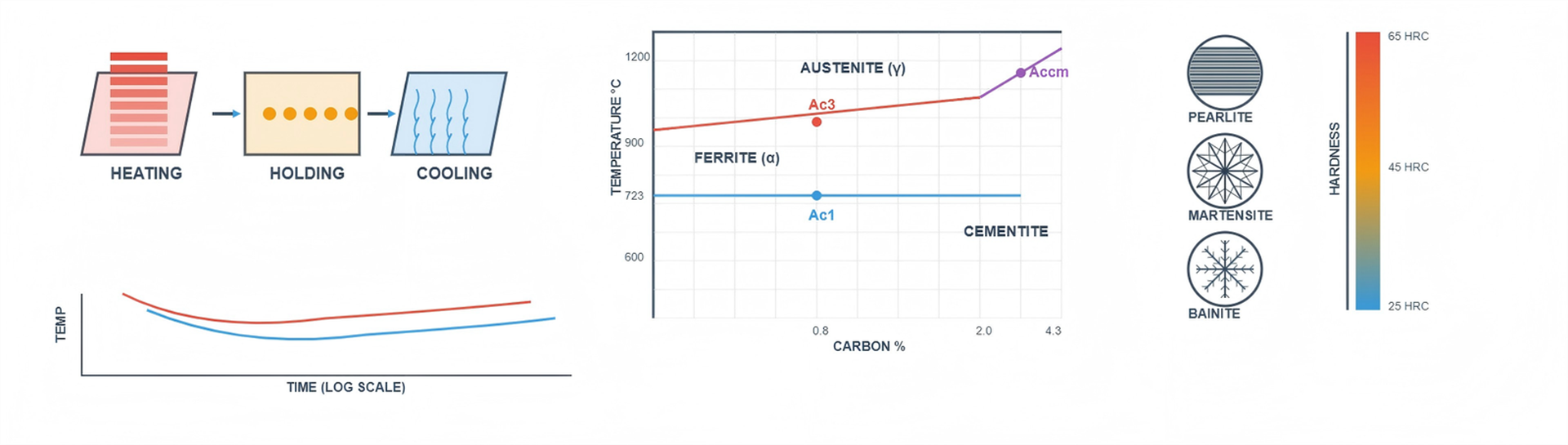
Simplified representation showing critical transformation points that influence heat treatment processes and injection molding mold cost
Conventional Heat Treatment Methods and Cost Implications
Annealing Processes
Annealing serves as a preparatory treatment that significantly influences wholesale injection molding mold cost by improving machinability and reducing internal stresses. The process involves heating steel to appropriate temperatures, maintaining that temperature for a specific duration, then cooling slowly to achieve desired properties. Complete annealing, also known as recrystallization annealing, treats hypoeutectoid steels by heating them above the Ac3 point by 30-50°C. This treatment refines grain structure, reduces hardness, improves cutting performance, and eliminates internal stresses that could otherwise increase precision injection molding mold cost through machining difficulties or premature tool wear.
Spheroidizing annealing specifically addresses the needs of hypereutectoid steels, transforming carbides into spherical forms that enhance machinability. By heating steel to 30-50°C above the Ac1 point and controlling the cooling process, manufacturers can significantly reduce injection molding mold cost quotation amounts related to machining operations. Isothermal spheroidizing annealing further optimizes this process by rapidly cooling to temperatures slightly below Ar1 for isothermal transformation, reducing treatment time while maintaining quality standards essential for competitive injection molding mold cost.
"Proper spheroidizing annealing can reduce machining costs by up to 40% in high-carbon tool steels commonly used for injection molds, while simultaneously improving tool life by 25-30% during subsequent cutting operations"
- Zhang et al., 2023, springer.com

Annealing Benefits for Injection Molds
Reduced internal stresses preventing mold distortion
Improved machinability lowering production costs
Uniform microstructure ensuring consistent performance
Reduced hardness facilitating complex machining
Enhanced dimensional stability during subsequent processing
Isothermal annealing offers particular advantages for managing bulk injection molding mold cost in high-carbon and high-alloy steels. By heating to Ac3 (for hypoeutectoid steels) or Ac1 (for eutectoid and hypereutectoid steels), then rapidly cooling to temperatures below Ar1 for isothermal transformation, manufacturers achieve uniform microstructures with consistent properties throughout the workpiece. This uniformity translates directly into more predictable OEM injection molding mold cost calculations and improved long-term performance.
Normalizing Treatment
Normalizing involves heating steel to 30-50°C above Ac3 (for hypoeutectoid steels) or Acm (for eutectoid and hypereutectoid steels), followed by air cooling. This treatment produces finer pearlite structures compared to annealing, resulting in higher strength and hardness levels that can reduce durable injection molding mold cost through enhanced wear resistance. For low and medium carbon steels, normalizing often replaces complete annealing, offering time savings that translate into lower customized injection molding mold cost without sacrificing performance.
Normalizing Advantages
Faster processing than annealing
Lower energy consumption
Higher strength and hardness
Improved machinability for certain alloys
Normalizing Considerations
Potentially higher hardness increasing machining difficulty
May cause greater dimensional changes
Less effective for high-alloy steels
Requires proper cooling conditions
The selection between normalizing and annealing significantly impacts injection molding mold cost from manufacturers. While normalizing requires less time and energy, potentially reducing initial costs, the resulting higher hardness may increase subsequent machining expenses. Careful analysis of the entire manufacturing process chain is essential when evaluating injection molding mold cost pricelist options to ensure optimal overall value.
Quenching and Tempering Operations

Quenching Media Comparison
Water
Rapid cooling, higher hardness potential, increased distortion risk
Oil
Moderate cooling rate, reduced distortion, good hardness development
Polymer Solutions
Controllable cooling rates, balanced hardness and distortion
Quenching represents the most critical heat treatment for achieving the high hardness required in injection molds. By heating steel above Ac3 (hypoeutectoid) or Ac1 (hypereutectoid) by 30-50°C, then rapidly cooling in appropriate media, austenite transforms to martensite or lower bainite. The selection of quenching medium profoundly affects both treatment success and low price injection molding mold cost considerations. Water provides rapid cooling but increases distortion risk, while oil offers gentler cooling with reduced cracking potential but may not achieve maximum hardness in all steels.
Temperature selection during quenching directly influences custom injection molding mold cost through its impact on final properties and distortion levels. Excessive temperatures cause grain coarsening, producing coarse needle martensite that increases brittleness and cracking susceptibility. These defects can catastrophically increase injection molding mold cost if rework or replacement becomes necessary. Optimal quenching temperature selection balances the need for complete austenitization against the risks of overheating.
Tempering following quenching is essential for achieving the property balance required in production molds. Low-temperature tempering below 250°C maintains high hardness while reducing internal stresses, critical for cutting tools and wear-resistant mold components. This treatment typically achieves 56-64 HRC hardness, optimal for many mold applications affecting injection molding mold cost calculations. Medium-temperature tempering at 350-500°C produces tempered troostite with enhanced elasticity, while high-temperature tempering at 500-650°C creates tempered sorbite offering superior toughness combined with adequate strength.
Tempering Temperature Effects on Hardness

Surface Treatment Technologies
Surface Hardening Methods
Surface hardening achieves the "hard surface, tough core" combination essential for many mold components, directly impacting factory injection molding mold cost efficiency. Flame hardening offers equipment simplicity and application flexibility, though temperature control challenges may affect quality consistency and subsequent injection molding mold cost. Induction hardening provides superior control through electromagnetic heating, enabling precise hardened layer depth management crucial for precision injection molding mold cost optimization.
Flame Hardening
Induction Hardening
High-frequency induction hardening has become increasingly prevalent in mold manufacturing due to its controllability and automation potential. The relationship between frequency and hardened layer depth allows engineers to tailor treatments to specific component requirements, optimizing high quality injection molding mold cost through targeted property enhancement. Post-hardening tempering at 180-250°C reduces quenching stresses while maintaining surface hardness and wear resistance essential for extended mold service life.
Chemical Heat Treatment Applications
Chemical heat treatment modifies both surface chemistry and microstructure, offering unique property combinations that influence wholesale injection molding mold cost decisions. Carburizing increases surface carbon content by heating low-carbon steels to 900-950°C in carbon-rich atmospheres. This process creates wear-resistant surfaces while maintaining tough cores, ideal for components experiencing both wear and impact loads. The depth and uniformity of carburized layers directly affect competitive injection molding mold cost by determining component longevity and replacement intervals.

Nitriding
Nitriding at 500-600°C introduces nitrogen into steel surfaces, creating extremely hard nitride layers without the distortion associated with high-temperature treatments. This characteristic makes nitriding particularly valuable for maintaining dimensional accuracy in precision molds, reducing injection molding mold cost quotation complexity by minimizing post-treatment machining requirements. The process typically follows quenching and tempering, serving as the final treatment step to maximize dimensional stability.
Metal Diffusion Treatments
Metal diffusion treatments introduce chromium, aluminum, or other elements to achieve specialized surface properties without the expense of solid high-alloy steels. While requiring higher temperatures and longer treatment times than carburizing or nitriding, these processes can significantly reduce bulk injection molding mold cost by allowing manufacturers to use less expensive base materials while achieving premium surface characteristics.
Advanced Heat Treatment Technologies

Controlled Atmosphere Processing
Controlled atmosphere heat treatment prevents oxidation and decarburization during heating, critical for maintaining surface quality and dimensional accuracy.
This technology reduces post-treatment processing requirements, directly lowering OEM injection molding mold cost through eliminated or reduced finishing operations. The ability to control surface carbon content during treatment enables precise property tailoring, essential for optimizing durable injection molding mold cost through extended service life.

Vacuum Heat Treatment
Vacuum processing eliminates atmospheric interactions entirely, producing clean, bright surfaces without oxidation or decarburization.
The slower heating rates and reduced temperature gradients minimize distortion, critical for complex mold geometries where dimensional stability affects customized injection molding mold cost. Vacuum treatment's superior property uniformity and minimal distortion make it increasingly cost-effective for high-precision applications despite higher initial equipment investments.

Deformation Heat Treatment
Combining plastic deformation with heat treatment multiplies strengthening mechanisms, achieving property combinations unattainable through conventional processing.
Low-temperature deformation heat treatment involves austenitizing, rapid cooling to temperatures between Ar1 and Ms, plastic deformation, then immediate quenching and tempering. This process can reduce injection molding mold cost from manufacturers by enabling the use of lower-alloy steels while achieving premium properties.
High-Temperature Deformation Heat Treatment
High-temperature deformation heat treatment, including forge quenching and roll quenching, integrates forming and heat treatment operations. This consolidation reduces processing steps and energy consumption, potentially lowering low price injection molding mold cost while improving mechanical properties through refined microstructures and enhanced toughness.
These advanced processes require sophisticated equipment and process control, representing a higher initial investment but often delivering superior returns through reduced injection molding mold cost over the production lifecycle. The integration of computer modeling and simulation has further improved the efficiency and reliability of these advanced heat treatment technologies, making them increasingly accessible for optimizing injection molding mold cost across various production scales.
Economic Optimization Strategies
Understanding heat treatment's impact on injection molding mold cost enables strategic optimization throughout the manufacturing process. Material selection must balance initial cost against processing requirements and final properties. While premium steels may increase initial investment, their superior properties often reduce overall bulk injection molding mold cost through extended service life and reduced maintenance requirements.
Process Consolidation
Distortion Control
Heat Treatment Investment vs. Long-Term Injection Molding Mold Cost

Comparison showing how initial heat treatment investment correlates with total mold cost over production lifecycle
Quality Assurance and Cost Management
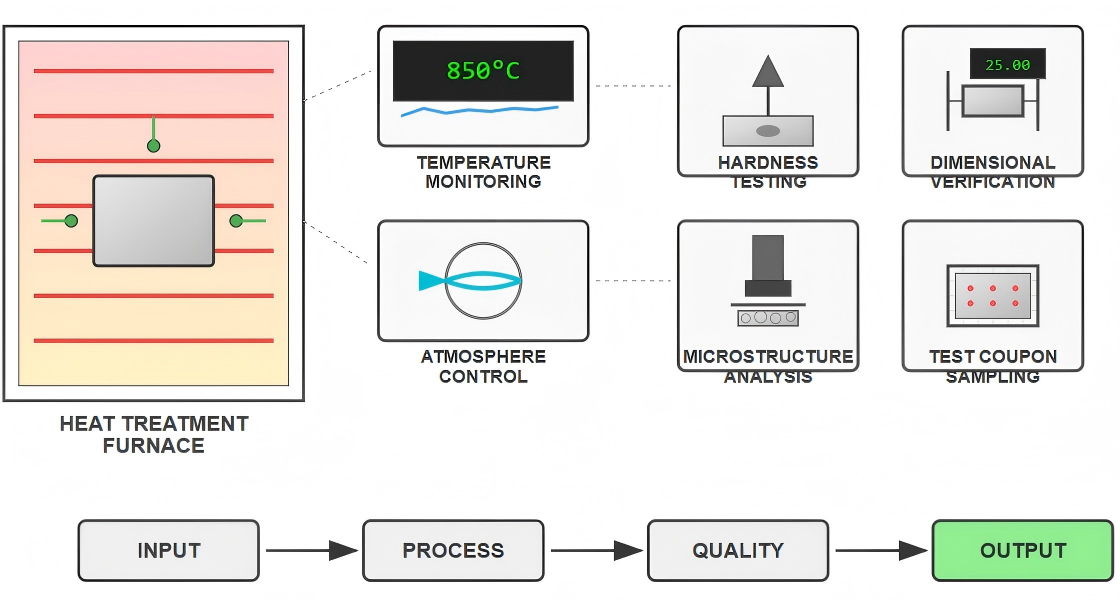
Implementing robust quality control throughout heat treatment processes ensures consistent properties essential for predictable low price injection molding mold cost. Temperature monitoring, atmosphere control, and cooling rate verification prevent property variations that could necessitate premature mold replacement. Documentation of treatment parameters enables process optimization and troubleshooting, supporting continuous improvement in injection molding mold cost pricelist competitiveness.
Preventive maintenance of heat treatment equipment directly impacts custom injection molding mold cost reliability. Regular calibration of temperature controllers, atmosphere analyzers, and cooling systems prevents drift that could compromise treatment quality. Investment in modern control systems with data logging capabilities supports process optimization efforts aimed at reducing suppliers injection molding mold cost while maintaining quality standards.
Key Quality Control Measures
Continuous Temperature Monitoring
Multiple thermocouple placement with real-time data recording
Microstructural Analysis
Periodic metallographic examination of test coupons
Hardness Testing
Strategic sampling across treated components
Dimensional Verification
Precision measurement before and after treatment
Cost Impact of Quality Issues

Quality issues in heat treatment directly impact injection molding mold cost through increased rework, reduced service life, and potential production disruptions.