





Installation and Debugging of Injection Molds
Essential Practices in Design for Injection Molding
The installation and debugging process of injection molds represents a critical phase in manufacturing that directly impacts product quality and production efficiency. Understanding proper installation procedures is fundamental to successful design for injection molding operations, as even the most meticulously crafted molds can fail to produce quality parts without correct setup and calibration.

Modern injection molding machine with properly installed mold during production
Pre-Installation Preparation Work
Before commencing mold installation, thorough preparation ensures smooth operation and prevents costly mistakes. Engineers must first familiarize themselves with all relevant technical documentation, including mold assembly drawings that clarify the structure, characteristics, and working principles of the mold. This documentation review forms an integral part of design for injection molding best practices, as it establishes clear understanding between design intent and practical implementation.
Inspection Phase
Involves examining mold forming parts and gating systems for surface roughness compliance, checking for scratches or collapses that could affect part quality. All moving components require verification of proper fit, correct positioning at movement endpoints, and smooth operation without binding. When implementing design for injection molding principles, these inspections validate that theoretical designs translate effectively into functional tooling.
Equipment Verification
Encompasses checking oil circuits, water cooling channels, and electrical systems for proper operation. The injection machine's operating switches must be set to manual or jog mode, with hydraulic system pressure adjusted to low settings initially. All stroke switches require adjustment to specified positions, ensuring the moving platen operates smoothly.
Hoisting equipment safety checks cannot be overlooked, as mold weights often exceed manual handling capabilities. Verifying crane capacity and operational range prevents accidents during installation. Professional design for injection molding practices mandate comprehensive safety protocols throughout the installation process.

Engineer performing pre-installation inspection of mold components, a critical step in design for injection molding
Technical Parameter Verification
Critical parameter verification before installation prevents equipment damage and ensures product quality. Injection volume, representing the maximum plastic volume the machine can inject in one stroke during air injection conditions, must accommodate total part and runner volume requirements. The combined volume should not exceed eighty percent of the machine's rated capacity, with actual injection volumes typically ranging from twenty-five to seventy percent of nominal machine capacity. This consideration in design for injection molding ensures sustainable production without overtaxing equipment.
| Parameter | Considerations | Design for Injection Molding Impact |
|---|---|---|
| Injection Pressure | Must overcome flow resistance through nozzles, runners, and cavities | Ensures proper filling without excessive pressure that could damage mold |
| Injection Speed | Ranges from 125 to 2000 cm³/s based on volume requirements | Affects part quality, surface finish, and cycle time efficiency |
| Plasticizing Capacity | Maximum material volume that can be properly melted per unit time | Determines production rates and material consistency |
| Clamping Force | Typically 30-40% greater than cavity pressure | Prevents mold separation during injection and flash formation |
Injection pressure requirements demand careful analysis, as sufficient pressure must overcome flow resistance through nozzles, runners, and cavities. Pressure requirements vary based on flow resistance, part geometry, plastic material properties, plasticization method, processing temperatures, mold temperature, and dimensional accuracy requirements. Successful design for injection molding implementations verify that available machine pressure meets or exceeds mold design specifications.
"The optimization of injection molding parameters through systematic analysis can reduce defect rates by up to 40% while improving cycle times by 25%. Critical factors include precise control of injection pressure, temperature profiles, and cooling rates, which must be calibrated during the initial setup phase to achieve optimal part quality and dimensional stability."
- Journal of Manufacturing Science and Engineering, asme.org
Injection speed selection significantly influences part quality and production efficiency. Standard injection speeds correlate with injection volumes, ranging from 125 cubic centimeters per second for 125 cubic centimeter volumes to 2000 cubic centimeters per second for 10,000 cubic centimeter volumes. Corresponding injection times vary from one second to five seconds based on volume. These parameters exemplify how design for injection molding integrates machine capabilities with process requirements.
Plasticizing capacity defines the maximum material volume the machine can properly melt per unit time. This parameter directly affects production rates and must align with projected manufacturing volumes. Clamping force requirements prevent mold separation during injection, typically requiring forces thirty to forty percent greater than cavity pressure to maintain proper sealing. These calculations demonstrate how design for injection molding encompasses both theoretical analysis and practical safety factors.

Monitoring and verifying technical parameters on an injection molding machine control panel
Installation Dimension Verification
Dimensional compatibility between mold and machine represents a fundamental aspect of successful installation. The nozzle sphere dimensions require precise matching with mold sprue bushings. For horizontal and vertical injection machines, the nozzle sphere radius should be one to two millimeters smaller than the sprue bushing sphere radius, while the nozzle orifice diameter should be half to one millimeter smaller than the sprue bushing inlet diameter. This dimensional relationship in design for injection molding prevents leakage while ensuring proper material flow.
Locating Ring Dimensions
Must provide accurate positioning between mold and machine platens, typically following H9/f9 tolerance specifications or maintaining 0.1mm clearance.
Mold Dimensions
Must fit within machine daylight limitations, with closed mold height between minimum and maximum machine specifications.
Opening Stroke
Must ensure complete part ejection without interference, with additional clearance of 5-10mm for single parting line molds.
Locating ring dimensions must provide accurate positioning between mold and machine platens. The relationship between machine platen locating holes and mold locating rings typically follows H9/f9 tolerance specifications or maintains a 0.1-millimeter clearance. This ensures alignment between the main runner axis and machine nozzle axis, preventing material leakage and facilitating runner removal. Small molds generally utilize eight to ten-millimeter thick locating rings, while large molds require ten to fifteen-millimeter thicknesses. Proper locating ring design for injection molding applications ensures repeatable positioning accuracy.
Mold dimensions must fit within machine daylight limitations. The closed mold height must fall between minimum and maximum machine daylight specifications. When closed height falls below minimum requirements, spacer plates provide adjustment capability. Conversely, molds exceeding maximum daylight cannot achieve proper clamping or may restrict opening stroke, particularly problematic for hydraulic toggle clamp mechanisms that cannot achieve full extension. Width and length dimensions require verification to ensure mold insertion between tie bars, highlighting how design for injection molding must consider machine-specific constraints.
Mold mounting methods include direct screw fastening or clamp plate securing. Direct fastening requires precise alignment between mold mounting holes and machine platen holes. Clamp plate mounting provides greater flexibility, requiring only that platen holes exist near mold edges for clamp placement. Most applications favor clamp plate mounting due to its adaptability. Understanding mounting options enhances design for injection molding flexibility across different machine configurations.
Opening stroke verification ensures complete part ejection without interference. Single parting line molds require maximum machine opening stroke to exceed combined part height and ejection distance by five to ten millimeters. Double parting line molds additionally require runner plate separation distance accommodation. These clearances in design for injection molding prevent mechanical interference during automated operation.

Precise dimensional requirements ensure proper alignment in design for injection molding installations
Ejection System Verification
Ejection mechanism compatibility represents another critical installation consideration. Injection machines employ various ejection configurations including center ejector rod mechanical systems, dual side rod mechanical systems, center rod hydraulic ejection with side rod mechanical combination, and center rod hydraulic with auxiliary hydraulic cylinder arrangements. Prior to installation, verification of ejection system type, rod diameter, spacing, and stroke ensures proper part removal. Effective design for injection molding incorporates machine ejection capabilities into mold construction planning.
Modern Ejection System Technologies
Modern injection machines utilize advanced hydraulic transmission systems incorporating precision pressure and velocity valves. These systems enable opening and closing speeds reaching twenty-five to thirty-five meters per minute, with some achieving sixty to ninety meters per minute. Such high-speed operation demands robust mold construction and precise alignment, considerations integral to contemporary design for injection molding practices.
Cooling water flow requirements vary based on machine loading conditions. Inadequate cooling affects product quality and complicates part ejection. The barrel rear cooling collar requires consistent low-temperature water flow to prevent premature material melting at the hopper throat, which would impede material feeding. Thermal management represents a crucial aspect of design for injection molding, directly influencing cycle times and part quality.

Ejection system components must be carefully verified during installation for proper operation
Installation and Debugging Procedures
The installation process begins with machine activation and platen separation. Power connection and machine startup position moving and stationary platens in the open position for mold insertion. Platen surfaces and locating holes require thorough cleaning to remove contaminants and burrs that could affect mold seating. This preparation exemplifies attention to detail required in professional design for injection molding implementation.
Small Mold Installation
Often employs manual handling when weight permits. Wooden boards placed across lower tie bars provide support platforms for lateral mold insertion into the machine frame. Raising the support allows locating ring engagement with the stationary platen locating hole while positioning the mold correctly.
Slow platen closure clamps the mold between platens, after which clamp plates and bolts secure the stationary half. The moving half receives initial loose mounting to permit self-alignment during subsequent opening cycles. After several open-close sequences establish proper positioning, final tightening secures the moving half. This methodical approach in design for injection molding ensures accurate mold alignment.
Heavy Mold Installation
Requires mechanical lifting using overhead cranes or gantry systems. Installation procedures mirror manual methods but with enhanced safety protocols. Molds featuring side-action mechanisms require horizontal slide orientation, while hydraulic core-pull systems demand adherence to specified installation orientations.
Split installation methods suit oversized molds exceeding integral lifting capacity. The stationary half installs first, lowered between tie bars from above and aligned with the locating hole before clamping. The moving half follows, guided by alignment features into proper registration with the stationary half.
Safety Protocols
During installation require coordinated communication between multiple operators to prevent injury or equipment damage. Clamp plates must maintain parallelism with platens without tilting, ensuring uniform pressure distribution. Tilted clamping risks mold shifting or dropping, creating dangerous conditions.
Additionally, clearance verification prevents clamp interference during closure, essential for safe design for injection molding practices.

Proper installation of large injection molds requires specialized equipment and safety protocols
Mold Adjustment and Trial Operations
Following installation, mold tightness adjustment based on closed height and ejection distance ensures adequate opening stroke and clamping force. Proper adjustment maintains parting line gaps between 0.02 and 0.04 millimeters, preventing excessive flash while permitting cavity venting. This balance in design for injection molding optimizes part quality while protecting mold components.
Trial Operation Sequence
Ejector Pin Stroke Adjustment
Occurs with molds secured and slowly opened until the moving platen reaches full retraction. Pin position adjustment ensures complete part ejection while maintaining five to ten-millimeter clearance between ejector plates and support plates.
Nozzle and Sprue Alignment
Verification uses paper strips to assess contact uniformity. Following alignment confirmation, injection unit positioning screws lock the relationship.
Circuit Connections Check
For cooling and heating systems require verification of unobstructed water flow and proper electrical current ratings.
Dry Cycling
Without material confirms proper operation of guidance systems, ejection mechanisms, return systems, core-pull actuators, cooling circuits, and heating elements.
Material Introduction
Only after verifying reliable operation should material introduction commence for actual molding trials.
These safety margins reflect conservative design for injection molding philosophies prioritizing equipment longevity. Nozzle and sprue bushing alignment verification uses paper strips to assess contact uniformity. Following alignment confirmation, injection unit positioning screws lock the relationship. This alignment criticality in design for injection molding prevents material leakage and ensures consistent filling patterns.
Circuit connections for cooling and heating systems require verification of unobstructed water flow and proper electrical current ratings. Temperature control instrumentation enables precise thermal management while electrical safety measures prevent shock hazards. Thermal control sophistication demonstrates evolution in design for injection molding technology.
Initial dry cycling without material confirms proper operation of guidance systems, ejection mechanisms, return systems, core-pull actuators, cooling circuits, and heating elements. Only after verifying reliable operation should material introduction commence for actual molding trials. This systematic verification embodies professional design for injection molding methodology.

Mold adjustment during trial operations ensures optimal performance in production
Practical Installation Example: Soap Box Mold
Consider the installation process for a soap box injection mold as a practical demonstration of these principles. Tool preparation includes hex keys, combination wrenches, adjustable wrenches, brass drift pins, and hammers in appropriate sizes for the specific mold. Initial mold inspection confirms all fasteners are properly tightened and mounting surfaces are clean. These preparatory steps exemplify thorough design for injection molding practices.
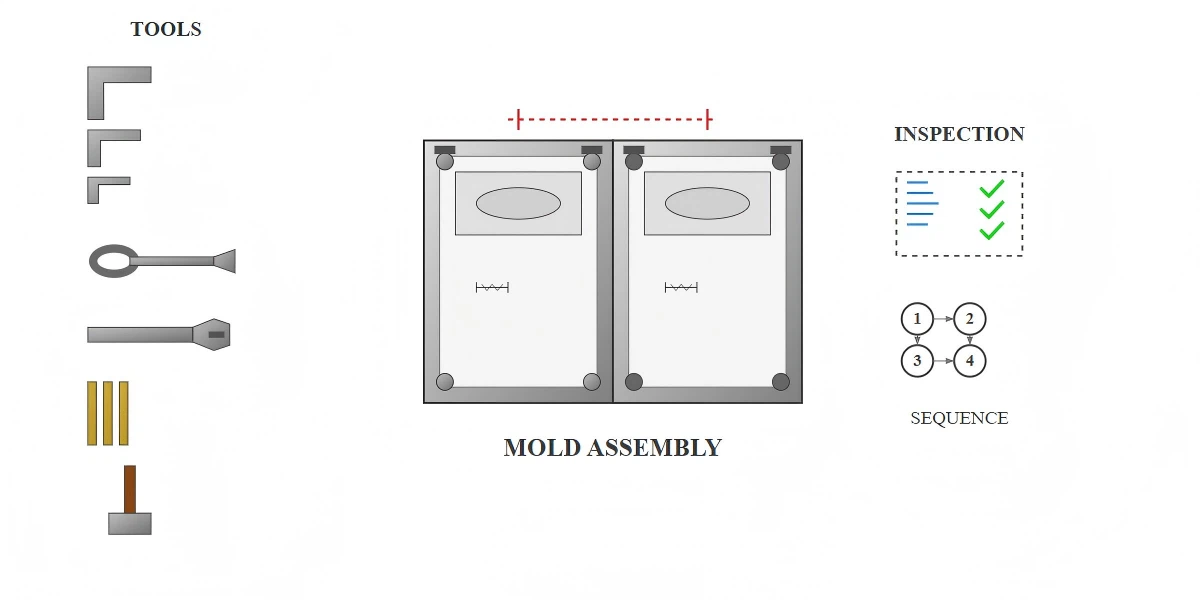
Soap box mold components prepared for installation

Machine preparation involves power activation, motor startup, and verification of all machine functions. Platen spacing adjustment matches mold height requirements, either through manual measurement or automatic adjustment systems on equipped machines. The mold enters the installation area via overhead lifting, with the locating ring engaging the stationary platen center hole. Low-pressure, low-speed closure compresses the mold, with pressure gauge monitoring confirming complete closure before motor shutdown. This controlled approach in design for injection molding prevents equipment damage.
Clamp plate installation secures both mold halves, with four clamp sets each for stationary and moving halves in this example. Initial moving half mounting remains loose to permit self-centering during multiple trial cycles. Following alignment verification and smooth operation confirmation, final tightening completes mechanical installation. This iterative process ensures optimal design for injection molding implementation.
Cooling circuit connection follows water path analysis, with flow testing confirming proper operation. Mold opening reveals cavity and core features, enabling foreign object inspection and ejection distance adjustment. Parameter setting establishes initial processing conditions including temperatures, pressures, speeds, and timing. Trial production validates these parameters, with adjustments refining product quality. Documentation captures optimal settings for future reference, completing the design for injection molding installation process.
Advanced Considerations in Modern Installation Practices
Contemporary injection molding operations increasingly incorporate automation and Industry 4.0 concepts into installation procedures. Smart sensors monitor alignment precision during installation, providing real-time feedback on parallelism and concentricity. These technological advances enhance traditional design for injection molding approaches with data-driven precision.

Predictive Maintenance
Systems utilize installation baseline data to track degradation over production runs. Vibration signatures, temperature profiles, and pressure patterns established during initial setup provide reference standards.

Quick-Change Systems
Revolutionize mold installation efficiency with standardized mounting interfaces, automatic utility connections, and preset parameter storage reducing changeover times from hours to minutes.

Simulation Software
Validates installation parameters before physical implementation, predicting potential issues like inadequate cooling, excessive deflection, or insufficient venting.
"Advanced mold installation practices integrate digital twins with real-time monitoring to create closed-loop systems that continuously optimize performance. This integration of physical and virtual worlds in design for injection molding reduces setup times by up to 35% while improving dimensional accuracy by 20%."
- International Journal of Advanced Manufacturing Technology, springer.com
Training requirements for installation personnel continue increasing as molds become more sophisticated. Hydraulic core-pull mechanisms, hot runner systems, valve gates, and sequential molding capabilities demand specialized knowledge for proper setup. Investment in technician education ensures effective design for injection molding implementation across complex applications.
Environmental considerations influence modern installation practices, with energy-efficient machines and sustainable materials gaining prominence. Cooling water recycling, waste heat recovery, and biodegradable hydraulic fluids reflect industry commitment to environmental responsibility. These green initiatives reshape design for injection molding priorities beyond pure economic factors.
Quality system integration requires documented installation procedures, verification checklists, and validation protocols. ISO standards mandate traceability from design through production, with installation parameters forming critical quality records. This systematic documentation in design for injection molding supports continuous improvement initiatives.
Troubleshooting Common Installation Issues
Despite careful preparation, installation challenges occasionally arise requiring systematic resolution. Nozzle misalignment manifests as material leakage or sprue bushing damage, corrected through careful repositioning and alignment verification. Understanding these failure modes improves design for injection molding robustness.
| Common Issue | Symptoms | Solution |
|---|---|---|
| Nozzle Misalignment | Material leakage, sprue damage, irregular filling | Precise repositioning using alignment tools, verification with paper test |
| Insufficient Clamping Force | Flash, parting line separation, dimensional inconsistency | Increase pressure, verify tonnage requirements, check for platen parallelism |
| Ejection Problems | Stuck parts, ejection marks, incomplete ejection | Adjust stroke settings, check pin alignment, verify draft angles |
| Cooling Inadequacies | Extended cycle times, warpage, ejection difficulties | Verify flow rates, clean channels, check temperature settings |
| Mechanical Binding | Rough movement, unusual noises, incomplete cycling | Inspect for contamination, check alignment, verify component condition |
Insufficient clamping force produces flash or parting line separation, addressed through pressure increase or tonnage verification. Conversely, excessive clamping force causes platen deflection, mold damage, or premature wear. Balancing these forces exemplifies optimization in design for injection molding applications.
Ejection problems stem from incorrect stroke settings, misaligned pins, or inadequate draft angles. Systematic evaluation identifies root causes, enabling targeted corrections. These troubleshooting skills distinguish experienced design for injection molding practitioners.
Cooling inadequacies manifest as extended cycle times, part warpage, or ejection difficulties. Flow rate verification, channel cleaning, and temperature monitoring resolve most cooling issues. Thermal management expertise proves essential for successful design for injection molding implementation.
Mechanical binding during mold movement indicates alignment problems, contamination, or component damage. Careful inspection and methodical adjustment restore smooth operation. Patience during troubleshooting prevents hasty decisions that could worsen problems in design for injection molding applications.

Systematic troubleshooting is essential for resolving installation issues in injection molding