





What Is Surface sandblasting treatment?
Surface sandblasting treatment
Sandblasting uses compressed air as the power to form a high-speed jet stream that rapidly projects abrasive media (copper slag, quartz sand, corundum, iron grit, sea sand) onto the surface of the workpiece to be treated, changing the appearance or shape of the workpiece surface. Due to the impact and cutting action of the abrasive media on the workpiece surface, the surface of the workpiece achieves a certain degree of cleanliness and different roughness. Sandblasting the surface of mold forming parts can achieve a relatively coarse but uniform surface roughness, generally used to create a frosted decorative finish on the surface of the finished part. Many injection molding mold suppliers apply this technique to meet specific surface texture requirements before delivery. The following uses the sandblasting treatment of a soap dish cavity surface as an example to illustrate the application of the sandblasting process in mold surface treatment. After polishing, the cavity surface before sandblasting is shown in Figure 6-14.

The abrasive media chosen for sandblasting is cast iron grit, with a particle size of 0.5 to 1.5 mm. The abrasive media is required to be angular, clean, dry, and free of oil, as shown in Figure 6-15. Before sandblasting, the surfaces of the cavity that are not to be sandblasted must be protected, usually with thick adhesive tape, as shown in Figure 6-16.


The protected cavity is placed into the sandblasting machine for preparation, as shown in Figure 6-17. During the sandblasting process, the worker puts on thick gloves, inserts their hands into the two inlets of the sandblasting machine, holds the spray hose, and directs it at the area requiring sandblasting, as shown in Figure 6-18. Throughout the sandblasting process, the spraying situation needs to be observed constantly through the observation window. Professional injection molding processing manufacturers typically equip advanced sandblasting equipment to ensure consistent treatment quality.

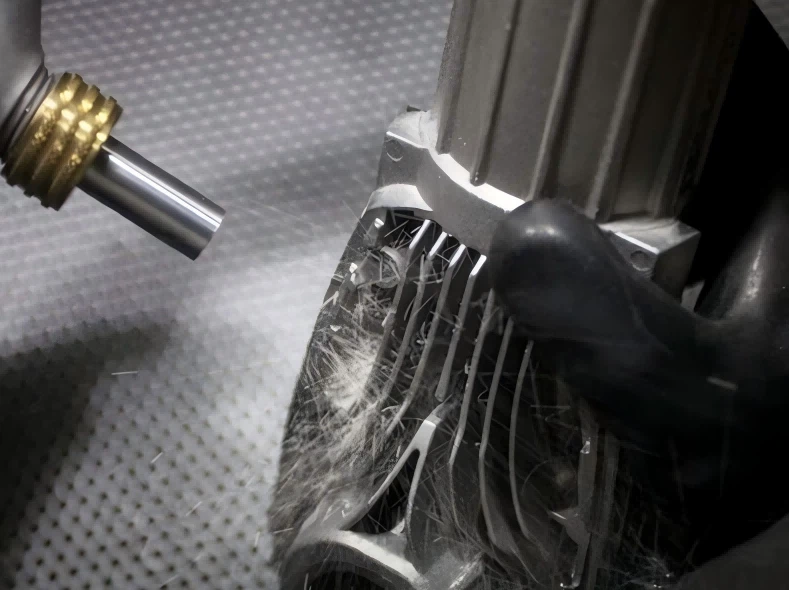
The following points need attention during the sandblasting process:
①The compressed air used for sandblasting must be treated by a cooling device and an oil-water separator to ensure the compressed air is dry and oil-free, with a compressed air pressure of 0.7 MPa.
②The distance from the nozzle to the base metal surface should be maintained at 100 to 300 mm.
③The angle between the spray direction and the normal of the base metal surface should be controlled within the range of 15° to 30°.
④The sandblasting hose should be kept as straight as possible to reduce pressure loss and localized wear on the hose by the abrasive media. For areas where bending is necessary during operation, the direction must be frequently alternated to ensure even wear and prolong the service life of the hose.
⑤The speed of nozzle movement should be flexibly adjusted based on the air pressure, abrasive media output, and the contamination level of the structure surface.
⑥During the spraying process, the air-to-media ratio should be adjusted promptly based on air pressure, nozzle diameter, desired quality of treatment, and efficiency. Precise control of these parameters is essential for any reliable injection molding mold manufacturer to guarantee product quality.
The cavity after sandblasting treatment is shown in Figure 6-19. The on-site processing video can be found in the "Surface Sandblasting.mp4" file under the "Case Videos" folder in the resource library of the China University MOOC "Mold Manufacturing Technology" (Course ID: 0802SUST006).

For companies with batch production needs, choosing an experienced injection molding surface treatment service provider can effectively improve product appearance consistency. To learn more about mold surface treatment processes or seek professional injection molding solutions, it is recommended to consult with service providers who have extensive industry experience.