Overview
Metal powders with sufficiently small particle size (<45 μm), high powder loading in polymers, and high density after sintering can be used for metal injection molding, with powders having an average particle size of less than 22 μm being the most ideal. Numerous methods exist for powder preparation, but powders prepared by different methods possess different properties, which ultimately affect the density, size, and deformation of the injected parts. Because small particles are used to characterize powder properties, many characterization methods (such as sieving) are insufficient to accurately monitor and predict the results of the metal injection molding process. This chapter mainly introduces powders used in metal injection molding, different powder preparation methods, the properties of metal injection molding powders, and the influence of powder geometry or manufacturing methods on the metal injection molding process.
Different preparation techniques for MIM powder
There are many methods for preparing powders for metal injection molding (MIM), including gas atomization, water atomization, thermal decomposition, and chemical reduction.
When it is necessary to add a small amount of powder to an alloy or to prepare certain specific alloys in a powder mixture, other powder preparation methods, such as mechanical crushing/grinding, are usually used. The carburizing of pure tungsten powder to produce tungsten carbide-grade powder is an exception. Table 3.1 shows the preparation methods and characteristics of MIM powders; other powder preparation techniques can be found elsewhere.
Classifying the particle size and particle size distribution of MIM powders is an important step in powder preparation because many MIM powders are taken from batches of powder with different particle sizes; therefore, it is essential to ensure the consistency of MIM powder across batches.
Table 3.1 Preparation Methods and Characteristics of MIM Powders
| Preparation Method | Relative Cost | Metal or Alloy Examples | Particle Size /μm | Particle Shape |
|---|---|---|---|---|
| Gas Atomization | High | Stainless steel, superalloy F75, MP35N, Titanium, master alloy additives | 5 ~ 45 | Spherical |
| Water Atomization | Medium | Same as gas atomization except for titanium and iron alloys | 5 ~ 45 | Elliptical, irregular shape |
| Thermal Decomposition | Medium | Iron, Nickel | 0.2 ~ 20 | Spherical, needle-shaped |
| Chemical Reduction | High/Medium | Tungsten, Molybdenum | 0.1 ~ 10 | Polygonal, spherical |

Gas atomization
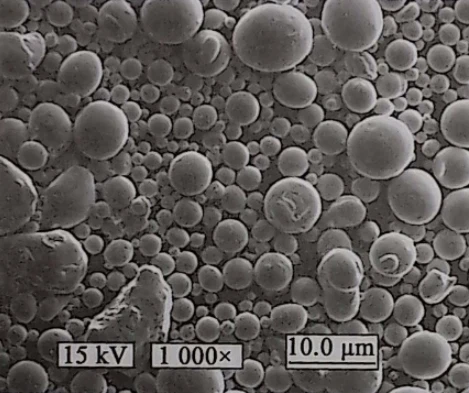
Gas atomization is a method of preparing powder by melting metals or alloys through induction or other heating methods and then atomizing the melt through a nozzle. After leaving the nozzle, the molten metal or alloy is impacted by a high-speed gas flow, breaking the melt into fine droplets. These droplets solidify into spherical particles during free fall. The high-speed ejected gas is typically nitrogen, argon, or nitrogen; air can also be used to form certain special powders. Air-atomized particles have a high degree of surface oxidation; therefore, air atomization is not recommended for most engineering materials, especially those for which oxide films are difficult to remove during post-sintering. The atomized droplets fall freely within a large container, thus solidifying before contacting the container walls. During atomization, if turbulence exists near the nozzle, small solid particles can re-enter the atomized melt, forming small, solidified powder particles on the particle surface. These irregular powder particles interfere with powder packing density and subsequent flow properties of the MIM feed. Wide-size-distribution atomized powders can be produced by sieving or air sorting. Oversized particles can be re-atomized to produce smaller-size powders. Figure 3.4 shows a typical scanning electron microscope (SEM) image of atomized stainless steel powder, which has a spherical shape, high surface purity, and high packing density.
Water Atomization
The principles of water atomization and gas atomization are basically similar. The difference is that water, instead of gas, is used to break down molten metal into fine particles. It utilizes a high-pressure water jet to impact the molten metal flow, rapidly breaking it down and solidifying it into powder. Superheated melt, after being atomized by a high-pressure water jet, produces a large number of fine, spherical particles. Therefore, using water atomization to prepare metal powder under superheated temperatures and high water pressures is crucial for MIM (Metal Injection Molding). Similar to gas atomization, particle size classification of water-atomized powder is an important step in MIM powder production. Figure 3.5 shows a typical SEM image of water-atomized stainless steel powder. These particles have irregular shapes, and compared to gas atomization, the surface oxidation of water-atomized powder particles is more severe. Irregularly shaped particles have an advantage in maintaining shape during degreasing of injection-molded parts. Water atomization has a much higher production efficiency than gas atomization, therefore, the production cost of water-atomized powder is much lower than that of gas-atomized powder.

Thermal Decomposition
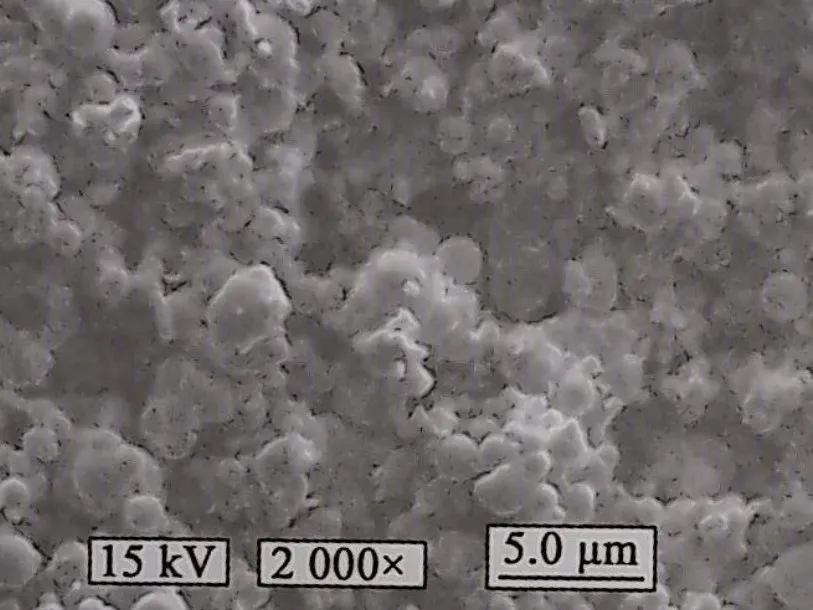
Thermal decomposition is a chemical decomposition caused by heat, commonly used to produce nickel and iron powders for metal injection molding. Tungsten and cobalt powders can also be prepared using this technology. Powders produced by thermal decomposition have a purity greater than 99% and a particle size ranging from 0.20 to 20 μm. In this process, the metal reacts with carbon monoxide under high pressure and temperature to form a carbon-based metal. This carbon-based liquid is purified, cooled, and then reheated under the action of a catalyst, causing the vapor to condense into powder. Figure 3.6 shows a typical SEM image of thermally decomposed carbon-based iron powder. These powders typically contain carbon impurities and must be reduced in hydrogen before use or during sintering, or used in calculations as an alloying component for low-alloy steel. If the powder is reduced before metal injection molding, the particles must be ground to eliminate agglomeration because they clump together during reduction. Furthermore, the sintering activity of these reduced powders is lower than that of unreduced powders because fine particles are fully sintered or assimilated by larger particles during reduction.
Chemical Reduction Method
The chemical reduction method is one of the oldest known powder production methods. This method first purifies the oxide, then uses a reducing agent such as carbon to react with it to generate carbon monoxide or carbon dioxide for reduction. Hydrogen can also be used to reduce the oxide to a metallic powder. To reduce particle size, the reduction reaction is carried out at a relatively low temperature, but the reaction rate is low. Using higher temperatures can accelerate this reaction process, but higher temperatures can cause diffusion bonding of particles, which must then be removed by grinding or milling to a sufficiently fine particle size. If the particles are not crushed, the aggregated powder cannot be properly loaded into the binder system, resulting in high feed viscosity and uneven feeding during injection molding. Figure 3.7 shows a typical SEM image of tungsten powder produced by chemical reduction.