





What Is Overmold?
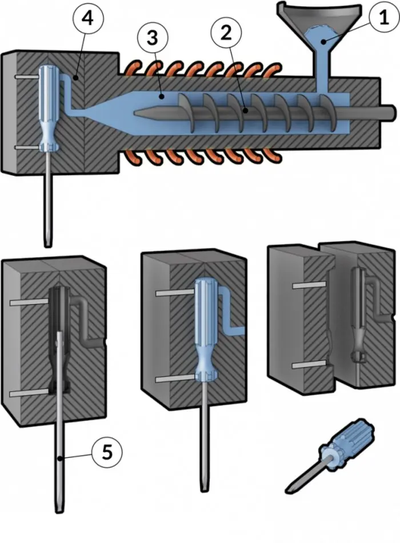
I got into overmolding about twelve years ago when a customer dropped a bin of screwdriver handles on my desk. The TPE grips were peeling off like dead skin. "Fix this," he said. That was my introduction to the process.
Overmolding puts one plastic over another. Usually soft over hard. A TPE or TPU layer goes around a rigid ABS or nylon core. The grip on your cordless drill, the soft part of your toothbrush handle, the bumper on your phone case. All overmolded.
The concept sounds simple. The execution is not.
The Bond Problem
Here is what nobody tells you upfront. The two materials have to like each other. Chemically. If the polarity does not match, you get what that customer dropped on my desk. Parts that look fine coming off the press, then fall apart three weeks later when someone actually uses them.
PP works with SEBS. They have similar molecular structure. ABS and PC need TPU or a specially formulated TPE. Nylon is a nightmare. I have watched engineers spend months trying to get TPE to stick to glass-filled nylon 66. The heat stabilizers in the nylon kill the bond. You think you have it dialed in, ship fifty thousand parts, get a call two months later that the grips are sliding off.
We had a power tool program go sideways because someone changed nylon suppliers without telling anyone. Same spec on paper. Different additive package. The new stuff had more impact modifier. Bond strength dropped forty percent.
Material data sheets do not tell you this. The only way to know is to run the combination and test it.
Two Ways to Do It
Most shops run overmolding one of two ways.
Pick-and-place is the cheap option. You mold the substrate in one press, pull the parts, put them in boxes, walk them over to another press, load them into a second tool, shoot the overmold. Simple tooling. Standard presses. But you need an operator loading parts all day. And the substrate is cold when you shoot the second material. That hurts the bond.
We had a medical handle program running pick-and-place. Worked fine in summer. Winter came, shop floor dropped to 60 degrees, parts started failing peel tests. The cold substrate was not giving the TPE molecules anything to grab onto. Had to add a preheat station. One more step, one more thing to go wrong.
Two-shot uses a rotary platen or a transfer system to move the substrate from cavity A to cavity B while it is still warm. One machine, one cycle, better bond. But the tool costs three times as much and you need specialized equipment. We have a 400-ton Engel with a rotating platen. That machine sat for eight months before we found enough volume to justify running it.
The crossover point depends on your labor rate and your annual volume. I have seen programs flip from pick-and-place to two-shot and back again when the customer revised their forecast.

When the Grip Peels
A TPE peel-off is the most common failure mode. The soft material lets go of the substrate. Sometimes it happens gradually at the edges. Sometimes the whole grip slides off in one piece.
Causes:
Moisture in the substrate. Nylon is hygroscopic. It pulls water out of the air. If you do not dry it before molding, steam forms at the interface during the second shot. That steam prevents molecular bonding. I have seen entire runs scrapped because someone left a Gaylord of nylon open over the weekend.
Contamination. Any oil, dust, or mold release residue on the substrate surface kills the bond. We had a tool tech who liked to hit the cores with silicone spray. Made the parts eject easier. Also made the overmold peel off. Took us two weeks to figure out what was happening.
Wrong temperature. The TPE has an optimal window for bonding. Too cold and it does not flow into the substrate surface. Too hot and you start degrading the material. Every material combination has a different sweet spot. The data sheet gives you a starting point. You dial it in from there.
Incompatible materials. See above. This one is usually a design problem that shows up late.
The Testing
We pull parts off the line and test them. Peel test per ASTM D6862. You clamp the substrate, grab the TPE with a fixture, pull at 90 degrees, measure the force to separate them.
Above 15 pounds per inch is good. Below 10 is a problem. Between 10 and 15 is where you argue with your customer about whether the spec is realistic.
Two failure modes exist. Adhesive failure means the TPE pulls cleanly off the substrate. The bond let go. Cohesive failure means the TPE tears before it separates. The bond held but the material did not. Cohesive failure is actually what you want. It means the joint is stronger than the material itself.
I have had customers insist on 20 lbf/in when the TPE itself only tests at 18. You cannot bond stronger than the material. Physics does not care about the print spec.
Tool Design Details
The tool has to seal against the substrate to prevent flash. Overmold flash is particularly annoying because the TPE is rubbery and hard to trim cleanly. The seal surfaces on the tool wear over time. What runs clean at 10,000 shots might flash at 100,000.
Gate location matters. The TPE has to flow across the substrate surface without trapping air. Trapped air means voids at the interface. Voids mean weak spots. We had a part with a large flat overmold area. The gate was on one end. The material flowed across and pushed air toward the far corner. No vent there. Bond failed at that corner on every part. Added a vent pin, problem solved.
The mold temperature affects cycle time and bond strength in opposite ways. Hotter mold gives better bonding but longer cooling. You find the balance that meets your quality spec without killing your cost.
Texture on the substrate helps. A polished surface gives the TPE less to grab. Light texture, maybe SPI C-2 or C-3, gives mechanical interlocking on top of the chemical bond. We run textured substrate surfaces as standard practice now.

Real Numbers
Tool cost for a simple pick-and-place setup runs maybe $15,000 to $25,000 per cavity for the substrate tool, similar for the overmold tool. Two-shot tooling for the same part might hit $80,000 to $120,000 depending on complexity.
Cycle time for pick-and-place is whatever both tools run plus the transfer time. Figure 30 seconds for the substrate, 25 for the overmold, 10 seconds for the operator to load and unload. Call it 65 seconds floor to floor if everything goes smoothly.
Two-shot eliminates the transfer but the tool cycles both shots together. You end up around 35 to 45 seconds typically. More parts per hour but higher capital cost.
Material cost varies wildly. Commodity PP runs a dollar something per pound. Specialty TPE formulated for nylon bonding might hit six or eight dollars. The overmold layer is usually thin so it does not dominate part cost, but it adds up on high volume programs.
Where We Use It
Power tools are the biggest volume application I see. Every drill, impact driver, and saw handle has TPE overmolded grips. The soft material absorbs vibration, improves grip when your hands are sweaty or oily, and just feels better than bare plastic.
Medical devices use overmolding for ergonomics and for sealing. Surgical instruments need non-slip grips. Fluid handling equipment needs gaskets and seals molded in place. The overmold creates a surface that can be sterilized without trapping bacteria in assembly joints.
Automotive interiors are huge. Steering wheel inserts, shift knobs, door handles, buttons and switches. Everything the driver touches has soft-touch overmolding these days.
Consumer electronics use it for cases and covers. Your phone case with the soft bumper around the edge is overmolded. The soft pads on the bottom of your laptop are overmolded.
What Goes Wrong
Besides bond failure, there are other ways to mess this up.
Flash at the parting line or around shut-off features. The TPE squeezes out wherever the tool does not seal perfectly. You can trim it but that adds labor and the trim mark never looks as clean as a properly molded edge.
Short shots where the TPE does not fill completely. Usually a gating or venting problem. Or you are trying to push material too far in a thin section.
Warping of the substrate during the second shot. The TPE comes in hot. If the substrate wall is thin, it can distort. Then it does not fit in the assembly.
Sink marks where the TPE section is too thick. The same problem as single-shot molding. Keep the wall thickness uniform.
Delamination over time. This is different from immediate bond failure. The parts pass testing, go into service, then start failing months later. Usually caused by environmental exposure, chemical attack, or cyclic stress that eventually breaks down the interface. We had an outdoor tool program where UV exposure degraded the TPE surface and eventually caused separation. Took eighteen months in the field to see it.
Making It Work
Material selection comes first. Get the substrate and TPE matched up front. Run peel tests on sample plaques before you cut steel. Bring your material supplier into the conversation early. They have compatibility charts and can recommend specific grades.
Design the substrate for overmolding from the start. Texture the bonding surfaces. Add mechanical interlocks where the TPE can wrap around features or flow through holes. Give yourself more adhesion than you think you need because the production process will never be as clean as the prototype.
Control your substrate inventory. Keep it dry. Keep it clean. If you are running nylon, that material goes from the dryer to the press and nowhere else. We built a dedicated staging area next to our two-shot machine so nobody could contaminate substrates while waiting to load.
Validate the process with production tooling, production materials, production operators. The prototype parts made by your best technician on a Saturday do not tell you what is going to happen on a Tuesday afternoon when the B-shift is running.
Then sample. Measure. Adjust. Sample again. Overmolding is less forgiving than single-shot work. But when you get it right, you end up with parts that would be impossible to make any other way.
That customer with the peeling screwdriver handles? We switched him to a different TPE grade, added texture to the substrate cores, bumped the melt temperature up 15 degrees. Parts have been running for nine years now without a single field return.