





What Is Cleanroom?
I've been working around medical device manufacturing for over 15 years now, and one of the questions I still get from new clients is: what exactly is a cleanroom, and do we really need one?
The short answer is - it depends on what you're making. But let me explain the basics first.
A cleanroom is simply a room where the air is filtered and controlled to keep particles out. The definition comes from ISO 14644-1, which sets international standards for air cleanliness. In medical manufacturing, we use cleanrooms because even tiny particles (we're talking stuff you can't see with your eyes) can contaminate a device that's going into someone's body.
Why bother with all this?
Here's the thing. A speck of dust on a consumer electronics product? Probably no big deal. A speck of dust on an implant going into someone's chest? That's a potential infection, a lawsuit, a recall.
The FDA doesn't tell you exactly what cleanroom class you need for every device - that would be too easy. What they do is require you to justify your manufacturing environment based on risk. You have to show that your facility is appropriate for the product. This is all under 21 CFR Part 820 (the Quality System Regulation) and ties into ISO 13485 for quality management.
I've seen companies try to cut corners here. It rarely ends well. One client came to us after an FDA warning letter because their "controlled environment" was basically a regular room with a portable HEPA unit in the corner. The auditor wasn't impressed.

The ISO classification system
Cleanrooms are classified by how many particles are floating around per cubic meter. ISO 14644-1 gives us a scale from ISO 1 (cleanest, practically impossible to achieve in a working facility) down to ISO 9 (which is basically just a regular room).
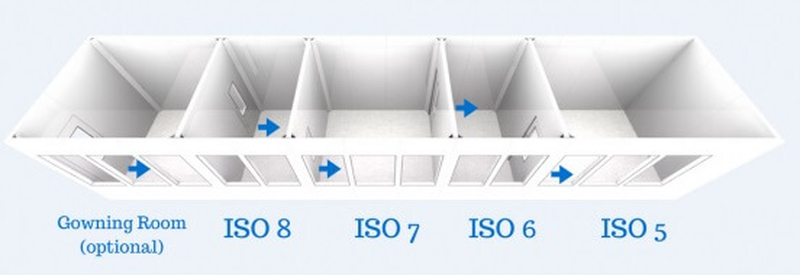
For medical devices, you're usually looking at ISO 5 through ISO 8:
ISO 8 is entry-level. We're talking 3,520,000 particles (at 0.5 microns or larger) per cubic meter. Sounds like a lot, but compare that to a typical office which can have 500,000 to 1,000,000 particles per cubic foot. ISO 8 rooms work fine for packaging, non-sterile assembly, general prep work. A lot of Class I medical devices (the low-risk stuff like tongue depressors, bandages) can be made here.
ISO 7 is where most contract manufacturers operate for medical work. You're down to 352,000 particles per cubic meter. Surgical gowns, wound dressings, diagnostic equipment - this is ISO 7 territory. The room needs an airlock, positive pressure (usually +25 to +30 pascal above surrounding areas), and 60-90 air changes per hour.
ISO 6 gets more serious. 35,200 particles per cubic meter. Catheters, certain surgical instruments. You start needing unidirectional airflow at this level.
ISO 5 is what we use for implantables - pacemakers, artificial joints, stents. These devices go inside the body and stay there. Only 3,520 particles per cubic meter allowed. Air changes can exceed 240 per hour. The construction costs go up significantly.
(Note: you'll still see the old Federal Standard 209E classifications in some facilities - Class 100, Class 1,000, Class 10,000, Class 100,000. These roughly correspond to ISO 5, 6, 7, and 8. The old standard was officially cancelled in 2001, but the terminology stuck around.)

How does air filtration actually work?
The heart of any cleanroom is the HEPA filter. HEPA stands for High-Efficiency Particulate Air (or Arrestor, depending on who you ask). A true HEPA filter captures 99.97% of particles at 0.3 microns and larger. Some facilities use ULPA filters (Ultra-Low Particulate Air) for even tighter control, but that's more common in semiconductor fabs than medical device shops.
Fans pull room air through these filters and push it back in. The air change rate - how many times per hour the entire room volume passes through filtration - determines how quickly you recover from contamination events. Someone walks through the room, sheds some skin cells, the air system cleans it up. At ISO 7, you need the equivalent of the whole room being filtered 60-90 times per hour. At ISO 5, it's 240+ times per hour.
Positive pressure is the other key piece. The cleanroom sits at higher air pressure than surrounding spaces. When you open a door, air flows OUT, not in. This keeps corridor particles from drifting into your production area.
The people problem
Here's something that surprises a lot of folks: the biggest contamination source in any cleanroom is the people working in it.
A person at rest sheds something like 100,000 particles per minute. Walking around? Over a
million. Skin flakes, hair, fibers from clothing, oils, cosmetics - we're basically walking contamination generators.
This is why gowning matters so much. In an ISO 8 room, you might get away with shoe covers, a hair net, and a lab coat. ISO 7 adds full coveralls and gloves. ISO 5 and 6? Full bunny suits, hoods, booties, double gloving. Some facilities require air showers (they blow loose particles off your suit before you enter).
And yes, no eating, no drinking, no gum. Some places ban certain cosmetics. I know one facility that switched to cleanroom-compatible pens because regular ballpoint pens shed too many particles from the ink and paper contact.
Building a cleanroom
The walls, ceiling, and floor all matter. You want smooth, non-porous surfaces that don't shed particles and can be wiped down easily. FRP (fiberglass reinforced plastic) panels are popular. So is stainless steel and epoxy-coated surfaces. Corners are usually coved - that curved transition instead of a sharp 90-degree angle - because sharp corners collect debris and are hard to clean.
Floors in ISO 5 and 6 rooms need to be seamless. Usually welded vinyl sheet or poured epoxy. ISO 7 and 8 can sometimes use vinyl composite tile (VCT) if it's properly maintained, but you'll need to strip and wax it regularly.
Everything that goes into the room has to be cleanroom-compatible. Cardboard? Forbidden - it sheds fibers constantly. Wood? Same problem. All equipment needs enclosed motors, stainless steel surfaces, non-particle-shedding materials.
Monitoring and validation
You can't just build a cleanroom and assume it works. You have to prove it, continuously.
Particle counters sample the air at set intervals and locations. The data gets logged and compared against your classification limits. If you're ISO 7 and your particle count spikes above 352,000, you've got a problem to investigate.
Temperature, humidity, and differential pressure get monitored too - usually continuously with alarms if things drift out of spec. Surface swabs check for microbial contamination. Personnel monitoring (glove sampling, mainly) verifies that gowning procedures are effective.
HEPA filter integrity testing is done periodically with an aerosol challenge. You generate a known aerosol upstream of the filter and check downstream for leaks. Any penetration means the filter or its seal has failed and needs replacement.
All of this generates documentation. Lots and lots of documentation. When the FDA shows up for an audit, they want to see your monitoring records, your maintenance logs, your gowning SOPs, your corrective action reports when something went wrong.
What does this cost?
Building costs vary widely, but as a rough guide: ISO 8 construction might run $200-400 per square foot. ISO 7 pushes toward $400-600. ISO 5 can easily exceed $800-1,000 per square foot or more depending on the complexity.
Operating costs add up too. Energy for all that air handling isn't cheap. Filter replacements, gowning supplies, monitoring equipment calibration, personnel training - it all factors in.
A lot of manufacturers build one step cleaner than they currently need. If you're making ISO 8 products today but might move into ISO 7 territory next year, it's cheaper to build the ISO 7 room now than to retrofit later.
Modular cleanroom systems (prefab panels, ceiling grids, fan filter units) offer flexibility if your needs might change. Softwall cleanrooms (basically vinyl curtains on aluminum frames) can work for ISO 8 applications or temporary setups, though they're not suitable for anything cleaner.
Practical takeaways
Match your cleanroom class to your device risk. Implants need ISO 5 or 6. Devices touching mucous membranes or broken skin usually need ISO 7. Non-critical stuff can work in ISO 8. The FDA wants to see that your choice makes sense based on risk analysis - not just that you picked a number.
Don't skimp on documentation. This is one of those areas where the paperwork really matters. Failed particle counts, missed filter changes, gowning violations - if you don't have records showing what happened and what you did about it, auditors will assume the worst.
Train your people and retrain them regularly. I've seen perfectly good cleanrooms compromised because someone didn't understand why they couldn't scratch their nose with their glove on. The human factor is always the weak link.
And if you're building new, plan for more capacity than you think you need. Retrofitting cleanrooms is expensive and disruptive. Better to have room to grow.