





What are Draft Angles?
Draft angles are tapered surfaces applied to vertical walls of molded parts that facilitate smooth ejection from the mold. Measured in degrees from vertical, these angles prevent parts from sticking during removal and reduce friction that could damage both the component and the mold itself.
Draft Angle Definition in Mold Manufacturing
In mold manufacturing, a draft angle is the intentional taper added to a wall, rib, boss, cavity, core or other vertical feature so the molded part can move in the pull direction without locking against the tool. The angle is usually measured from the straight vertical surface, not from the horizontal plane. This is why a small value, such as 1 degree per side, can still create enough clearance for many plastic parts while keeping the visible shape close to the original CAD model.
For product designers, the practical meaning is simple: any surface that is parallel to the mold opening direction should be checked before tooling starts. A surface that looks perfectly straight in CAD may become a release problem after shrinkage, texture, ribs, undercuts or tight tolerance zones are added.
Why Draft Angles Are Essential for Manufacturing
When molten material cools inside a mold, it contracts and grips the mold surfaces. This physical reality creates enormous friction during ejection. Without adequate taper, parts either stick completely or scrape along mold walls as they're forced out.
The consequences extend beyond scratched surfaces. Parts without proper draft can warp under ejection stress, develop structural weakness, or fail to eject entirely. Manufacturing teams then face a choice between manual extraction-which damages expensive tooling-or scrapping the part completely.
Industry data shows that inadequate draft angles can increase production costs by 15-30% through extended cycle times, higher scrap rates, and accelerated mold wear. Tooling that should last 500,000 cycles might fail at 200,000 when draft angles are insufficient. To see how these cost mechanics play out on real production runs, our breakdown of why draft angle injection molding reduces ejection force and scrap rates walks through several documented case studies.
How Draft Angles Work Mechanically
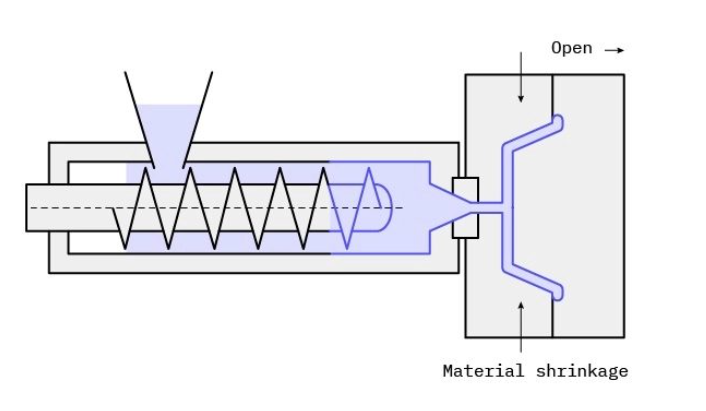
The engineering principle is straightforward: as molded parts cool, they shrink by 0.5-7% depending on material properties. This shrinkage creates clamping forces that pull parts tight against mold cores while simultaneously pulling away from cavity walls.
A drafted surface transforms this challenge into an advantage. The slight taper means that as soon as ejector pins push the part even fractionally outward, the entire component breaks contact with the mold surface. The geometry ensures that continued movement maintains clearance rather than creating drag.
Think of removing a tapered cork from a bottle versus trying to extract a straight cylinder. The taper creates a release point where friction drops to near zero. Draft angles apply this same mechanical advantage to every vertical surface that contacts the mold.
Standard Draft Angle Specifications
The baseline recommendation is 1-2 degrees of draft per side for parts with mold depths up to 2 inches. This range handles most thermoplastic materials under standard processing conditions.
Draft Angle Chart for Injection Molding
The following draft angle chart can be used as an early design reference before final mold review. It should not replace DFM feedback from the mold maker, but it helps designers avoid the most common mistake: applying the same taper to every feature regardless of depth, texture or material behavior.
| Design condition | Practical starting point | Notes for mold review |
|---|---|---|
| General vertical walls | 1°-2° per side | Suitable for many standard thermoplastic parts up to about 2 inches deep. |
| Minimum draft for straight-looking walls | 0.25°-0.5° per side | Only for selected surfaces where the function or appearance cannot accept larger taper. |
| Deep ribs, bosses or pockets | Add more taper as depth increases | Internal features often need more attention because parts shrink onto the core. |
| Light texture | Around 3° | Texture creates micro-resistance during ejection and can cause drag marks. |
| Heavy texture or leather-like grain | 5° or more | Deep texture usually needs a larger release angle to protect the surface finish. |
| Mold shutoff or metal sliding contact | 3° minimum | Used where steel-to-steel contact must close cleanly without galling. |
This mold draft angle chart is most useful during early plastic part design. Once the material, surface finish, parting line and ejection system are confirmed, the final values should be adjusted around the real tool structure instead of copied as fixed rules.
However, several factors force deviations from this baseline:
Material shrinkage rates: Crystalline materials like polyethylene and nylon shrink more during cooling and require larger draft angles than amorphous materials like polycarbonate. The difference can be substantial-polyethylene might need 2-3 degrees where polycarbonate manages with 1 degree.
Part depth: Deeper cavities create more surface area for friction. For parts exceeding 2 inches in depth, add approximately 1 degree of draft for each additional inch to compensate for the increased contact area.
Surface texture: Textured surfaces create micro-undercuts that multiply friction. Light textures require minimum 3 degrees of draft, while heavy textures demand 5 degrees or more. The rule of thumb adds 1 degree per 0.001 inches of texture depth.
Metal-on-metal contact: Where mold components slide against each other during separation, minimum 3 degrees of draft is essential to prevent galling and ensure smooth mold operation.
Material-Specific Requirements
Different plastics behave radically differently during cooling, which directly impacts draft requirements.
ABS and commodity plastics: These workhorse materials handle standard 1-2 degree draft well. Their moderate shrinkage and good flow properties make them forgiving of minor draft variations.
Glass-filled materials: Adding glass fibers increases strength but creates abrasive surfaces that wear molds faster. Glass-filled plastics require larger draft angles than soft, ductile, or self-lubricating resins-typically 1.5-2.5 degrees minimum.
Nylon: This material represents an interesting exception. Nylon's flexibility and self-lubricating properties mean draft angles can sometimes be reduced or even eliminated, though 1-2 degrees remains recommended for optimal tool life.
High-temperature engineering resins: Materials like PEEK and PPS shrink significantly and require careful draft calculation. Their stiffness when cooled means they won't flex during ejection, making adequate draft absolutely critical.
Draft Angles in Injection Molding, Casting and Forging
Although the word draft is used across several manufacturing processes, the design reason is not always identical. In injection molding, the main concern is plastic shrinkage around the core and friction during ejection. In die casting, the same concept helps the metal part release from the die without dragging, denting or locking. In sand casting, the taper also helps the pattern leave the sand mold without breaking the mold surface.
A draft angle in casting or forging is often discussed with the parting line, material flow, pattern removal, flash control and later machining allowance. For plastic parts, the conversation is usually more focused on core/cavity direction, texture, shrinkage, ejector layout and cosmetic defects. This distinction matters because a draft angle for injection molding should not be copied directly from a die casting or forging rule without checking the material, tool construction and release direction.
For searches such as zero draft angles stamping, the intent is usually different from plastic molding. Sheet metal stamping does not normally trap a cooling plastic part around a core in the same way, but vertical walls, formed flanges and drawn features still need to be reviewed for release, springback, die clearance and possible secondary operations. If the buyer is comparing processes, the safest approach is to confirm whether the feature is molded, cast, forged or stamped before applying any draft recommendation.
Metal Injection Molding Considerations
Metal Injection Molding introduces unique complications to draft angle design. Unlike polymers, metal powders mixed with binders shrink dramatically during sintering-often 15-20% by volume.
This extreme shrinkage actually works in favor of draft requirements. Parts pull away from mold surfaces more readily than plastic equivalents. However, the binder system's behavior during initial ejection still requires proper draft design.
MIM parts typically use 0.5-2 degrees of draft depending on complexity. The sintering shrinkage means final dimensions differ substantially from the molded "green" part, which must be factored into tolerance calculations. Designers must account for both the molding draft and the post-sinter dimensional changes.
Surface finish considerations differ too. MIM parts often undergo secondary operations like machining or polishing, which can remove evidence of draft angles on critical surfaces while maintaining them where needed for initial ejection. If you are evaluating this route for a specific component, our metal injection molding (MIM) parts and tooling capability shows the stainless grades and part types we run in production.
Common Design Mistakes
The most frequent error occurs when designers ignore draft entirely during prototyping. Parts designed for 3D printing or CNC machining-where draft serves no purpose-transition poorly to injection molding. Retrofitting draft into finalized designs often requires complete redesigns that delay production and inflate costs.
Another persistent mistake involves applying uniform draft across all features. Complex parts need variable draft angles optimized for each feature's geometry, depth, and function. Ribs, bosses, and gussets each have specific requirements that differ from main wall surfaces.
Undersized boss design combined with inadequate draft creates a perfect storm for ejection problems. The boss either cracks during ejection or causes sink marks on opposing surfaces. Both outcomes require expensive rework.
Designers sometimes apply excessive draft to simplify manufacturing without considering functional implications. A connector housing with 5 degrees of draft might eject beautifully but fail to maintain dimensional tolerances for proper mating. The optimal draft balances manufacturability against performance requirements.
Calculating Draft for Complex Geometries
Simple cylindrical or box-like parts follow standard draft guidelines straightforwardly. Real-world components with multiple features, varying depths, and functional requirements need systematic analysis.
Draft Angle Formula and Simple Calculation
A basic draft angle calculation starts with the height of the drafted wall and the dimensional change between the top and bottom of that wall. For one drafted side, the formula is: draft angle = arctan(dimensional offset ÷ wall height). For a symmetrical plastic box with taper on both sides, use half of the total width difference: draft angle = arctan((top width - bottom width) ÷ 2 ÷ wall height).
For example, if a plastic housing is 50 mm deep and the top opening is 1.8 mm wider than the bottom because both side walls are drafted, each side has a 0.9 mm offset. The calculated taper is arctan(0.9 ÷ 50), or about 1.03 degrees per side. This type of draft angle formula helps designers understand how a small angular change can become a measurable dimensional difference on tall walls.
When calculating draft for plastic parts, the number should be checked against assembly requirements. A connector shell, battery cover or cosmetic enclosure may eject well with more taper, but the same change can shift mating surfaces, clips, screw bosses or sealing edges if the datum strategy is not controlled.
Start by identifying the parting line-the plane where mold halves separate. Every surface must draft away from this line in the direction of mold opening. For parts with centerline parting, both top and bottom sections need independent draft consideration.
Internal features: Cores that form holes or recesses shrink onto the mold during cooling. Internal surfaces typically require 0.5-1 degree more draft than external surfaces to overcome this clamping effect.
Undercuts: True undercuts cannot be drafted away and require side actions or complex tooling. Before adding expensive mold features, verify whether slightly increased draft could eliminate the undercut entirely. When the undercut truly cannot be removed, a special mold with sliders, lifters or a collapsible core is usually the next step to plan for.
Snap fits and living hinges: These functional features often fight against draft requirements. Snap fits need precise dimensions that draft angles alter. The solution involves applying minimal draft (0.25-0.5 degrees) and working closely with mold makers to optimize ejection systems.
Draft Direction and Mold Opening
Draft angle effectiveness depends critically on orientation relative to mold opening direction. A part might have beautiful 2-degree draft that provides zero benefit if it's applied perpendicular to the pull direction.
Imagine a cylindrical part molded vertically. Draft applied to the circumference helps ejection. Draft applied to the top and bottom surfaces does nothing for ejection but might be necessary for aesthetic or functional reasons. Understanding this distinction prevents wasting draft angle budgets on surfaces that don't need it.
For parts with complex geometries, mold flow analysis software can simulate ejection and identify problem areas before steel is cut. These simulations reveal where draft angles are adequate and where adjustments are needed.
Plus Draft vs Minus Draft
Plus draft and minus draft describe the direction in which material is added or removed when a tapered surface is created from a reference edge or face. In practical mold design, positive draft usually opens the part in the pull direction so the feature becomes easier to release. Negative draft moves against the release direction and can create a locking condition, which may require a side action, lifter, split cavity or design change.
The same nominal angle can produce very different results depending on the draft hinge. If the hinge is placed at a critical outside edge, the visible outer dimension can be preserved while material is removed from the inner side. If the hinge is placed at the base of a rib or boss, the root thickness may increase and create sink risk. For this reason, a draft note on a drawing should specify not only the degree value, but also the pull direction, reference surface and critical dimensions that must be protected.

Balancing Draft with Dimensional Tolerances
Draft angles necessarily alter part dimensions. A 100mm tall wall with 1 degree draft differs by 1.75mm between top and bottom. For many applications this variation is irrelevant. For precision assemblies, it creates serious problems.
The solution involves strategic draft placement. Apply full draft to non-critical surfaces while minimizing draft on surfaces with tight tolerance requirements. Manufacturing can sometimes achieve 0.25 degree draft on specific surfaces when necessary, though at increased cost and risk.
Another approach uses localized features to maintain critical dimensions. A molded connector housing might have 2 degrees of draft on external walls but include molded-in datum surfaces with minimal draft for precise alignment during assembly.
Texture and Surface Finish Impact
Surface texture fundamentally changes draft requirements. A polished mirror finish slides easily from the mold with 0.5-1 degree draft. That same part with leather texture needs 3-5 degrees to prevent the texture pattern from acting as mechanical locks.
The standard calculation adds 1 degree of draft for every 0.001 inches (0.025mm) of texture depth. This accounts for the micro-undercuts created by chemical etching or laser texturing processes used to create surface patterns.
Texture type matters beyond depth. Geometric patterns with sharp edges require more draft than organic patterns. Directional textures can sometimes reduce draft needs if oriented to slide out along the pull direction.
Prototyping and Validation
Before committing to production tooling, validate draft angles through prototype tooling. Aluminum molds or 3D-printed tools allow testing actual ejection behavior under realistic conditions.
Watch for subtle problems during test runs. Parts might eject successfully but show stress whitening, microscopic scratches, or dimensional distortion. These symptoms indicate inadequate draft even when gross ejection failure doesn't occur.
Progressive testing using adjustable draft inserts in soft tooling can identify the minimum viable draft before hardening steel production molds. This iterative approach prevents expensive corrections to hardened tooling.
Draft Angle Analysis Before Tooling
Draft angle analysis should be completed before final mold design, especially for parts that include ribs, bosses, snap fits, deep pockets, textured surfaces or appearance-critical walls. CAD tools can color-code surfaces by pull direction and show which areas are below the target taper. This makes it easier to separate simple correction areas from true undercuts that need lifters, sliders or a different parting line.
A practical mold draft angle review should answer four questions: which direction will the part release, which surfaces are below the minimum angle, which dimensions cannot be changed, and which features can be modified without affecting assembly. When these points are checked early, the design team can often solve the problem by changing a wall, moving a split line or adjusting a rib rather than adding expensive mold actions later.
For OEM projects, it is also useful to mark the critical surfaces on the drawing. A general note such as "apply draft as required" can be misunderstood. Clear callouts for pull direction, cosmetic faces, sealing faces, datum areas and allowed taper give the mold maker enough information to protect both manufacturability and product function.
Advanced Draft Strategies
Skilled mold designers employ sophisticated techniques to minimize draft impact on part function. One approach uses variable draft-applying the minimum necessary angle to critical surfaces while using standard draft elsewhere.
Split cavity designs can reduce draft requirements by moving the parting line to less critical areas. A part that needs 3 degrees of draft with conventional tooling might achieve acceptable results with 1 degree using creative mold construction.
For ultra-precision applications where draft cannot be tolerated, designers sometimes resort to molds with collapsing cores or mechanical undercuts. These solutions dramatically increase tooling cost but allow molding parts that would otherwise be impossible.
Inspection and Quality Control
Measuring draft angles requires careful technique. Common errors include incorrect alignment of reference surfaces, measuring over insufficient surface area, and failing to account for surface finish effects on measurements.
Digital measuring systems like coordinate measuring machines provide precise draft angle verification. Modern CMM software includes specialized routines that define the pull direction and calculate angles relative to this vector, particularly useful for complex parts with multiple draft angles.
Production parts should undergo periodic draft verification to catch gradual changes from mold wear or maintenance. Drift in draft angles often precedes more serious tooling problems.
Cost-Benefit Analysis
Adequate draft angles reduce manufacturing costs through multiple mechanisms. Faster cycle times accumulate substantial savings over production runs. A part that ejects in 2 seconds instead of 4 seconds produces 50% more parts per machine hour.
Mold longevity improves dramatically with proper draft. A tool designed for 1 million cycles might achieve only 300,000 without adequate draft, requiring premature replacement or expensive refurbishment.
Scrap reduction provides immediate bottom-line impact. Even 2% defect rates from ejection damage consume profit margins on high-volume production. Draft angles that eliminate these defects pay for themselves within thousands of cycles.
Quick Answers About Draft Angles
What is a draft angle?
A draft angle is a small taper added to a molded, cast or formed part so the part can release from the tool in the opening direction. In plastic injection molding, it reduces friction, surface scratches, ejection stress and mold wear.
What is the standard draft angle for injection molding?
For many injection molded plastic parts, 1°-2° per side is a practical starting range. The final value depends on wall depth, resin shrinkage, texture, core/cavity direction, tolerance needs and the ejection system.
How do you calculate draft angle?
For one side of a wall, calculate draft angle by using arctan(offset ÷ wall height). For a symmetrical box, divide the total width difference by two first, then divide by the wall height.
Do textured plastic parts need more draft?
Yes. Textured surfaces usually need more taper because the texture creates microscopic resistance during release. Light texture may need around 3°, while heavy texture or leather-like grain may need 5° or more depending on depth and pattern direction.
Is any draft better than no draft?
In most molded plastic parts, yes. Even 0.25°-0.5° can reduce scraping and ejection force compared with a perfectly vertical wall, although it may not be enough for deep, rigid or textured features.
Frequently Asked Questions
Can I mold parts with zero draft angle?
Zero draft is technically possible with very soft, flexible materials like silicone or certain grades of nylon. However, even these materials benefit from minimal draft to extend tool life. For rigid engineering plastics, zero draft virtually guarantees ejection problems. The minimum recommended draft for any injection-molded part is 0.25-0.5 degrees. For an example of how this is handled in practice, see our zero draft part with zero draft on the core insert, which relies on specialized ejection and tool construction.
What is the difference between zero draft and negative draft?
Zero draft means the wall is straight relative to the mold opening direction. Negative draft means the wall leans against the release direction and mechanically locks the part in the tool. A zero-draft surface may still be possible in limited areas with flexible materials, special ejection, polishing or secondary machining, but a negative-draft feature usually needs a slider, lifter, collapsible core or redesign.
Can a molded part use different drafting angles on different features?
Yes. A well-designed molded part often uses different drafting angles on external walls, internal ribs, bosses, shutoffs and textured faces. The goal is not to make every surface identical; the goal is to give each feature enough release clearance while preserving the surfaces that control fit, sealing, appearance or assembly.
How do draft angles affect part strength?
Draft angles themselves don't typically impact structural performance. The slight dimensional variation from tapering rarely affects load-bearing capacity. However, parts damaged during ejection due to inadequate draft can develop internal stress concentrations that compromise strength. Proper draft actually improves part quality by preventing ejection damage.
What if my design can't accommodate standard draft angles?
Work with experienced mold designers to explore alternatives. Options include specialized ejection systems, molds with side actions, or split cavity designs. In extreme cases, secondary operations like machining can remove draft from critical surfaces after molding. Each solution adds cost and complexity but may be necessary for certain applications.
Do all surfaces need the same draft angle?
Different features can and should have different draft angles optimized for their specific requirements. Ribs might use 2 degrees, external walls 1.5 degrees, and bosses 1 degree. The key is ensuring every surface has adequate draft relative to its depth, texture, and position in the mold.

Implementation Considerations
Successful draft angle implementation begins during initial design phases. CAD software can apply draft automatically, but manual verification ensures draft direction aligns with intended mold opening. Design review should explicitly check draft adequacy before finalizing geometry.
Communication between design engineers and mold makers is essential. Designers understand functional requirements; mold makers understand manufacturing constraints. Early collaboration identifies optimal compromise between these sometimes-competing demands. If you are ready to move from design review to a real tool, our plastic injection mold manufacturing and tooling service covers core/cavity design, ejection layout and material selection for parts like the ones discussed here.
Documentation should specify not just draft angles but also draft direction and reference surfaces. Ambiguous specifications lead to costly misunderstandings during tooling fabrication. Clear drawings with annotated draft callouts prevent these problems.
The investment in proper draft angle design pays dividends throughout a product's manufacturing life. Parts that eject cleanly, molds that last their expected lifetime, and production lines that run without interruption-these outcomes stem from careful attention to this fundamental manufacturing requirement.
Draft angles represent one of those engineering details that seem minor until ignored. Then they become expensive lessons in the importance of design for manufacturability. Understanding and applying proper draft angles from the start separates successful projects from problematic ones.
References:
Protolabs - Draft Angle Guidelines for Injection Molding (protolabs.com)
FirstMold - What is the Draft Angle in Mold Design? (firstmold.com)
RevPart - Injection Molding Draft Angle Guide (revpart.com)
ScienceDirect - Draft Angle Engineering Topics (sciencedirect.com)
Fictiv - Draft Angle Injection Molding (fictiv.com)
RapidDirect - Draft Angle for Injection Molding Design Guide (rapiddirect.com)