





A plastic injection mold represents the cornerstone of modern manufacturing, enabling the mass production of countless plastic components we encounter daily. From automotive parts to consumer electronics, the precision and efficiency of injection molding have revolutionized how we create plastic products.

Understanding Plastic Injection Mold Fundamentals
What is a Plastic Injection Mold?
A plastic injection mold is a precision-engineered tool used in the injection molding process to shape molten plastic material into specific forms. The mold consists of two primary halves: the cavity (female) and core (male) sections, which together create the desired shape of the final product. When these halves close, they form a hollow space that defines the geometry of the injection molded parts.
The injection molding machine forces heated, molten plastic into this cavity under high pressure, where it cools and solidifies into the desired shape. This process enables manufacturers to produce identical parts with exceptional precision and consistency, making it ideal for high-volume production runs.
Key Components of Injection Molds
Modern plastic injection molds incorporate several critical components that ensure optimal performance:
Cavity and Core Systems: These form the primary shape of the part, with the cavity creating external features and the core forming internal geometries. The precision of these components directly impacts part quality and dimensional accuracy.
Runner Systems 🔄: These channels guide molten plastic from the injection point to the mold cavities. Efficient runner design minimizes material waste and ensures uniform filling of complex geometries.
Cooling Channels: Strategically placed cooling lines regulate temperature throughout the molding cycle, reducing cycle times and preventing defects such as warpage or sink marks.
Ejection Systems: These mechanisms safely remove finished parts from the mold without damage, incorporating ejector pins, sleeves, and sometimes pneumatic or hydraulic systems.

Types and Classifications of Plastic Injection Molds
Single-Cavity vs. Multi-Cavity Molds
| Mold Type | Advantages | Best Applications | Production Volume |
|---|---|---|---|
| Single-Cavity | Lower initial cost, easier maintenance, better quality control | Prototypes, large parts, low-volume production | 1,000-10,000 parts |
| Multi-Cavity | Higher productivity, lower per-part cost, efficient material usage | Small parts, high-volume production, consumer goods | 50,000+ parts |
| Family Molds | Cost-effective for related parts, shared tooling costs | Related component sets, automotive assemblies | 10,000-100,000 parts |
Hot Runner vs. Cold Runner Systems
Hot Runner Systems maintain molten plastic at optimal temperature throughout the delivery process, eliminating waste and reducing cycle times. These systems excel in high-volume production where material efficiency and rapid cycling are paramount.
Cold Runner Systems offer simpler maintenance and lower initial costs, making them suitable for applications where material waste is acceptable or where frequent color changes are required.
Materials and Design Considerations
Selecting Appropriate Plastic Materials 🧪
The choice of plastic material significantly impacts mold design and performance. Common materials include:
Thermoplastics: ABS, polypropylene, polyethylene, and polystyrene offer excellent moldability and recycling capabilities. These materials flow well at moderate temperatures and provide good surface finish.
Engineering Plastics: Nylon, polycarbonate, and POM require higher processing temperatures and more robust mold designs but offer superior mechanical properties.
Specialty Materials: Glass-filled plastics, flame-retardant compounds, and bio-based materials present unique challenges requiring specialized mold features and processing parameters.

Design Principles for Optimal Mold Performance
Effective plastic injection mold design incorporates several fundamental principles:
Wall Thickness Uniformity: Consistent wall sections prevent differential cooling, which can cause warpage and internal stresses. Typical wall thickness ranges from 1-4mm depending on material and application.
Draft Angles 📐: Slight tapers (typically 0.5-2 degrees) facilitate part ejection and extend mold life. Textured surfaces require increased draft angles to prevent sticking.
Fillet Radii: Rounded transitions reduce stress concentrations and improve material flow, particularly important in high-stress applications.
Manufacturing Process and Quality Control
The Injection Molding Cycle
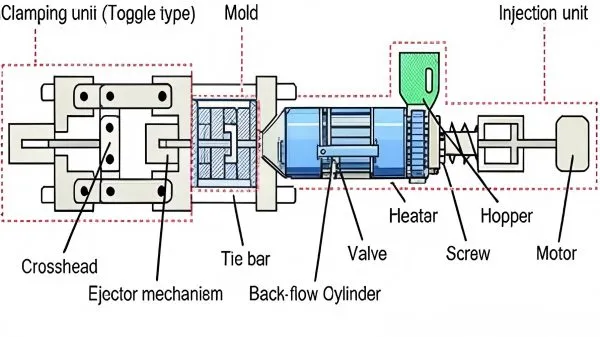
The injection molding process follows a precise sequence:
- Clamping: The injection molding machine closes the mold halves under tremendous force (typically 50-2000 tons)
- Injection: Molten plastic is injected into the cavity at high pressure and velocity
- Dwelling: Additional pressure maintains part integrity as the plastic begins cooling
- Cooling: The part solidifies within the mold, with cooling time representing 70-80% of total cycle time
- Ejection: The mold opens and the finished part is removed
Quality Assurance in Plastic Injection Molding
| Quality Parameter | Measurement Method | Typical Tolerance | Impact on Performance |
|---|---|---|---|
| Dimensional Accuracy | CMM, Calipers | ±0.05-0.2mm | Fit and function |
| Surface Finish | Profilometer | Ra 0.1-3.2μm | Appearance, sealing |
| Material Properties | Tensile testing, Impact testing | ±5-10% of specification | Mechanical performance |
| Visual Defects | Visual inspection, Automated systems | Zero defects for Class A surfaces | Customer satisfaction |
Advanced Mold Technologies
Modern custom injection molding incorporates cutting-edge technologies:
Multi-Shot Molding: Enables production of parts with multiple materials or colors in a single operation, reducing assembly costs and improving part integration.
Insert Molding: Combines metal inserts with plastic components during the molding process, creating robust hybrid parts with enhanced functionality.
Gas-Assisted Injection Molding: Uses pressurized gas to create hollow sections, reducing material usage and eliminating sink marks in thick sections.

Applications and Industry Solutions
Automotive Industry Applications 🚗
The automotive sector relies heavily on plastic injection molding services for components ranging from interior trim to under-hood applications. Critical applications include dashboard assemblies, door panels, bumper systems, and electronic housings. These parts must withstand extreme temperatures, UV exposure, and mechanical stress while maintaining precise tolerances.
Consumer Electronics and Medical Devices
Injection molded parts in electronics require exceptional dimensional stability and surface quality. Medical applications demand biocompatible materials and cleanroom manufacturing conditions, with validation requirements that can extend development timelines but ensure patient safety.
Packaging and Consumer Products
The packaging industry utilizes plastic injection molds for containers, closures, and specialized packaging solutions. These applications prioritize cost efficiency, rapid production cycles, and consistent quality across millions of parts.

Cost Analysis and Economic Factors
Mold Development Investment
| Mold Complexity | Initial Investment | Lead Time | Expected Life |
|---|---|---|---|
| Simple (1-2 cavities) | $5,000-$15,000 | 4-6 weeks | 100,000-500,000 parts |
| Moderate (4-8 cavities) | $15,000-$50,000 | 6-10 weeks | 500,000-1,000,000 parts |
| Complex (16+ cavities) | $50,000-$200,000+ | 10-16 weeks | 1,000,000+ parts |
Return on Investment Considerations
Custom injection molding projects require careful financial analysis considering tooling costs, part volumes, material expenses, and production timelines. Break-even analysis typically shows advantages for volumes exceeding 10,000 parts, with significant cost benefits emerging above 100,000 units.
Maintenance and Troubleshooting
Preventive Maintenance Strategies 🔧
Regular maintenance extends plastic mold life and maintains product quality. Key maintenance activities include cleaning, lubrication, inspection of wear components, and preventive replacement of high-wear items such as ejector pins and gate inserts.
Common Defects and Solutions
Flash: Excess material along parting lines typically results from worn mold surfaces or excessive injection pressure. Solutions include mold refurbishment and process optimization.
Short Shots: Incomplete filling occurs due to insufficient injection pressure, inadequate venting, or premature material solidification. Resolution involves process adjustments and potential mold modifications.
Warpage: Dimensional distortion results from uneven cooling or internal stresses. Solutions include gate relocation, cooling system optimization, and material selection changes.
Future Trends and Innovations
Industry 4.0 Integration 🤖
Smart manufacturing technologies are transforming plastic injection molding services. Real-time monitoring systems track process parameters, predict maintenance needs, and optimize production efficiency. Machine learning algorithms analyze historical data to prevent defects and reduce scrap rates.
Sustainable Manufacturing Practices
Environmental considerations drive innovations in recyclable materials, energy-efficient processing, and circular economy principles. Bio-based plastics and chemical recycling technologies are expanding material options while reducing environmental impact.
Plastic injection molds remain fundamental to modern manufacturing, enabling efficient production of countless products across diverse industries. Success in this field requires understanding complex interactions between materials, design, processing, and quality control. As technology advances, manufacturers who embrace innovation while maintaining focus on fundamental principles will continue to thrive in this dynamic industry.
The evolution of injection mold technology continues accelerating, driven by demands for greater efficiency, sustainability, and customization. By staying informed about emerging trends and maintaining commitment to quality excellence, manufacturers can leverage these powerful tools to create value for customers and society.

Glossary
Cavity: The hollow space within a mold that defines the external shape of the molded part.
Core: The raised portion of a mold that creates internal features and hollow sections in the molded part.
Draft Angle: A slight taper applied to vertical surfaces to facilitate part removal from the mold.
Flash: Excess plastic material that escapes from the mold cavity, typically along parting lines.
Gate: The opening through which molten plastic enters the mold cavity.
Parting Line: The boundary where two mold halves meet, often visible as a slight line on the finished part.
Runner: Channels that direct molten plastic from the sprue to the mold cavities.
Sprue: The main channel through which plastic enters the mold from the injection machine.
Undercut: A feature that prevents straight ejection from the mold, requiring special mechanisms for part removal.
Venting: Small channels that allow air to escape from the mold cavity during injection.
Common Industry Problems and Solutions
Problem: High Scrap Rates in Production
Solution: Implement statistical process control monitoring key parameters such as injection pressure, temperature, and cycle time. Establish control limits based on capability studies and investigate any out-of-control conditions immediately. Regular maintenance scheduling and operator training reduce variation and improve consistency. Expected improvement: 30-50% reduction in scrap rates within 6 months.
Problem: Extended Cycle Times Reducing Productivity
Solution: Optimize cooling system design through conformal cooling channels and improved heat transfer. Analyze material flow using mold flow simulation software to identify bottlenecks. Implement hot runner systems where appropriate to eliminate runner cooling time. Balance cavity filling to ensure simultaneous completion. Expected improvement: 15-25% cycle time reduction.
Problem: Inconsistent Part Dimensions Across Production Runs
Solution: Establish rigorous process validation protocols including Design of Experiments (DOE) to identify critical process variables. Implement real-time monitoring systems for injection pressure, melt temperature, and mold temperature. Create standardized operating procedures with specific parameter ranges and change control procedures. Expected improvement: 60-80% reduction in dimensional variation.
Problem: Premature Mold Wear and Frequent Maintenance
Solution: Upgrade to premium tool steels with appropriate surface treatments such as nitriding or PVD coatings. Implement predictive maintenance programs using vibration analysis and thermal imaging. Establish proper material handling procedures to prevent contamination. Design adequate venting to prevent gas burn marks. Expected improvement: 2-3x increase in mold life expectancy.
Authoritative References and Further Reading
Plastics Technology Magazine - "Injection Molding Process Optimization Guidelines" https://www.ptonline.com/articles/injection-molding-process-optimization
Society of Plastics Engineers (SPE) - "Injection Molding Handbook, 3rd Edition" https://www.4spe.org/i4a/pages/index.cfm?pageid=3285
International Journal of Advanced Manufacturing Technology - "Recent Advances in Injection Molding Process Control" https://link.springer.com/journal/170/volumes-and-issues
Moldmaking Technology - "Best Practices for Mold Design and Manufacturing" https://www.moldmakingtechnology.com/articles/category/mold-design