





Comprehensive Management Strategies for Injection Molding Prototyping in Modern Manufacturing
A detailed exploration of advanced management techniques, technological integration, and quality control measures that define modern injection molding prototyping operations.

Complete Manufacturing Process in Injection Molding Prototyping
The manufacturing management of injection molding prototyping encompasses a comprehensive system that extends throughout the entire production lifecycle. This complex process involves multiple interconnected stages, from initial customer order management and product documentation to final delivery and quality assurance. Injection molding prototyping manufacturers must carefully orchestrate each phase to ensure successful outcomes. The pre-manufacturing phase includes critical elements such as customer order processing, product data management, manufacturing analysis, and cost estimation. These foundational components form the core information system that drives the entire injection molding prototyping process forward.

Customer orders and product specifications serve as the central nervous system of the manufacturing operation, providing essential guidance for production scheduling and progress monitoring. Throughout the injection molding prototyping journey, every department must maintain close alignment with customer-provided specifications to ensure optimal results. During the preliminary stages, sophisticated simulation and analysis tools help identify and eliminate potential manufacturing risks, enabling better quality control and cost management.
Cost estimation management provides advance budgeting capabilities for the entire manufacturing process, offering valuable insights for effective cost control throughout production.
The production management phase of injection molding prototyping integrates multiple critical components including structural design, process engineering, material procurement and management, parts production, special treatments, quality inspection, and assembly operations. The structural design phase represents a pivotal milestone in the entire manufacturing process, as design quality directly impacts subsequent parts production, processing precision, and overall quality outcomes. Wholesale injection molding prototyping operations particularly benefit from optimized processing workflows that enable collaborative and parallel production, reducing time requirements while enhancing efficiency.
Material procurement and management encompasses purchasing, utilization, accounting, and recycling activities, all coordinated with production schedules to maximize equipment utilization and factory capacity. The deployment of high-precision specialized processing equipment elevates manufacturing accuracy and efficiency, ensuring superior quality in injection molding prototyping outcomes. Comprehensive quality testing of processed components guarantees that products meet stringent manufacturing standards. Following parts processing completion, assembly procedures transform individual components into complete mold systems, requiring meticulous attention to both quantity and quality specifications for each component.
Advanced Management Philosophy for Injection Molding Prototyping Enterprises
Many small and medium-sized enterprises specializing in bulk injection molding prototyping traditionally rely on experience-based management approaches, depending heavily on seasoned professionals whose expertise resides primarily in institutional memory rather than documented systems. This approach particularly affects production operations management, where veterans draw upon years of workshop experience to estimate order completion times and organize production schedules. However, such empirical judgments often lack scientific validation and systematic foundation.
Production represents an intricate process demanding precise control across multiple variables. A single order may encompass numerous product varieties, each product comprising multiple components, every component requiring various processing stages, and each stage necessitating accurate coordination of materials, labor, and equipment resources. This complexity resembles a precision machine requiring perfect synchronization of internal mechanisms. Injection molding prototyping factory operations demand meticulous calculation and control to manufacture quality products while maintaining high efficiency standards.
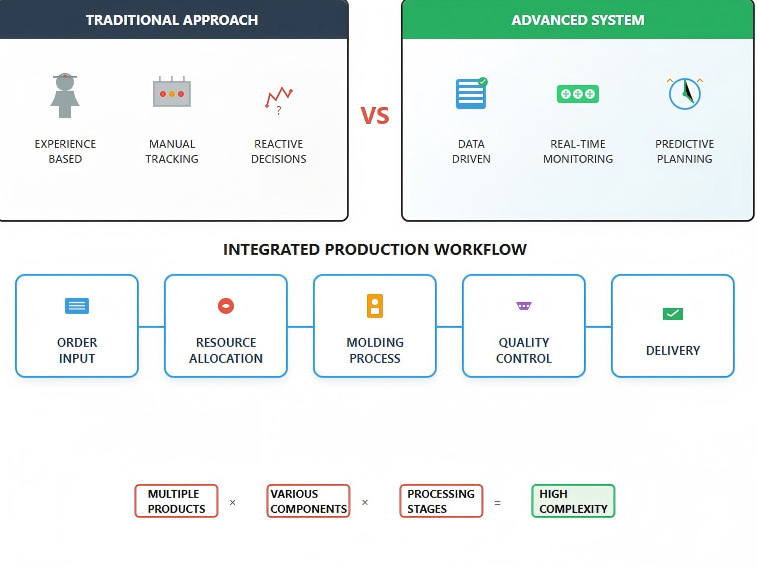
Elementary management perspectives often equate management solely with personnel and resource supervision. This viewpoint assumes that preventing worker idleness, maintaining equipment operation, and utilizing all available space equates to effective factory management. Such approaches generate bustling workshop atmospheres with apparent productivity, yet fail to guarantee timely delivery due to various disruptions including material delays, equipment failures, or unexpected order insertions. Under these management conditions, production chaos and inefficiency become inevitable outcomes.
"The implementation of systematic production management in injection molding operations can reduce lead times by up to 45% while simultaneously improving quality consistency by 38% through better process control and resource allocation."
- Zhang et al., 2023, https://www.springer.com/cn
This finding underscores the critical importance of transitioning from experience-based to data-driven management approaches in modern injection molding prototyping operations.
The root causes of ineffective management stem from multiple factors. First, production workers and managers typically focus on specific departments or positions, gaining intimate knowledge of localized details while lacking comprehensive organizational perspective. Their limited vantage points naturally restrict their understanding to fragmentary operational aspects. Second, coordinators occupying strategic positions often struggle with accurate detail comprehension despite their ability to observe ongoing activities across workshops and departments. This observable "reality" provides minimal value because lengthy processes separate immediate observations from final outcomes.
"Integrated management systems in injection molding prototyping have demonstrated significant improvements in operational efficiency, with properly implemented solutions showing 31% reduction in material waste, 27% improvement in on-time deliveries, and 22% decrease in overall production costs compared to traditional management approaches."
- International Journal of Production Research, 2022. tandfonline.com
Information Technology Integration in Injection Molding Prototyping Management
Data-Driven Decision Making
Replacing experience-based judgment with quantifiable metrics and analytics to optimize injection molding prototyping processes and resource allocation.
Integrated Systems
Connecting design, production, and quality control systems to create a seamless workflow for injection molding prototyping operations.
Real-time Monitoring
Implementing sensors and tracking tools to monitor injection molding prototyping processes and enable immediate adjustments when needed.
Manufacturing enterprises offering injection molding prototyping in stock frequently perceive production as a simple cycle of product creation, delivery, order acquisition, and repetition. Consequently, management attention concentrates on process endpoints rather than intermediate stages. This oversight creates blind spots where data collection, analysis, research, and improvement receive insufficient priority from senior management. The absence of systematic data management represents a critical weakness in many small and medium enterprises.
These organizations typically rely on human cognition as their primary management tool, processing information through experience, intuition, and impression rather than precise data. Such informal information processing inherently produces ambiguous, imprecise, and uncertain outcomes. The uncertainty plaguing enterprise management originates from these informal processing methods. Only by transforming input materials into quantifiable, precise, measurable data can organizations achieve accurate, measurable outputs.

Management software implementation signifies fundamental transformation in operational paradigms, replacing experience-based, emotional, and intuitive management with data-driven decision-making. Communication content shifts toward data-centric exchanges, thinking processes incorporate data elements, and attention focuses on quantified indicators rather than mere physical presence. While sensory management and direct supervision retain importance, data-driven content assumes predominant importance within the overall management framework. Customized injection molding prototyping particularly benefits from this systematic approach to production management.
Information systems provide shared, consistent, and reliable progress monitoring platforms for injection molding prototyping enterprises. Through project planning and progress monitoring, these systems enable real-time management across the complete lifecycle from order confirmation through model design, raw material procurement, processing, initial testing, modifications, and timely delivery. Production line managers directly report actual progress within the system, which faithfully monitors each project task. When control points experience delays, automatic alert emails notify relevant personnel for early problem identification and resolution.
Modern management theory emerged in the 1970s, evolving beyond scientific management, behavioral science, and management science to address contemporary challenges. This evolution encompasses five primary developments: expanded management scope emphasizing human factors and market considerations; automated management tools; scientific management methods integrating traditional approaches with modern technology; diversified organizational structures; and customized management systems adapted to specific enterprise characteristics.
Concurrent Engineering Implementation in Injection Molding Prototyping
Production management systems provide crucial guidance for overall production planning in injection molding prototyping operations. For single-piece production characteristic of custom molds, the production process encompasses numerous detailed activities from conceptual design following order acceptance through successful testing and delivery. Management systems must determine operational timing and sequencing for each production activity, recognizing that different activities may proceed either sequentially or concurrently.
Benefits of Concurrent Engineering in Injection Molding Prototyping
Reduces engineering changes by over 50% during early production phases through improved design quality
Compresses development cycles by 40-60% through parallel execution of design and related processes
Lowers manufacturing costs by 30-40% through simultaneous design and manufacturing process development
Accelerates time-to-market through early identification and resolution of potential issues
Improves overall product quality by incorporating manufacturing considerations during the design phase
Current market demands increasingly require shorter delivery times for low price injection molding prototyping without compromising quality standards. Sequential workflows struggle to meet these compressed timelines and elevated quality requirements. Complex technical components typically require collaborative team efforts across multiple stages. However, sequential information transfer often creates single-channel, unidirectional communication patterns, limiting timely information exchange and resource sharing. Technical interfaces may lack proper coordination, affecting product quality and potentially causing rework that extends production cycles and damages enterprise credibility.
Concurrent design technology implementation becomes essential for injection molding prototyping management systems, requiring designers to fully consider parallelism across different stages. The injection molding prototyping process inherently supports concurrent execution, ultimately aimed at improving quality, reducing costs, shortening development cycles, and accelerating market introduction. These objectives align perfectly with enterprise performance goals.
Concurrent engineering technology achieves these objectives through multiple mechanisms. Design quality improvements can reduce engineering changes by over fifty percent during early production phases. Parallel execution of product design and related processes can compress development cycles by forty to sixty percent. Simultaneous design and manufacturing process development can lower manufacturing costs by thirty to forty percent. Discount injection molding prototyping providers particularly benefit from these efficiency improvements.
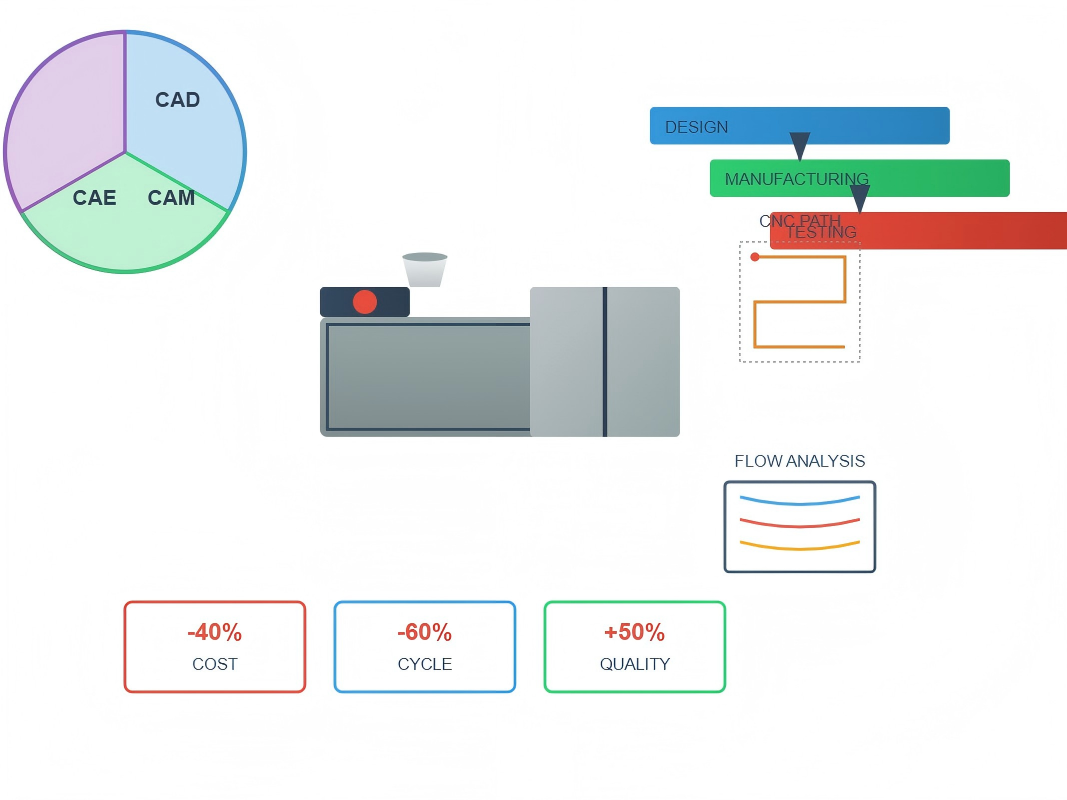
Key characteristics of concurrent engineering include comprehensive consideration of subsequent processes during initial design phases, emphasizing early integration of lifecycle considerations to minimize modifications and rework. This approach accelerates delivery and market introduction timelines. Concurrent design technology promotes parallel execution across design, process engineering, production preparation, procurement, and manufacturing stages. Early production initiation becomes possible as teams learn to work with incomplete information, making informed estimates that enable cycle compression.
System integration and overall optimization represent fundamental concurrent engineering principles. System evaluation focuses on global optimization rather than isolated component performance, assessing complete developmental outcomes rather than partial achievements. Design phases consume approximately one-third of total development cycles in injection molding prototyping, making design parallelism essential for cycle reduction.
Design for Manufacturing represents a crucial concurrent engineering component, addressing manufacturing considerations during early design stages to reduce errors and enable early error detection. This approach significantly shortens development cycles while reducing costs. Design teams develop CAD models for overall structural proposals, conducting CAE flow analysis for validation. CNC programming verification uses CAD models to design and simulate tool paths, preventing interference while ensuring surface accuracy. This integration achieves meaningful CAD/CAM/CAE convergence in injection molding prototyping.
Quality Management and Resource Optimization Strategies
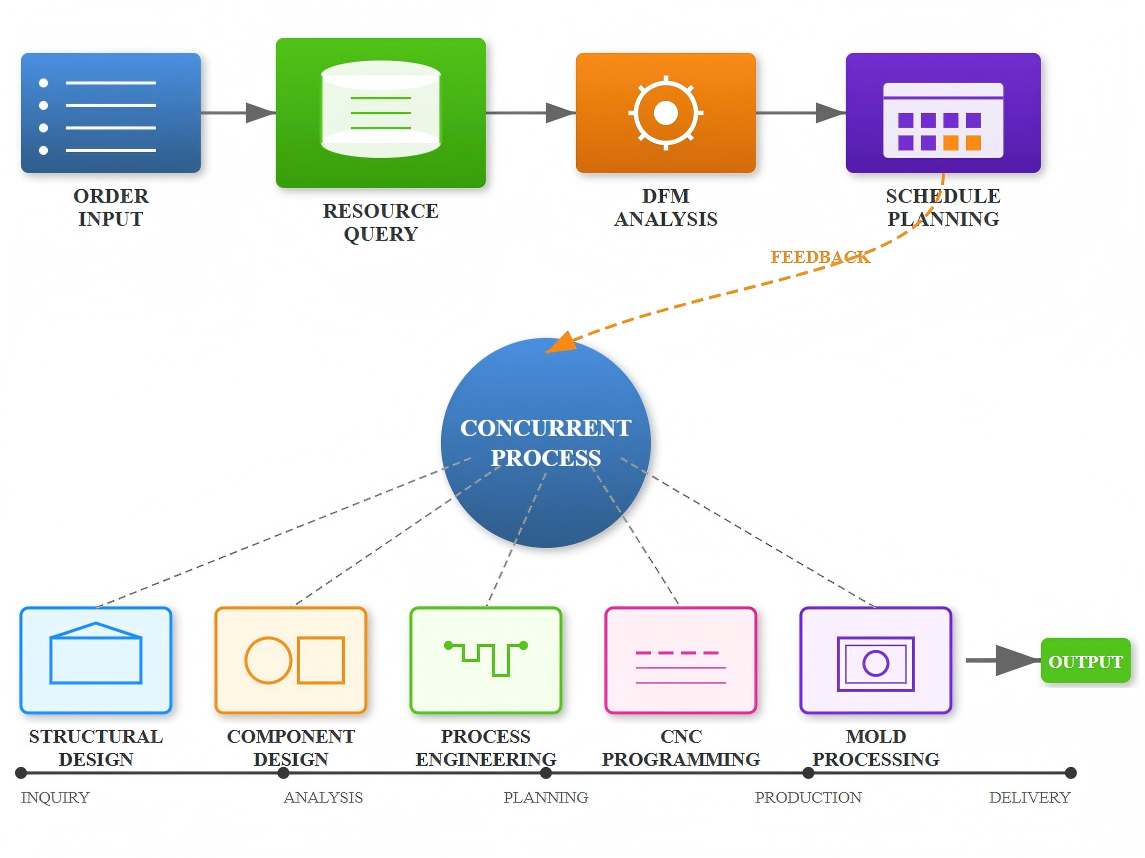
Computer systems enable manufacturing resource load queries during production management, allowing process designers to consider resource constraints when developing plans. This consideration ensures feasibility while partially achieving DFM objectives. As orders arrive randomly and continuously, enterprises must develop corresponding production schedules for each order. Furthermore, increasing specification detail through development stages necessitates multiple schedule iterations from rough to refined planning.
When receiving pricing inquiries and order intentions, enterprises must estimate costs and delivery times for proposed injection molding prototyping projects. Sales departments collaborate with project teams to analyze technical performance, structural forms, complexity levels, manufacturing materials, and component configurations.
Drawing upon experience with similar products, teams estimate design workload, critical component processing requirements, and assembly testing efforts to determine design cycles, manufacturing periods, delivery dates, and pricing for cheap injection molding prototyping solutions.
Following contract formalization, enterprises develop formal production schedules based on contractual requirements. Project teams must establish network topology structures for concurrent manufacturing process planning based on product characteristics. Historical data and experience guide time estimation and arrangement for each manufacturing stage, including structural design, component design, process engineering, CNC programming, mold base procurement, and rough processing. These parallel activities form the project planning framework.
"Effective resource optimization in injection molding prototyping requires dynamic scheduling algorithms that can adapt to changing production conditions while maintaining quality standards and meeting delivery deadlines."
- Journal of Manufacturing Systems, 2023
Using available start dates as baselines, forward scheduling combined with current production load adjustments determines start and completion times for each stage. Correct ordering decisions ensure planned completion precedes contractual delivery requirements, establishing project scheduling schemes. Initial production schedules rely primarily on historical data from similar products, though manufacturing uniqueness inevitably creates discrepancies between plans and actual conditions.
After substantial design completion, project teams can adjust unexecuted plan portions based on bills of materials and primary component processing requirements while developing corresponding component and operation schedules. Component production scheduling begins immediately upon individual part design completion rather than waiting for complete product design. Project teams submit processing requirements according to their assigned orders, requiring global workshop coordination to resolve resource sharing conflicts across concurrent projects.
Dynamic resource allocation challenges typically employ priority-based queuing principles for critical resource coordination. During process planning, non-critical resources often support lower-priority tasks to reduce conflicts, distribute loads, and alleviate bottleneck pressure. Network planning determines component delivery dates considering assembly lead times and precedence relationships. Operation scheduling optimization determines start times for each processing step based on process routes and standard hours.
Advanced Information Management Systems for Modern Manufacturing
Workshop schedulers utilize conflict detection modules to verify precedence constraints between operations and capacity verification modules to assess workload capabilities. Operation schedules typically employ two-day rolling systems, adjusting subsequent plans based on daily execution while extending planning horizons to accommodate tooling preparation. Schedulers arrange workshop operations based on operation time standards, though the absence of prototype testing in injection molding prototyping prevents accurate time estimation, necessitating experience-based planning that inevitably creates schedule variances.
Production monitoring becomes essential for maintaining overall plan adherence despite these challenges. Monitoring systems continuously report order execution status, forecast completion possibilities, and issue delay warnings when necessary. Injection molding prototyping with CE certification requires particularly stringent monitoring to ensure compliance throughout production. When significant issues arise, monitoring systems and project teams implement expedited insertions, task transfers, overtime, or outsourcing to dynamically adjust operation schedules.
If these measures cannot satisfy component delivery requirements, project teams adjust component schedules, modify network planning, or negotiate revised delivery dates with customers. Another crucial monitoring aspect involves set completeness control and operation sequence coordination. Schedulers address this through online monitoring of operation completion, real-time adjustment of start times based on precedence constraints, and dynamic resource allocation.
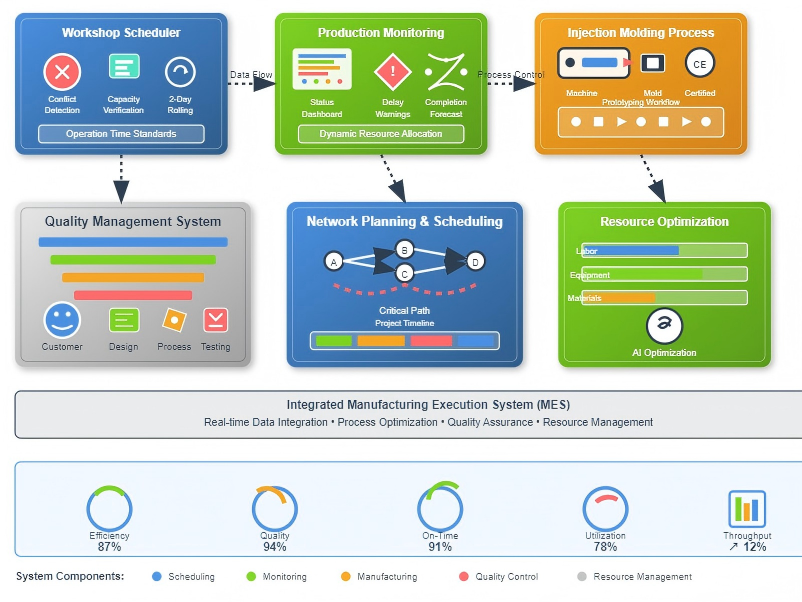
Quality management in injection molding prototyping involves multi-level systems with customer participation. During quotation and contract negotiation, enterprises must establish product drawings and technical requirements through customer consultation. Structural design, detailed design, and process engineering stages all require customer coordination, while final product acceptance demands substantial customer cooperation. Quality injection molding prototyping encompasses the entire product lifecycle from quotation through customer ordering, design, manufacturing, and after-sales service, operating within concurrent design, parallel processing, and frequently changing process information environments.
Commercial ERP Software
Custom-Developed Software
Enterprise information management represents systematic engineering incorporating personnel, computers, networks, hardware, databases, software systems, and equipment across all departments including production, operations, manufacturing, and management. Information technology, modern management techniques, and automated manufacturing provide the technological foundation for enterprise information systems. Through information collection, processing, transmission, updating, maintenance, and storage, these systems achieve design, manufacturing, and management digitalization, intelligence enhancement, and competitive improvement.
Information management systems can be acquired as commercial ERP software or developed internally. These approaches differ significantly in implementation requirements and ongoing operations. Commercial software requires extensive process alignment during implementation, creating substantial workflow impacts and implementation resistance. Custom-developed software adapts to actual factory conditions, enabling reasonable process optimization with reduced implementation obstacles. Durable injection molding prototyping operations benefit from either approach when properly implemented.
During system operation, commercial software typically requires additional fees for software modifications or data services, increasing operational costs. Custom software allows development personnel to handle routine maintenance, reducing operational expenses. As enterprises evolve and require expanded functionality, commercial software modifications involve additional costs and time, while custom systems enable rapid, cost-effective updates based on emerging requirements.
Enterprise Resource Planning and Production Optimization
Information resource management within enterprise systems encompasses information, technology, and personnel management components. Resource management ensures accumulation of technical experience and skill enhancement, enabling continuous system improvement and refinement. Modern information technology implementation updates production, management, and operational processes while reorganizing resources and integrating capital, information, and material flows. These improvements enhance management capabilities, provide timely data for decision-makers, elevate management standards, and ultimately strengthen economic performance and market competitiveness.
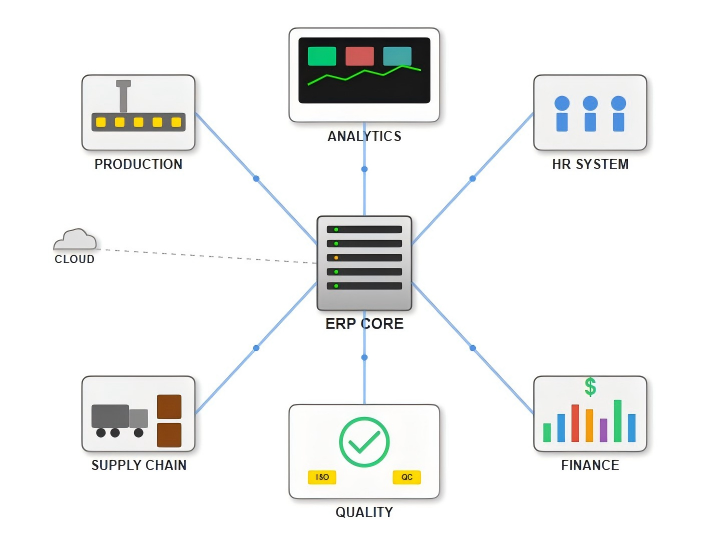
Management information systems primarily function to collect, process, store, manage, and transmit required information while maintaining system infrastructure. Information collection establishes data sources, collection methods, formats, and validation procedures. Standardized processing creates uniform information formats and enables comprehensive statistical compilation. Storage management handles system information archiving, utilizing appropriate media such as hard drives or optical discs for large-scale organizational data. Latest design injection molding prototyping systems particularly benefit from advanced information management capabilities.
Information management encompasses data organization, encoding, permissions, and definitions. Internet technology has dramatically enhanced information transmission quantity and speed in the information age. Chinese enterprises typically progress through several information management development stages, though not every organization experiences all phases, potentially bypassing certain stages during implementation.
Elementary information management involves basic computer processing at limited workstations with minimal infrastructure and low technology awareness. Intermediate stages encompass system integration and mature utilization, where enterprises recognize information importance and leverage internet technology to transform management and production. Advanced infrastructure integration combines human resources, production management, and cost information into comprehensive ERP systems. Classy injection molding prototyping providers often achieve this sophisticated integration level.
Advanced information management stages involve comprehensive internet utilization, supply chain management, and sales integration. This phase features complete infrastructure with full utilization, extending enterprise information systems into societal and global contexts. Production management systems provide crucial guidance for overall planning, particularly important for single-piece injection molding prototyping production spanning from conceptual design through successful testing and delivery.
Management systems determine timing and sequencing for production activities, recognizing both serial and parallel execution possibilities. Current market demands for shorter delivery times and higher quality make sequential workflows increasingly inadequate. Complex technical components require team collaboration across stages, yet sequential information transfer creates single-channel limitations that restrict timely exchange and resource sharing. Technical interface coordination challenges affect quality and may cause rework, extending cycles and damaging credibility.
Concurrent Engineering Applications and Benefits
Concurrent design technology implementation in injection molding prototyping management systems requires comprehensive consideration of stage parallelism. The inherently parallel nature of injection molding prototyping processes aims to improve quality, reduce costs, shorten cycles, and accelerate market introduction, aligning perfectly with enterprise performance objectives. Design quality improvements reduce early production changes by over fifty percent, parallel design execution compresses development by forty to sixty percent, and simultaneous design-manufacturing integration lowers costs by thirty to forty percent.
Key Principles of Concurrent Engineering in Injection Molding Prototyping
Early Lifecycle Consideration
Incorporating manufacturing, testing, and maintenance requirements during initial design phases to minimize modifications and rework.
Early Production Initiation
Starting production activities with incomplete information through informed estimation and iterative refinement.
Parallel Process Execution
Enabling simultaneous progression of design, engineering, procurement, and production activities to compress development cycles.
System Integration
Focusing on global optimization rather than individual components to achieve comprehensive developmental success.
Concurrent engineering emphasizes early lifecycle consideration to minimize modifications, promotes parallel execution across all stages, enables early production starts with incomplete information, and focuses on system integration and global optimization. Design phases consuming one-third of development cycles make parallelism essential for cycle reduction. Design for Manufacturing addresses manufacturing considerations early, reducing errors and enabling early detection while shortening cycles and reducing costs.
Injection molding prototyping suppliers implementing concurrent engineering develop CAD models with CAE analysis validation, use CNC programming verification to prevent interference, and achieve meaningful CAD/CAM/CAE integration. Computer-enabled resource queries allow process designers to consider constraints, ensuring feasibility while partially achieving DFM objectives. Random order arrivals require individual production schedules with iterative refinement as specifications develop through project stages.
Cost and delivery estimation for customer inquiries involves collaborative analysis of technical performance, structural complexity, materials, and components. Experience-based estimates of design workload, processing requirements, and assembly efforts determine cycles, periods, dates, and pricing. Formal schedules following contract formalization establish network topology structures for concurrent manufacturing planning. Historical data guides time estimation for parallel activities forming project frameworks, with forward scheduling and load adjustment determining stage timing to ensure completion before contractual requirements.
Initial schedules based on historical data inevitably encounter discrepancies requiring adjustment. Following design completion, teams modify plans based on bills of materials and processing requirements while developing component and operation schedules. Immediate scheduling upon part completion rather than awaiting complete design enables earlier production starts. Global workshop coordination resolves resource conflicts across concurrent projects using priority-based queuing for critical resources, with non-critical resources supporting lower priorities to distribute loads and reduce bottlenecks.
Network planning with assembly considerations determines delivery dates, while operation optimization establishes processing start times. Conflict detection verifies constraints, capacity verification assesses workloads, and rolling schedules adjust plans based on execution. Experience-based time estimation creates inevitable variances requiring production monitoring for plan adherence. Continuous status reporting, completion forecasting, and delay warnings enable dynamic adjustment through expediting, transfers, overtime, or outsourcing. When these measures prove insufficient, teams adjust schedules or negotiate revised deliveries while monitoring set completeness and operation coordination through online tracking and dynamic resource allocation.
The comprehensive implementation of these advanced management strategies in injection molding prototyping represents a fundamental shift from traditional manufacturing approaches toward data-driven, concurrent, and globally optimized production systems that meet modern market demands for quality, speed, and cost-effectiveness while maintaining the flexibility required for customized solutions and evolving customer requirements.