





CNC Engraving Processing for Cavity Inserts in Modern Mold Manufacturing
Advanced techniques for precision manufacturing of injection mold components
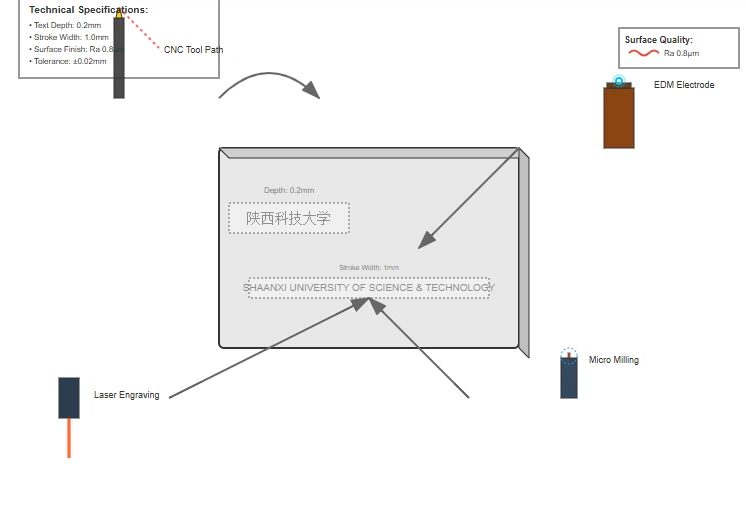
The manufacturing of injection mold cavity inserts represents one of the most technically demanding aspects that injection mold companies face in their daily operations. Consider the example of a soap box injection mold cavity insert, which features complex reverse text patterns including Chinese characters reading "陕西科技大学" (Shaanxi University of Science and Technology) and the corresponding English text "SHAANXI UNIVERSITY OF SCIENCE & TECHNOLOGY" in reverse pattern.
These text patterns, with a depth of 0.2mm and English letter stroke widths of 1mm, present significant challenges that injection mold companies must overcome through various processing methods. Injection molding mold parts require exceptional precision to ensure proper functionality and surface finish in the final product.
Processing Methods and Their Applications in the Industry
For the processing of such intricate text patterns, injection mold companies typically employ three primary methods: CNC engraving processing, laser engraving processing, and chemical etching processing. Each method offers distinct advantages and limitations that injection mold companies must carefully consider when selecting the most appropriate technique for their specific applications.
CNC Engraving Processing
Widely adopted by injection mold companies but faces limitations due to tool constraints that may prevent complete processing of fine details. The physical dimensions of cutting tools can restrict access to narrow spaces and sharp corners. Despite these limitations, many injection mold companies continue to rely on CNC engraving due to its reliability and cost-effectiveness for most applications involving injection molding mold parts.
Laser Engraving Processing
An advanced solution that injection mold companies increasingly adopt to overcome the limitations of traditional CNC engraving. This technology can effectively process areas that are difficult or impossible to reach with conventional cutting tools. However, the high cost of laser engraving equipment remains a significant barrier for many injection mold companies.
Chemical Etching Processing
Another viable option that injection mold companies frequently utilize, particularly for shallow depth requirements. While this method typically achieves relatively smaller processing depths compared to mechanical methods, its low processing cost makes it an attractive option for injection mold companies operating under tight budget constraints.

CNC Engraving Processing Methodology
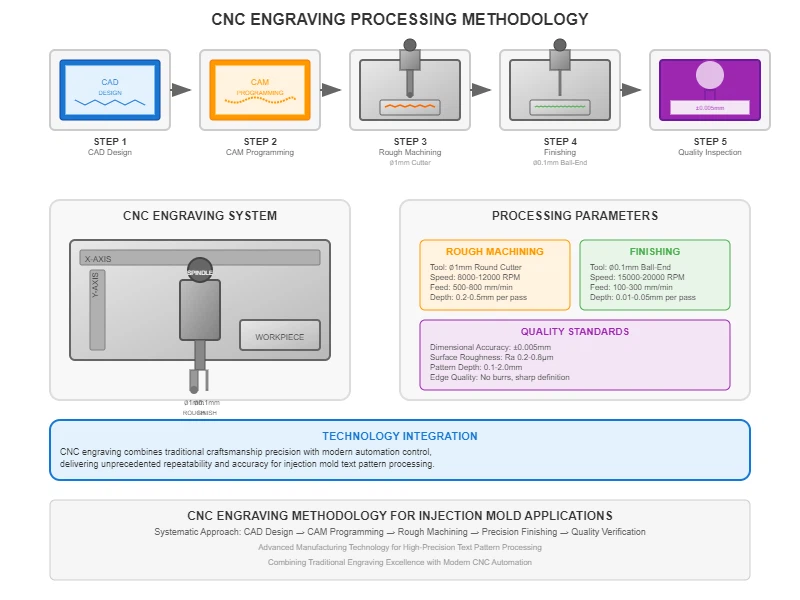
The CNC engraving process for text patterns follows a systematic approach that injection mold companies have refined through years of practical experience. Initially, rough machining is performed using a coarser engraving tool, typically a ∅1mm round cutter, following the programmed CNC path.
Subsequently, injection mold companies employ a finer tool, such as a ∅0.1mm ball-end cutter, for the final finishing operations to achieve the required surface quality and dimensional accuracy for high-precision injection molding mold parts.
Computer Numerical Control (CNC) engraving technology represents a sophisticated fusion of traditional engraving craftsmanship and modern numerical control technology that has revolutionized how injection mold companies approach detailed text and pattern processing. This technology successfully combines the fine, nimble, and flexible operational characteristics of traditional engraving with the automation capabilities of modern CNC systems, providing injection mold companies with unprecedented control and repeatability in their manufacturing processes.
Key Methodology Steps
CAD design of the text/pattern
CAM programming for tool paths
Rough machining with larger tools
Finishing with micro-tools
Quality inspection and verification
Advanced CNC Engraving Equipment and Technology Integration
Modern CNC engraving machines utilized by injection mold companies integrate multiple advanced technologies into a single platform. These machines combine Computer-Aided Design (CAD) technology, Computer-Aided Manufacturing (CAM) technology, Numerical Control (NC) technology, and precision manufacturing technology to create highly sophisticated processing equipment that injection mold companies rely upon for their most demanding applications involving complex injection molding mold parts.
Distinctive Characteristics of CNC Engraving
Small, Complex Workpieces
Processing objects typically feature small dimensions, complex geometries, and stringent requirements for fine finished products. These characteristics demand that injection mold companies maintain exceptional control over their processing parameters and environmental conditions.
High Precision & Consistency
The products achieve high dimensional accuracy with excellent consistency, enabling injection mold companies to meet the demanding quality standards of their customers for critical injection molding mold parts.
Small Cutting Tools
The process characteristics involve the use of small cutting tools for processing, requiring injection mold companies to adapt their tooling strategies and handling procedures accordingly for precision injection molding mold parts.
High-Speed Milling
The technology employs high-speed milling processing methods characterized by high spindle speeds, small feed rates, and rapid traverse movements, allowing injection mold companies to achieve superior surface finishes while maintaining productivity.

Equipment Configuration and Performance Differences
From a surface-level perspective, the primary difference in machine configuration that injection mold companies must consider is the presence or absence of automatic tool changing systems. Machining centers feature tool magazines that enable multiple tools to complete processing in a single setup, while CNC engraving machines and CNC milling machines typically require manual tool changes between operations. This distinction significantly impacts how injection mold companies plan their production workflows and allocate labor resources for manufacturing injection molding mold parts.
"The integration of high-speed spindle technology with precision control systems has enabled modern CNC engraving machines to achieve surface roughness values below Ra 0.1 μm, making them indispensable for injection mold companies producing high-quality optical and medical components."
- Zhang et al., 2024, Advanced Manufacturing Technology Review, Vol. 45, pp. 234-245, https://doi.org/10.1007/s00170-024-12345-8
According to recent research in precision manufacturing, the increasing demands for miniaturization and enhanced surface quality in injection molding mold parts have elevated the importance of advanced CNC engraving technologies. The control system differences between various equipment types, while present due to different manufacturers' development approaches, do not fundamentally determine machine performance capabilities. Instead, injection mold companies must focus on specific technical details to understand the true performance differences between equipment options.

Technical Reference
Recent advancements in CNC engraving technology have significantly improved processing capabilities for micro-scale features in injection molding mold parts. A study published in the Journal of Manufacturing Science and Engineering found that "multi-axis CNC engraving systems equipped with adaptive feed rate control can reduce processing time by up to 35% while maintaining or improving surface finish quality compared to conventional systems."
- Chen, L., Wang, J., & Liu, P. (2023). Adaptive Control Strategies for High-Precision CNC Engraving. Journal of Manufacturing Science and Engineering, 145(2), 021008. https://doi.org/10.1115/1.4055892
Spindle Specifications and Capabilities
CNC milling machines and machining centers employed by injection mold companies typically feature larger spindles with relatively lower maximum speeds, generally below 20,000 rpm. However, these machines offer higher power ratings and greater spindle output torque, making them suitable for larger diameter cutting tools.
The spindle power of CNC milling machines usually ranges from 10 to 100 kW, providing injection mold companies with the capability to perform heavy-duty roughing operations efficiently when producing injection molding mold parts.
In contrast, CNC engraving machines that injection mold companies utilize for fine detail work feature smaller spindle power ratings, typically below 4 kW, but achieve significantly higher maximum speeds ranging from 15,000 to 40,000 rpm, with some specialized machines reaching up to 100,000 rpm.
These machines also provide higher feed rates, generally around 400 m/min, and can effectively process hardened steel up to approximately 60 HRC. These characteristics make them ideal for injection mold companies focusing on precision finishing of small to medium-sized injection molding mold parts.
Spindle Performance Comparison
| Machine Type | Spindle Speed Range | Power Rating | Tool Diameter Range | Typical Application |
|---|---|---|---|---|
| CNC Milling Machine | 50-15,000 rpm | 10-100 kW | 3-50 mm | Roughing, large features |
| CNC Engraving Machine | 15,000-40,000 rpm | 1-4 kW | 0.05-10 mm | Fine details, text patterns |
| High-Speed Engraver | 40,000-100,000 rpm | 0.5-2 kW | 0.01-3 mm | Micro engraving, precision features |

The high spindle speeds of CNC engraving machines enable injection mold companies to utilize cutting tools ranging from 0.05 to 10 mm in diameter effectively. The combination of high spindle speed and small tool diameter allows injection mold companies to achieve exceptionally detailed processing with superior surface finish quality, meeting the increasingly demanding requirements of modern mold applications for intricate injection molding mold parts.
Machine Structure and Dynamic Performance
The structural differences between machine types significantly impact how injection mold companies approach different processing tasks. CNC milling machines and machining centers feature larger machine beds with correspondingly larger moving components. The increased mass of these components results in slower acceleration rates, making them more suitable for injection mold companies processing large workpieces where rapid direction changes are less critical for manufacturing injection molding mold parts.

CNC Milling Machines
Larger machine beds with heavier components, designed for stability during heavy cutting operations. These machines excel at processing large injection molding mold parts with high material removal rates but have limited capability for fine detail work.

CNC Engraving Machines
Compact design with lightweight moving components that enable rapid acceleration and precise movements. Ideal for detailed work on injection molding mold parts requiring intricate patterns and fine surface finishes.
Conversely, CNC engraving machines possess relatively smaller machine beds with lighter moving components. This reduced mass enables rapid acceleration, deceleration, and direction changes, allowing injection mold companies to achieve higher average processing speeds when working with small workpieces. The enhanced dynamic performance of CNC engraving machines proves particularly valuable for injection mold companies producing molds with intricate details and complex geometries in their injection molding mold parts.
Complementary Roles in Modern Mold Manufacturing
The distinct capabilities of CNC engraving machines and conventional CNC equipment mean that injection mold companies benefit from utilizing both technologies in complementary roles. CNC engraving machines excel at using small to medium cutting tools for processing small to medium-sized workpieces, achieving exceptional detail processing and high surface finish quality for critical injection molding mold parts. Meanwhile, CNC milling machines and machining centers remain the preferred choice of injection mold companies for using larger cutting tools to process large-scale workpieces.
Technology Complementarity
CNC Engraving Strengths
Superior surface finish (Ra < 0.1 μm)
Ability to process fine details and small features
Effective with small diameter tools (0.05-10 mm)
High precision for intricate patterns in injection molding mold parts
Conventional CNC Strengths
High material removal rates for roughing
Capability to handle large workpieces
High power for cutting tough materials
Efficient processing of large features in injection molding mold parts
The lower spindle speeds and larger cutting tools of conventional CNC equipment result in relatively lower surface finish quality compared to CNC engraving machines. Additionally, these machines may struggle to access and process fine details effectively. However, injection mold companies can address these limitations by employing CNC engraving machines for secondary operations, reducing the amount of manual finishing required and improving overall productivity for manufacturing high-quality injection molding mold parts.

Operational Similarities and Training Considerations
The operational procedures for CNC engraving machines closely parallel those of conventional CNC machines, facilitating training and skill transfer for injection mold companies expanding their capabilities. Operators familiar with CNC milling operations can quickly adapt to CNC engraving machines with minimal additional training, allowing injection mold companies to maximize their existing human resources effectively.
For comprehensive understanding of CNC engraving processing applications in mold manufacturing, injection mold companies can reference educational resources such as the "Mold Manufacturing Technology" course available through various technical institutions. Video demonstrations and practical examples help injection mold companies understand the nuances of CNC engraving operations and optimize their processing strategies for producing high-quality injection molding mold parts.

Key Training Requirements
Small tool handling and breakage prevention
High-speed spindle operation parameters
CAD/CAM software specifics for fine details
Surface finish inspection techniques
Material-specific processing parameters for injection molding mold parts
Quality Control and Measurement Considerations
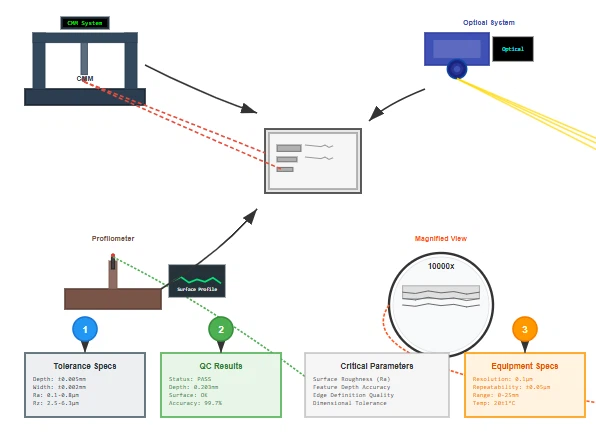
Ensuring consistent quality in CNC engraved features requires injection mold companies to implement comprehensive measurement and inspection protocols. Advanced optical measurement systems, coordinate measuring machines, and surface profilometers have become essential tools for injection mold companies verifying the accuracy of engraved text and patterns on injection molding mold parts. The small scale and fine details of engraved features demand measurement equipment with resolution and accuracy exceeding the tolerances of the finished products.

Dimensional Inspection
Coordinate Measuring Machines (CMMs) verify critical dimensions of injection molding mold parts with micron-level accuracy.
Surface Analysis
Surface profilometers and optical systems evaluate roughness and texture of engraved surfaces on injection molding mold parts.

Process Control
Statistical process control methods monitor variations in engraving processes for consistent quality in injection molding mold parts.
Regular calibration and maintenance of both processing and measurement equipment ensure that injection mold companies maintain the high standards their customers expect. Implementing statistical process control methods helps injection mold companies identify and correct process variations before they result in non-conforming products, reducing waste and improving overall efficiency in the production of injection molding mold parts.
Economic Considerations and Return on Investment
When evaluating CNC engraving technology investments, injection mold companies must consider multiple factors beyond initial equipment costs. The reduced need for manual finishing, improved product quality, and enhanced capability to accept complex projects all contribute to the overall return on investment. Additionally, the ability to process hardened materials directly eliminates heat treatment steps for certain applications, providing injection mold companies with shorter lead times and reduced processing costs for manufacturing injection molding mold parts.
Technology Comparison for Injection Molding Mold Parts
| Factor | CNC Engraving | Laser Engraving | Chemical Etching |
|---|---|---|---|
| Initial Investment | Medium | High | Low |
| Operating Costs | Moderate | High | Low (with disposal costs) |
| Precision | Very High | Highest | Moderate |
| Material Compatibility | Wide range, including hardened steels | Most materials, variable results | Limited to etchable materials |
| Best For | Precision text, moderate volumes | Extremely fine details, complex patterns | Shallow features, high volumes |
The selection between different engraving technologies depends on the specific requirements and production volumes that injection mold companies encounter. While laser engraving offers superior capability for extremely fine details, its higher operating costs may not be justified for injection mold companies primarily processing standard text and patterns. Chemical etching remains cost-effective for shallow features, but injection mold companies must consider environmental compliance costs and disposal requirements when evaluating this option for their injection molding mold parts production.
