





How Much Does a Metal Stamping Die Cost?
Anywhere from $3,000 to over $1 million. A simple blanking die and a multi-station automotive transfer die are both called "stamping dies" despite having almost nothing in common.
Here's how the cost breaks down by die type for quick reference: a single-station blanking or compound die runs $3,000–$25,000 and handles short production runs up to 300,000 strokes. Standard progressive dies fall in the $15,000–$80,000 range for 500,000+ stroke programs. Automotive-grade progressive tooling with tight tolerances and premium steel grades costs $80,000–$200,000 or more. Large-panel transfer dies, the kind used for hoods, fenders, and door skins, start at $200,000 and regularly exceed $1,000,000 when the full die line is included. The biggest cost drivers are station count, part geometry complexity, tool steel grade, and target production volume. Below 10,000 total parts, CNC or laser cutting almost always wins on cost. Above 50,000 parts, stamping typically pays back the die investment within 6–18 months.
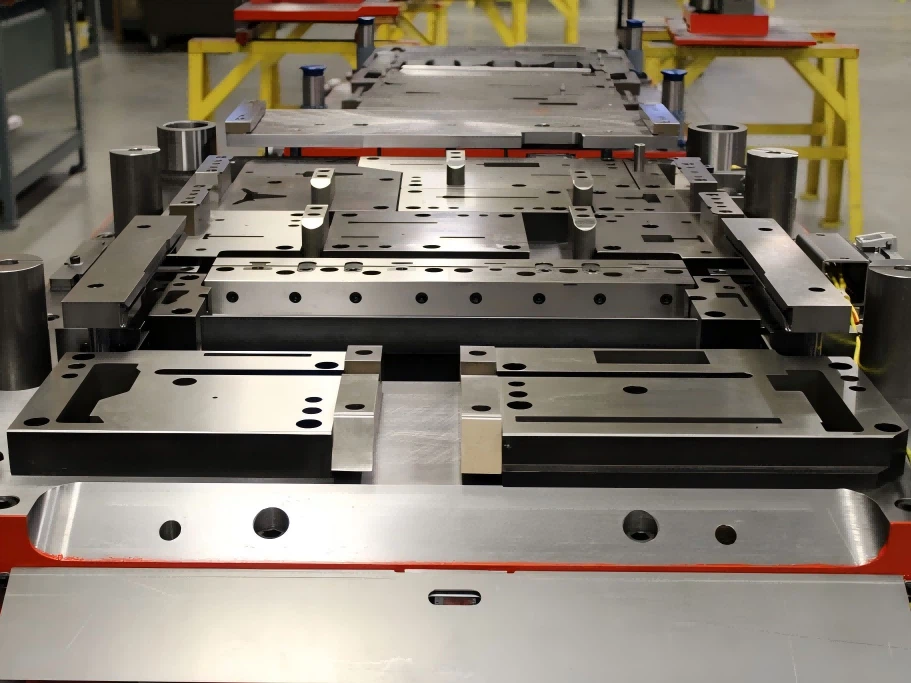
Price Ranges
Single-station blanking dies for prototypes start around $3,000-$8,000. Production-grade progressive dies? $25,000 to $80,000 most of the time. Automotive body panels and complex transfer dies get into six figures, sometimes way into them.
Context matters more than the number. Same part geometry, quotes from $45,000 to $325,000. Not because anyone's lying-different suppliers were interpreting the specs in completely different ways. The cheaper quote was building to a lower standard than the buyer actually needed.
| Die Type | Price Range | What You Get |
|---|---|---|
| Single-Station / Compound | $3,000 – $25,000 | Blanking, piercing, forming. 50k-300k strokes. Prototypes and small runs. |
| Progressive (Standard) | $15,000 – $80,000 | Multiple ops per stroke. 500k+ strokes with maintenance. |
| Progressive (Automotive) | $80,000 – $200,000+ | Tight tolerances, premium steels. Multi-million stroke programs. |
| Transfer Die | $200,000 – $1,000,000+ | Large panels, deep draws. Entire production systems. |
Why does a progressive die jump from $15k to $80k? A 3-station die for L-brackets isn't remotely comparable to a 10-station die with coining, in-die tapping, and tight-tolerance forming. Complexity doesn't scale linearly.
What Drives Progressive Die Stamping Cost Station by Station
The station count is the single variable that moves a progressive die quote the most. Each additional forming, piercing, or idle station adds roughly 8–12% to the total tooling investment. A 4-station bracket die and a 12-station connector die live in completely different cost universes, even when the final part footprint looks similar on paper.
Consider a real project: a stainless-steel terminal strip with three bend features, two pierced slots, and a coining operation. The strip layout required 8 active stations plus 2 idle stations for pitch stability. Tooling came in at $52,000. The customer's initial estimate was $30,000 because they counted operations, not stations. Idle stations don't form anything, but they hold the strip flat between aggressive operations. Skip them and the die produces scrap.
Material feed width matters too. A wider coil means a larger die set, heavier guide plates, and longer lead times for wire EDM on the punch profiles. The progressive stamping die cost typical range for parts running on strip widths under 100mm is $15,000–$45,000. Push past 200mm and you're looking at $50,000–$90,000 before any exotic steel upgrades.
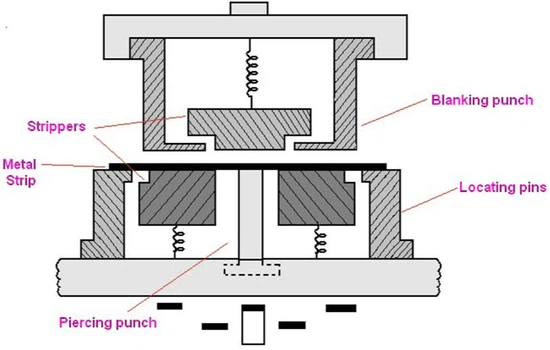
Automotive Panel Dies: What a Car Wing Stamping Die Actually Costs
Transfer dies for body panels operate on a different scale from anything in the progressive die world. A single fender or quarter-panel requires not one die, but a sequence: draw, trim, flange, and pierce. Each die in that line weighs 20–30 tons and demands dedicated CNC time measured in hundreds of hours.
A car wing stamping die price for the draw operation alone typically falls between $250,000 and $500,000. The full die line to produce a finished fender pushes the total to $500,000–$1,000,000. That's for production-grade tooling rated for multi-million stroke programs with Class A surface finish requirements. Prototype or low-volume soft tooling for the same geometry might cost $80,000–$150,000, but die life drops to 5,000–15,000 parts at best.
Why so expensive? Surface quality. Body panel dies require extensive hand-spotting after CNC machining. A skilled die maker spends weeks polishing contact surfaces so the stamped panel shows no orange peel, no witness marks, nothing the paint line can't hide. That manual finishing labor is what separates a $300,000 die from a $500,000 one, and it's almost impossible to shortcut. The fair price for a multi-station transfer die package depends heavily on how much spotting the part's surface geometry demands.
Cost Breakdown
When you get a quote, you're seeing several bundled costs:
Die material
is 20-40% of total. Steel for blocks, punches, inserts. This scales with size and doesn't vary much between suppliers using the same grades.
Machining and processing
eats up 30-50%. CNC, wire EDM, grinding, heat treat, assembly. A shop with newer equipment and skilled machinists produces tighter tolerances with less handwork. Sometimes they're cheaper despite higher rates because they're faster.
Design and engineering
runs 5-15%. Strip layout optimization alone can swing material utilization by 10-15%. Spending an extra $2k on design might save $20k in material costs over the production run.
Tryout and validation
adds 10-15%. Press time, sample material, iterative adjustments. Rush this to hit a date and you get a die that never works right.
Standard components like guide pillars, springs, cylinders run 5-10%. Commodity stuff.
Chinese Pricing Formula
Most Chinese tooling shops use a similar calculation. Take the lower die plate dimensions-say 400mm × 1000mm × 40mm in Cr12MoV. That's 126 kg at $4/kg, roughly $500. Times 4 for all plates = $2,000 in raw material.
Then multiply: 3× for single-station, 7× for progressive dies. That 400×1000mm progressive die comes to $14,000.
Is that the final price? Maybe not. But quotes wildly off from this deserve questions. Different steel grades, corner-cutting, or real efficiencies-you need to know which.
Quick math version: progressive die ≈ length (mm) × width (mm) × $0.25. Same die = $100,000. So you're looking at $14k (China) to $100k (US domestic). Reality falls somewhere between.
Tool Steel Mistakes
Buyers screw this up in both directions.
Under-spec
means A2 steel for a 500k+ part program. Die wears out mid-run. You saved $15k upfront, spent $40k on refurb and downtime.
Over-spec
means carbide inserts for 50k parts. Sure, it'll last forever. You also paid 3× the price for capacity you'll never touch.
Match it to volume:
- Under 100k parts: A2 is fine
- 100k-500k: D2 (industry workhorse)
- 500k-2M: DC53 or SKD11 (1.8-2× cost, worth it)
- Over 2M: Carbide inserts for wear components
The material being stamped also factors into steel selection, and it's a detail that gets missed in generic recommendations. Stainless steel and high-strength low-alloy (HSLA) grades wear die surfaces 2–3× faster than mild carbon steel at equivalent volumes. A die built in D2 for a 500,000-piece program in cold-rolled 1008 might only last 200,000 pieces if the application switches to 304 stainless. Tooling suppliers who quote without asking about the work material are pricing blind, and that's a red flag regardless of how competitive their stamping die cost estimate looks on the spreadsheet.
Heat treatment quality matters too. Standard runs $1.50/kg, vacuum is $4-6/kg. Budget suppliers ship dies where hardness varies 5 HRC across a single punch. That's not a tool, it's a liability waiting to happen.
When Stamping Pays Off
Under 500-1,000 parts? Skip stamping. CNC or laser cutting, zero tooling investment. Math doesn't work.
Crossover is usually 10,000-20,000 total parts. Below that, die amortization kills you. Above that, per-piece efficiency wins.
Example: 50k annual volume, 5 years (250k total parts)
| Method | Tooling | Per-Part | 5-Year Total |
|---|---|---|---|
| CNC | $0 | $5.70 | $1,425,000 |
| Laser+Brake | $2,000 | $4.00 | $1,002,000 |
| Progressive | $35,000 | $1.25 | $347,500 |
The math shifts further in favor of stamping when you factor in secondary operations. CNC and laser parts typically need deburring, manual bending, and fixture-based assembly. Each of those adds labor and quality variability. A well-designed progressive die delivers a finished or near-finished part straight off the press, which is why the real cost gap between processes is often wider than the per-piece comparison suggests. For programs running 100,000+ units annually, the progressive die stamping cost per part can drop below $0.30 for simple geometries, making it one of the lowest-cost forming methods available at scale.
Progressive die paid back in 5 months. Payback under 12 months? Do it. Over 24 months? Better be sure about those volume projections.
Die Classes
Class A, B, or C determines lifespan, maintenance, and price. Most specification mistakes happen here.
Over-specifying: Class A tooling (7M+ strokes) for 25k parts. Paying for 99.6% of capability you'll never use. Class C does the job at half price.
Under-specifying: Cheapest Class C quote for 500k parts. Major refurb at 100k strokes. You just paid for 5 dies instead of 1.
Worse? RFQs without specifying class. Suppliers fill in the blank however they want. That's your $45k-$325k quote spread right there.
| Class | Stroke Life | Tolerance | Relative Cost |
|---|---|---|---|
| C | <100k | ±0.1mm | 40-50% of A |
| B | 100k-500k | ±0.05mm | 60-70% of A |
| A | 1-7M+ | ±0.025mm | Baseline |
Hidden Costs
Purchase price is what you negotiate. Operating costs are what you pay for years.
Preventive maintenance: 3-5% of die value per year. World-class ops run 2-3%. Above 5%? Something's broken in your tooling or maintenance.
Spare parts inventory: One-time 5-10% of die value. Need backup punches on hand or the next breakdown becomes an emergency.
Setup labor: $200-600 per run for installation, alignment, first article. Running the die 12+ times yearly? Adds up fast.
Often missing from quotes:
- ECOs: $2k-$20k+
- Rush fees: 15-30% to cut lead time from 12 weeks to 6
- PPAP docs: $1k-$5k for automotive
Get itemized quotes. Lump sums hide the differences and make change orders a nightmare.
Lead Time and Its Real Cost Impact
Tooling lead time doesn't just delay production. It changes the economics of the entire project.
A standard progressive die build runs 8–12 weeks from design sign-off to first article. Complex automotive transfer tooling? 16–24 weeks is normal. Cutting that timeline in half with rush fees adds 15–30% to the stamping die price, and the premium isn't negotiable because it displaces other jobs on the shop's schedule.
But the less obvious cost sits on the buyer's side. If tooling delivery slips by 4 weeks and your production ramp date is fixed, you're buying parts through alternative processes at 3–5× the stamped cost to fill the gap. On a 100,000-unit annual program, that bridge production can burn through $50,000–$100,000 in weeks.
Material lead times compound the problem. Common cold-rolled steel ships in 4–6 weeks from US service centers. Specialty alloys or non-standard gauges can stretch to 12–16 weeks if mills are backlogged. The stamping die cost estimate you approved in January looks very different by March if hot-rolled coil pricing has moved 15% and your preferred gauge has a 10-week queue.
Experienced procurement teams build 2–3 weeks of buffer into every milestone. They also lock material pricing at the time of die order, not production start. That one move alone can save 5–8% on a program where steel prices are climbing.
Domestic vs. Offshore
Chinese tooling runs 40-60% less than US. Real savings. But total cost isn't the headline number.
$80k progressive die (US baseline):
US
$80k + $500 shipping + minimal overhead
= $83k
China
$40k + $4.5k shipping + $3k duties + $12k travel (2 trips) + $3k communication + $8k quality buffer
= $70.5k
16% real savings, not 50%. Still meaningful.
Quality varies wildly. Export-grade Chinese suppliers match US quality. Budget shops ship dies that can't hold tolerance after 5k strokes. It's about supplier qualification.
Red flags:
instant quotes, won't specify steel grades, no ISO 9001, won't allow third-party inspection.
Good signs:
detailed application questions, push back on bad specs, documented processes, contactable references.
How to Evaluate Whether a Stamping Die Quote Is Fair
The hardest part of sourcing tooling isn't getting quotes. It's knowing which number to trust.
Start with the Chinese pricing formula from earlier in this article as a sanity check. If a progressive die quote deviates more than 40% in either direction from that benchmark, something needs explaining. Lower could mean thinner plates, lower-grade steel, or fewer heat-treat cycles. Higher could mean premium steel, tighter machining tolerances, or simply a shop with more overhead.
Then look at the line items. A fair price on a multi-station transfer die quote should separately list: die material and grade, machining hours, heat treatment method and cost per kilogram, design hours, tryout press time, and standard components. If those six items aren't broken out, you can't compare the quote to anything. You're just comparing lump sums, which is how a $45,000 quote and a $325,000 quote end up on the same spreadsheet for the same part.
Ask what's excluded. PPAP documentation, engineering changes after sign-off, spare punch sets, die storage between production runs, shipping fixtures. These items add 8–15% to the headline stamping die price on most programs, and they're the line items budget shops leave off the initial quote to look competitive.
One useful tactic: request a die life guarantee tied to stroke count, not calendar time. A shop willing to warrant 500,000 strokes on D2 tooling is telling you something about their heat treatment and build quality. A shop that won't commit to a number is also telling you something.
Before You Quote
Incomplete specs = incomparable quotes.
Must include: part drawing with GD&T, material spec, annual + total volume, critical tolerances, die class or target strokes.
Should include: press specs, part exit requirements, surface finish needs, PPAP requirements.
Suppliers asking questions before quoting? Those are your people. Instant estimates mean they're applying generic multipliers without engineering anything.
Bottom Line
Under 10k parts: use CNC or laser. 10k-50k: Class B progressive in D2, budget $25k-$50k domestic or $15k-$30k offshore. 50k+: Class A or B with proper steel. 500k+: call a tooling engineer, the investment justifies professional optimization.
Biggest mistake isn't price-it's mismatched specifications. A properly spec'd die pays dividends for years. A mismatched one is a recurring problem.
Abis Mould provides tooling cost analysis and DFM review for stamping projects across automotive, electronics, and medical device applications. Contact our engineering team for project-specific guidance: https://www.abismould.com