





What Is the Difference Between Insert Molding and Overmolding?
Two processes, similar names, completely different engineering logic. We get asked this question often enough that it warrants a proper technical writeup rather than the usual marketing fluff you find elsewhere.
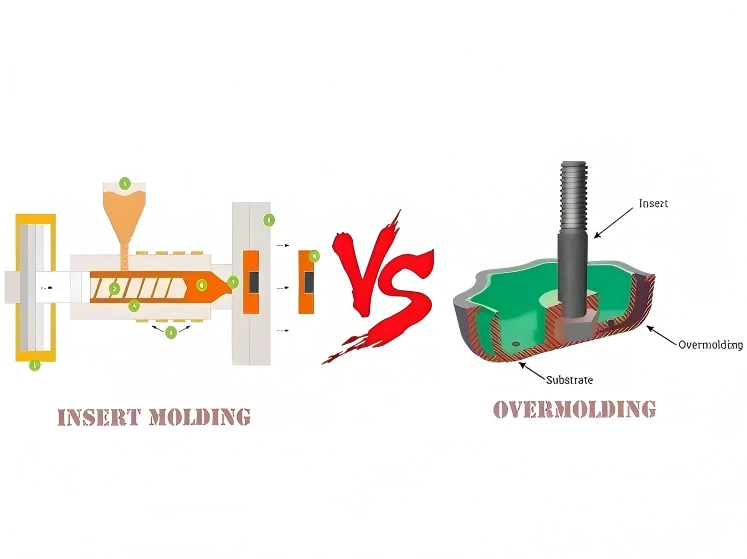
Insert molding puts a pre-made component (metal, ceramic, sometimes pre-molded plastic) into the mold before injection. Overmolding puts a second plastic layer over an existing plastic part. That's the one-sentence version. Everything else-tooling decisions, material headaches, failure modes-flows from this fundamental difference.
Where the confusion comes from
Both processes create multi-material parts. Both use injection molding equipment. Both get lumped together in supplier capability lists. But the engineering considerations diverge almost immediately.
Insert molding deals with metal-to-plastic interfaces. No chemical bond exists. You're relying entirely on geometry-knurls, holes, undercuts-to mechanically lock the insert in place. The plastic shrinks around the metal as it cools, which creates grip but also creates problems we'll get into later.
Overmolding deals with plastic-to-plastic interfaces. When material compatibility exists, you get actual molecular interdiffusion at the boundary. The TPE chains and substrate chains intermingle while both surfaces are above glass transition. Done right, the bond strength exceeds the material strength-you tear the TPE before you peel it off.
Done wrong, you get delamination in the field and angry phone calls from customers.
The thermal reality of polymer molds
Before getting into process specifics, there's background worth understanding about heat transfer in these applications.
Research from Bielefeld University of Applied Sciences demonstrated something that surprises people unfamiliar with polymer tooling: when you inject ABS into an ABS mold cavity, the contact temperature reaches approximately 145°C. The same injection into steel tooling? Contact temperature stays around 62-70°C.
Why this matters: cooling time scales dramatically with cavity material. Steel mold cooling takes roughly 12 seconds for typical wall sections. Polymer cavity? 680 seconds. The heat simply has nowhere to go-thermal conductivity is too low for conventional cooling channels to function.
This research led to an external cooling approach using water bath immersion after ejection, reducing cycle times to around 62 seconds with temperature drops of 16-39°C achievable. The SPM (Space Puzzle Mold) technique allows multi-part cavity inserts to be ejected with the workpiece, cooled externally, then cycled back in. Production runs of 165 parts with 80 cycles per batch set showed no external damage to the tooling.
We mention this because tooling thermal behavior affects both insert molding and overmolding outcomes, and most technical discussions skip the underlying physics entirely.
Insert molding: what actually happens
Metal inserts go into the mold. Plastic flows around them. Part ejects. Simple enough in concept.
The six-stage breakdown:
Preparation. Inserts get inspected, cleaned, sometimes surface-treated. Brass dominates for threaded applications-good machinability, decent corrosion resistance, predictable behavior. Stainless for harsh environments. Aluminum when weight matters. Surface features (knurling, circumferential grooves, through-holes) get designed to maximize mechanical retention.
Loading. Manual placement works for low volumes. Vertical presses make this easier since gravity helps rather than fights. Higher volumes justify automated loading-robots, bowl feeders, pick-and-place systems. Fixturing has to hold position against injection pressure, which gets substantial.
Preheating. Often skipped, frequently regretted. Metal conducts heat aggressively. Room-temperature brass dropped into a mold acts as a heat sink, locally cooling the melt, increasing viscosity, creating weak weld lines. Preheating to ~100°C addresses this. But there's a second reason people miss: thermal expansion. The heated insert expands. As the assembly cools, insert and plastic contract together, reducing the residual stress differential.
Injection. Standard injection molding parameters apply-melt temperature, injection speed, pack pressure, cooling time. Gate location matters more than usual because you're directing flow around an obstruction.
Cooling. Uneven by nature. Metal cools faster than plastic. The interface sees thermal gradients that don't exist in single-material molding.
Ejection and inspection. Position verification, pull-out testing if specified, dimensional checks. Visual inspection catches obvious problems; the subtle ones show up later.

The hoop stress problem
This deserves its own section because it's the failure mode that catches people.
Plastic shrinks when it solidifies. Typical shrinkage rates: ABS 0.4-0.7%, PP 1.0-2.5%, POM 1.8-2.5%. When plastic shrinks around a metal insert that isn't shrinking at the same rate, circumferential tensile stress develops in the plastic. This stress doesn't relax. It's built into the part permanently.
The calculation is straightforward:
Residual stress ≈ shrinkage rate × flexural modulus
For acetal (POM) with 2.5% shrinkage and ~2,600 MPa modulus, you're looking at hoop stress around 52 MPa. That's roughly 75% of POM's ultimate tensile strength. Not a comfortable margin. (kaysun.com/blog/material-behavior-hoop-stress-and-creep)
This explains the delayed cracking phenomenon-parts pass initial inspection, ship to customers, then crack weeks or months later as the material creeps under constant stress.
Design mitigation: adequate wall thickness around inserts (boss OD should be 1.5-2× insert OD), material selection favoring lower shrinkage and modulus, stress-relief geometry, and the preheating step mentioned earlier.
CTE mismatch and thermal cycling
Related but distinct from hoop stress: coefficient of thermal expansion differences.
Typical values:
- Plastics: 50-80 ppm/°C
- Brass: ~19 ppm/°C
- Aluminum: ~24 ppm/°C
- Steel: 10-13 ppm/°C
A 40+ ppm/°C differential means the plastic expands and contracts substantially more than the metal with each temperature cycle. In applications that see thermal cycling-automotive underhood, outdoor equipment, anything with on/off heating-this differential creates cyclic interface stress.
Documented case from engineering forums (eng-tips.com): brass inserts in 30% glass-filled nylon, passed initial pressure testing at 120 psi, leaked after temperature cycling to 80°C. The thermal expansion mismatch opened the interface. Post-test analysis showed crack initiation at stress concentrations on the insert surface.
The fix in that case wasn't process adjustment-it was design change. Secondary sealing (O-ring, elastomer gasket) or redesigned interface geometry. Insert molding alone cannot guarantee gas-tight seals when thermal cycling is involved, regardless of how perfect the molding process is.
Overmolding: process variants
Three approaches exist, each with different economics and quality implications.
Insert overmolding (transfer molding). Pre-molded substrate gets placed into a second mold. TPE or other overmold material injects over it. Uses standard single-shot equipment. Labor-intensive due to manual substrate loading. Economical below ~250,000 annual units depending on labor costs. Bond quality depends heavily on substrate temperature at time of overmold injection-cold substrate means weaker interfacial bonding.
Two-shot molding (multi-shot). Specialized equipment with multiple barrels. First material injects, mold rotates or slides, second material injects in the same cycle. Substrate stays warm between shots, maximizing molecular interdiffusion at the interface. Best bond quality. High tooling and equipment cost. Economical above ~250,000 annual units.
Co-injection. Simultaneous injection of both materials. Limited applications. Not commonly used for overmolding in the conventional sense.
The 250,000 unit threshold is approximate. Labor rate affects the calculation significantly. At $4/hour labor, insert overmolding remains economical at higher volumes. At $30/hour, two-shot becomes attractive sooner.
Material compatibility-the part that causes failures
Chemical bonding between overmold and substrate requires molecular compatibility. Compatibility charts exist but don't tell the whole story.
What works reliably:
Styrenic TPE (TPE-S) over PP, PE → chemical bond
TPV over PP, PE → chemical bond
TPU over ABS, PC, PA → chemical bond
What requires special formulation:
Styrenic TPE over ABS, PC, PA → standard grades fail, need modified chemistry
TPU over PP, PE → mechanical only, no chemical bond
What doesn't work:
Almost anything over POM → surface energy too low for chemical bonding
Mismatched polymer families without modification
Processing parameters affect bond quality substantially. TPE melt temperature recommendations from material suppliers (teknorapex.com):
- Over PP substrate: 170-190°C
- Over ABS substrate: 220°C
- Over PA substrate: 240°C
Higher melt temperature promotes interface heat transfer and molecular mobility. Injection speed should be fast to maintain temperature during fill. Overmold thickness below 1.5mm creates problems-material freezes before adequate bonding develops.
Failure mode diagnostics: When testing adhesion (peel test, shear test), examine the failure surface. Clean separation at the interface = adhesive failure = bond is the weak point = process or material problem. TPE tearing within itself, leaving residue on both surfaces = cohesive failure = bond exceeds material strength = acceptable.
The contamination case study
PlasticsToday documented a failure analysis worth knowing about. Knobs made from 30% glass-filled PP substrate with elastomer overmold. Production had been running fine, then a batch showed zero adhesion-TPE peeled off completely.
DSC analysis revealed the "PP" substrate contained 40-60% nylon 6 contamination. Material got mixed at some point upstream. The elastomer formulated for PP had no chemical affinity for nylon.
The tell: part weight. 30% GF nylon density is 1.35 g/cm³. 30% GF PP density is 1.13 g/cm³. Weight check would have caught this before overmolding.
Incoming material verification matters. Especially with recycled content or multiple suppliers.

Design rules that get ignored
From various industry sources and production experience:
For insert molding:
- Boss OD ≥ 1.5× insert diameter (2× preferred for high-stress applications)
- Insert protrusion into cavity ≥ 0.4mm (0.016")
- Molded depth below insert ≥ 1/6 insert diameter (prevents sink marks)
- Avoid sharp corners on inserts-stress concentrators accelerate cracking
- Consider insert preheating as standard practice, not optional
For overmolding:
- TPE minimum thickness 1.5mm for reliable bonding
- Inside corner radii ≥ 0.5× wall thickness
- Avoid thin sections that freeze before filling
- Textured substrate surfaces improve mechanical adhesion
- Gate location to minimize substrate reheating in sensitive areas
These get documented, put in design guidelines, then ignored when schedule pressure hits. The problems show up in production or worse, in the field.
Supplier qualification questions
When evaluating suppliers for these processes, the generic ISO certification check doesn't tell you much. Specific questions matter more.
For insert molding:
- What positional tolerance Cpk do you achieve on insert location? (Anything below 1.33 is concerning)
- Describe your insert preheating process. What temperature? How verified?
- Have you had delayed cracking issues? What was root cause and resolution?
- How do you handle different CTE materials?
For overmolding:
- How do you qualify new substrate/overmold combinations?
- What's your bond strength testing protocol? Show data.
- How do you control substrate temperature at overmold injection?
- What's your surface contamination prevention procedure?
For both:
- Walk me through a DFM review you pushed back on. What did you catch?
- Describe a production problem you solved. What changed?
- What's your approach when quoted design won't work?
Suppliers who say yes to everything without pushback are suppliers who will have problems in production. Technical engagement during quoting is a good sign.
Process selection logic
Rather than a decision tree (which oversimplifies), here's how the thinking usually goes:
Q: Need metal in the part?
A: Overmolding. Soft grip, sealing, vibration damping, impact absorption-the substrate provides structure, the overmold provides surface function.
Q: Volume under 50,000/year?
A: Insert overmolding with manual loading usually pencils out, unless labor costs are extreme.
Q: Volume over 250,000/year?
A: Two-shot molding economics become favorable. Higher capital, lower operating cost.
Q: Thermal cycling in application?
A: Pay close attention to CTE matching. Metal inserts in high-shrinkage plastics plus thermal cycling equals interface problems. May need secondary sealing.
Q: Bond strength safety-critical?
A: Favor two-shot over insert overmolding for the bond quality advantage. If insert overmolding is required, substrate preheating systems become mandatory rather than optional.
Q: Medical, automotive, aerospace?
A: Certification requirements (ISO 13485, IATF 16949, AS9100) narrow supplier options significantly. Material traceability, process validation, and documentation expectations differ from commercial/industrial applications.
Tooling cost reality
Numbers vary widely based on complexity, but rough ranges:
- Simple insert mold, single cavity: $5,000-15,000
- Multi-cavity insert mold with automation features: $30,000-80,000
- Two-shot mold with rotating core: $60,000-150,000+
- Complex multi-cavity two-shot: $100,000+
Offshore tooling runs 40-50% lower on initial quote. Total cost is another matter. Documented case (crescentind.com): domestic quote $49,000 for fully hardened steel mold rated for 1M shots. Offshore tool required modifications costing $49,500+ after delivery. Total program cost approached $100,000.
Not an argument against offshore-an argument for evaluating total cost including qualification time, modification risk, communication overhead, and logistics.
Application notes by industry

Medical devices. Both processes common. Insert molding for housings with electrical contacts; overmolding for grip surfaces on instruments. ISO 13485 mandatory. Cleanroom capability often required. Sterilization compatibility (gamma, EtO, autoclave) constrains material selection significantly-not all TPEs survive repeated autoclaving.
Automotive. Insert molding dominant for electrical connectors-terminal positioning accuracy is critical. IATF 16949 certification standard. Overmolding appears in interior soft-touch surfaces and under-hood sealing applications. Temperature range requirements (-40°C to +125°C typical) stress CTE matching.
Consumer electronics. Cable overmolding (strain relief), protective housings, accessory grips. Cycle time pressure more intense than industrial. Cosmetic requirements higher. Color matching between shots challenging in overmolding.
Industrial/power tools. Ergonomic overmolded grips are essentially standard. Vibration damping TPE selection affects user fatigue claims. Insert molding for threaded inserts in high-abuse housings where molded-in bosses would fail.
Common defect reference
Insert molding:
| Defect | Likely causes | First actions |
|---|---|---|
| Insert displacement | Injection pressure too high, fixture failure, gate impingement | Reduce velocity, check fixture, relocate gate |
| Weak weld lines | Cold insert heat-sinking the melt | Preheat inserts, raise melt temp |
| Sink marks near insert | Insufficient material below insert | Increase depth per design rule (≥1/6 diameter) |
| Delayed cracking | Excessive hoop stress | Material change, increase wall thickness, redesign |
| Leakage at interface | CTE mismatch, no seal design | Add secondary seal, accept limitation |
Overmolding:
| Defect | Likely causes | First actions |
|---|---|---|
| Delamination | Material incompatibility, cold substrate, contamination | Verify materials, preheat substrate, audit handling |
| Substrate warpage | Thermal shock from overmold | Lower melt temp, improve mold support, preheat |
| Incomplete fill | TPE too thin, freezing before fill | Increase thickness, raise melt temp, speed up injection |
| Flash at interface | Tool wear, inadequate clamping | Tool maintenance, clamp pressure adjustment |
| Weak bond (adhesive failure) | Wrong TPE grade, cold substrate, surface contamination | Material qualification, process adjustment |
The actual difference, summarized
Insert molding: metal (or other pre-formed component) goes in first, plastic encapsulates it, bond is mechanical.
Overmolding: plastic substrate exists, second plastic material goes over it, bond can be chemical if materials match.
Everything else-equipment, tooling, parameters, quality systems, failure modes-differs accordingly. The processes solve different problems. Choosing between them requires understanding what problem you actually have.
Technical discussions about specific applications are available through our engineering team. We've worked across medical, automotive, consumer, and industrial applications using both processes.