





What is Injection Molding Technology?
Injection molding technology produces desired parts or products by shaping the molten material into a cavity. The geometry of the cavity outlines the 3D shape of the designed products. Typically, high pressure is applied during injection to facilitate material flow and maintain compactness once the material is solidified.
The history of injection molding can be traced back to 1872; two American brothers(Hyatt and Isaiah) invented a simple hydraulic plunger plastic molding machine. Since then, it has continuously evolved and become more accurate, cost-effective, and diverse.
Recent innovations and advancements like micro-molding, metal injection molding, muti-component molding, robotics, and automation are why electronics, automotive, medical, consumer, and toy industries heavily use this technology.

Injection molding technology represents one of the most versatile and widely adopted manufacturing processes in modern industry. This sophisticated technique has revolutionized how we produce everything from tiny electronic components to large automotive parts, making it an indispensable cornerstone of contemporary manufacturing.
"Injection molding has established itself as the preeminent manufacturing process for producing complex plastic components with high precision and repeatability, enabling mass production at scale while maintaining exceptional quality standards across industries."
- Journal of Manufacturing Science and Engineering, Vol. 145, Issue 3, 2023 (view source)
The Fundamentals of Injection Molding
At its core, injection molding technology involves the precise injection of molten material, typically thermoplastic polymers, into a carefully designed mold cavity. The process begins when raw plastic pellets are fed into a heated barrel where they are melted and mixed by a rotating screw mechanism.
Once the material reaches the optimal temperature and consistency, it is injected under high pressure into a closed mold, where it cools and solidifies into the desired shape.
The effectiveness of injection molding technology lies in its ability to produce complex geometries with exceptional dimensional accuracy and surface finish quality. Unlike other manufacturing methods, this process can create intricate internal features, undercuts, and thin-walled sections that would be impossible or extremely costly to achieve through traditional machining or casting techniques.

Key Components and Equipment
Injection Unit
The injection unit is responsible for melting and injecting the material. It consists of a hopper for feeding plastic pellets, a heated barrel, and a reciprocating screw that melts, mixes, and delivers the molten plastic.
Clamping Unit
The clamping unit holds the mold securely during injection and cooling. It must generate sufficient force to keep the mold closed against the injection pressure, often ranging from several tons to thousands of tons.
The Mold
The mold is a precision-engineered tool typically made from hardened steel or aluminum. It contains the cavity that forms the desired part shape and must withstand repeated thermal and mechanical stresses.
Temperature Control Systems
These systems maintain precise thermal conditions throughout the barrel, nozzle, and mold, ensuring consistent material flow and optimal part quality during the injection molding process.

Key components of a modern injection molding machine showing the injection unit and clamping system
The Injection Molding Process Cycle
The injection molding technology process follows a systematic cycle that typically consists of four main phases. Each phase is carefully controlled to ensure consistent quality and production efficiency.
Mold Closing
The mold closes and clamps shut with tremendous force, often exceeding several hundred tons. This clamping force must be sufficient to withstand the injection pressure during the next phase.

Injection Phase
The molten plastic is injected into the mold cavity at high speed and pressure, filling even the most intricate details of the mold design. Injection pressure can range from 1000 to 20,000 psi depending on the material and part design.

Cooling and Packing
The material cools and solidifies while additional pressure is applied to compensate for material shrinkage. Cooling time is critical and depends on factors like material type, part thickness, and mold temperature.

Mold Opening and Ejection
Finally, the mold opens and the finished part is ejected using pins or other mechanical devices. This entire cycle can be completed in as little as a few seconds for simple parts or several minutes for complex components.

Materials and Applications
Common Materials in Injection Molding Technology
Polyethylene (PE)
A versatile thermoplastic known for its chemical resistance and flexibility, used in containers, bottles, and various consumer products.
Polypropylene (PP)
Offers excellent fatigue resistance and is used in automotive components, packaging, and household items due to its balance of strength and flexibility.
Polystyrene (PS)
Available in rigid and foam forms, used for packaging, disposable utensils, and electronic device housings.
ABS
A tough, impact-resistant polymer blend used in automotive parts, toys, and consumer electronics due to its strength and aesthetic qualities.
Nylon (Polyamide)
An engineering plastic with high strength, abrasion resistance, and heat resistance, used in gears, bushings, and structural components.
Polycarbonate (PC)
A transparent, impact-resistant plastic used in safety glasses, medical devices, and electronic components requiring clarity.
Industrial Applications

Automotive Industry
In automotive manufacturing, injection molding technology produces everything from dashboard components to complex engine parts, interior trim, and under-the-hood components that must withstand harsh conditions.

Electronics Industry
The electronics industry relies on injection molding technology for creating housings, connectors, and intricate internal components with precise dimensions and heat resistance properties.

Medical Device Manufacturing
Medical device manufacturers utilize injection molding technology to produce sterile, biocompatible components with tight tolerances, including surgical instruments, diagnostic equipment parts, and drug delivery systems.

Consumer Goods
Consumer goods represent perhaps the largest application area for injection molding technology. From kitchen utensils and toys to packaging containers and furniture components, this manufacturing method enables mass production of consistent, high-quality products.
Advantages and Benefits
High-Volume Efficiency
The primary advantage of injection molding technology lies in its exceptional efficiency for high-volume production. Once the initial mold is created, the cost per part decreases dramatically as production volume increases.
Remarkable Repeatability
The process offers remarkable repeatability, with each part maintaining consistent dimensions and properties throughout the production run, ensuring uniform quality across thousands or millions of parts.
Excellent Material Utilization
Injection molding technology provides excellent material utilization, as excess material from sprues and runners can typically be recycled and reused, minimizing waste.
Design Flexibility
Manufacturers can incorporate features like threads, logos, textures, and complex geometries directly into the molding process, eliminating secondary operations and reducing overall production costs.
Cost Efficiency Comparison
Injection molding becomes increasingly cost-effective with higher production volumes compared to other manufacturing methods, as the initial tooling cost is spread across more units.

Technological Advancements
Modern injection molding technology continues to evolve with innovations that expand capabilities, improve efficiency, and enable new applications across industries.

Micro-Molding
Micro-molding technology enables the production of extremely small, high-precision parts with dimensions measured in microns. This advancement is critical for medical devices, microelectronics, and other applications requiring miniature components.
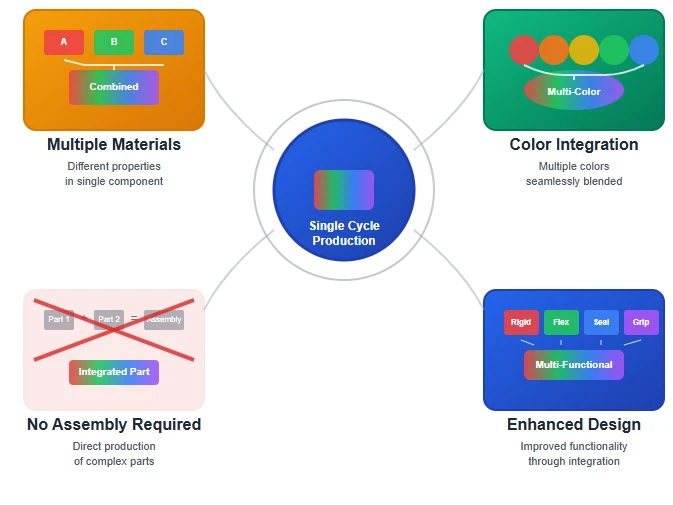
Multi-Component Molding
This innovation allows manufacturers to produce parts combining multiple materials or colors in a single production cycle, eliminating assembly steps and enabling new design possibilities with improved functionality.

Gas-Assisted Injection Molding
This technology injects inert gas into the molten plastic, creating hollow sections in the part. The result is lighter components with uniform wall thickness, reduced material usage, and improved structural integrity.

Industry 4.0 Integration
Smart manufacturing capabilities have brought predictive maintenance, real-time quality monitoring, and automated process optimization to injection molding technology, improving efficiency and reducing downtime.
Sustainable Practices in Injection Molding
Sustainable practices are increasingly important in injection molding technology, with manufacturers developing biodegradable materials, improving energy efficiency, and implementing closed-loop recycling systems. These advances ensure that injection molding technology remains relevant and responsible in an environmentally conscious world.
Innovations in sustainable injection molding include the development of bio-based polymers, energy-efficient heating and cooling systems, and process optimization software that minimizes material waste and energy consumption throughout the production cycle.
Why Injection Molding Technology Matters
Injection molding technology continues to be a driving force in modern manufacturing, enabling innovation across industries while maintaining efficiency and cost-effectiveness. Its ability to produce complex, high-quality parts at scale makes it indispensable in today's production landscape, with ongoing advancements ensuring its relevance for future manufacturing challenges.