





What Is Centrifugal Casting?
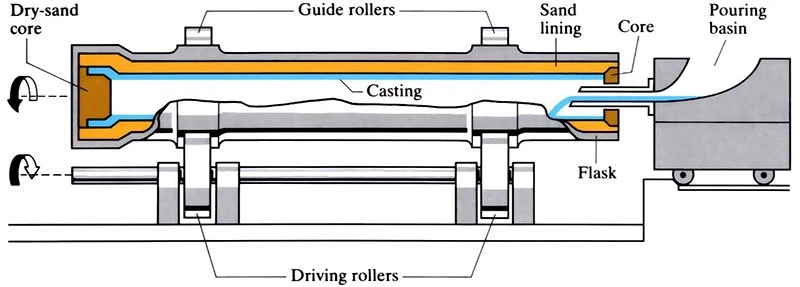
Centrifugal casting spins molten metal inside a mold. The rotation throws the metal outward. It solidifies against the mold wall first, then works its way inward. The result is a tube or cylinder with a dense outer skin.
If someone asks for a simple centrifugal casting definition, I describe it this way: pour metal into a spinning mold, let force pack the cleanest metal against the outside wall, then machine away the rougher inside surface. That is why the process is also called centrifuge casting, centrifugal molding, or centrifugal moulding in some shops, although foundries usually stick with the casting term.
I got into this side of the business about fourteen years ago when our shop started having premature failures on shot sleeves. We were buying static cast sleeves from a supplier in Ohio. They worked fine for maybe 35,000 shots, then the ID would start washing out. Switched to centrifugally cast sleeves from a place in Wisconsin. Same H13 material. The sleeves ran past 90,000 shots before we pulled them.
That got my attention.
The Physics
When you pour steel into a spinning mold, the heavy stuff goes to the outside. Inclusions, gas bubbles, slag-all of it migrates toward the bore. The outside surface ends up cleaner than anything you could get from a static pour. The grain structure is tighter too. Faster cooling at the mold wall does that.
The bore is garbage. You machine it out anyway on most tooling applications, so who cares. What matters is that working surface on the OD.
Rotation speed varies. Our sleeve supplier runs somewhere around 900 RPM for a standard aluminum shot sleeve. I asked their metallurgist once about going faster. He said past a certain point you get segregation issues with the carbides. They cluster at the OD and you end up with a brittle surface layer. There's a sweet spot.
There are a few versions of the process, and buyers mix them up all the time. True centrifugal cast work is for tubes, rings and sleeves where the bore is made by rotation instead of a core. Semi-centrifugal casting is used for wheel-shaped parts where the center can be machined out. Centrifuging casting is different again: the mold has multiple cavities around a center sprue, and rotation helps push metal into those cavities.
Where This Matters in Die Casting
Shot sleeves. That's 90% of why anyone in die casting cares about centrifugal casting.One thing worth clearing up: centrifugal die casting is not the same thing as high-pressure die casting. In normal die casting, pressure fills the die cavity. In this case, the centrifugal process is usually making the tooling component that later survives the die casting environment. A shot sleeve, wear ring or thick round insert may be centrifugally cast first, then finished by machining before it ever goes near a die casting machine.
The shot sleeve sits between your ladle and the die. Molten aluminum at 1250°F flows through it every cycle. The plunger tip slides back and forth inside it under high pressure. Erosion, thermal shock, mechanical wear-everything bad happens to a shot sleeve.
Aluminum centrifugal casting gets talked about from two different angles. Sometimes the aluminum alloy is the casting material. Other times, like shot sleeves, the part is made from tool steel because it has to handle repeated contact with molten aluminum. For die casting buyers, that difference matters. A foundry that can pour aluminum rings is not automatically qualified to make a sleeve that survives aluminum die casting production.
A centrifugally cast sleeve handles this better because the surface is denser. Less microporosity means fewer initiation sites for heat checking. The first cracks that form on any sleeve surface are the beginning of the end. Denser material delays that.
We also use centrifugal cast blanks for some larger core pins. Anything over about 2 inch diameter, the foundry can make a better blank than we can get from bar stock. Forged bar in that size range sometimes has centerline porosity from the original ingot. Centrifugal casting puts the porosity where you're going to machine it away.
What I've Learned
The performance gap between centrifugal and static cast depends on your application. Running zinc? The sleeves don't see nearly the abuse that aluminum creates. The cost premium for centrifugal cast might not pay back. Running aluminum at fast cycle times with a lot of metal velocity? Different story.
Temperature control on the casting process matters more than most buyers realize. I toured a centrifugal casting facility in Germany back in 2019. They monitored pour temperature within plus or minus 15 degrees F. Their mold preheat was controlled the same way. The shop I visited in Mexico the year before was running much looser. Both sold product that met the same hardness spec. The German material performed better in our dies. Not dramatically, but we tracked it.
The centrifugal casting mold is part of the quality story too. Most shops use steel, iron or graphite tooling, then control preheat and coating before the pour. I pay attention to the coating because it is not just a release layer. A good centrifugal coating controls heat transfer, protects the mold surface and helps the casting release without tearing up the OD. If the coating is uneven, you can still get a casting that passes hardness but machines poorly.
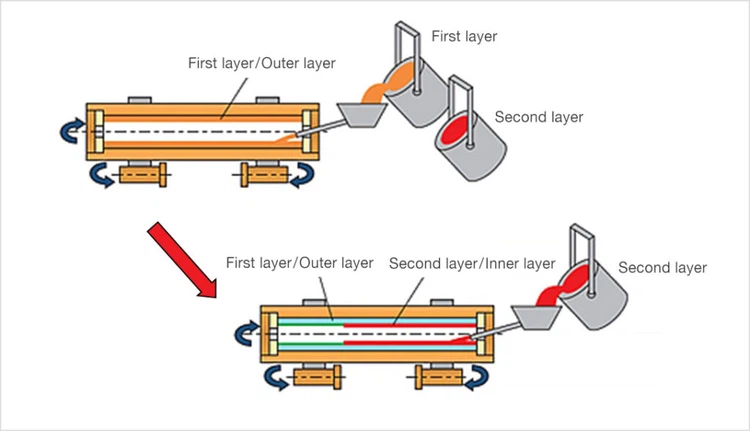
Bimetallic sleeves have become more common. The concept is a tough inner material with a hard outer shell. Centrifugal casting bonds them during solidification. You get the best of both. We tried these about five years ago. The performance was good but the supplier had delivery problems. Went back to monolithic H13. Still use those on a couple high-volume jobs where the economics work.
Large centrifugal castings are a different buying conversation. Once the diameter, length or finished weight gets big, the foundry's machine capacity is only the first filter. You also need to ask about heat treatment size limits, machining envelope, ultrasonic testing coverage and how much cleanup stock they leave on the ID. A big ring that cannot be heat treated or inspected properly is not really a usable casting.
Centrifugal casting applications go well beyond shot sleeves, but the logic is usually the same. If the part is round, thick enough to machine, and punished by heat, pressure or wear, the process starts to make sense. I have seen centrifugal castings used for bushings, liners, furnace tubes, wear rings, rolls and large cylindrical blanks. The common thread is not shape alone. It is the need for dense material where the working surface actually carries the load.
Buying This Stuff
Lead times are long. Ten weeks minimum, often longer. You cannot call up and order centrifugally cast shot sleeves for delivery next week. Plan ahead or keep spares on the shelf.
When you are comparing a centrifugal casting foundry, location is only part of the decision. I have bought from Wisconsin centrifugal casting suppliers because the quality was consistent and the freight made sense for U.S. tooling work. But the same checklist applies anywhere: ask for the alloy route, OD soundness requirement, machining allowance, NDT method, heat treatment record and whether they have made the same part before. Searching for centrifugal castings in Wisconsin might find good suppliers, but the purchase order still has to define what good means.
The specs matter. I've seen purchase orders that just say "centrifugally cast H13 shot sleeve" with dimensions. That's not enough. You want to specify minimum G-force or rotation parameters, porosity limits for the OD zone, and what testing you expect. UT inspection of the working surface area is standard. Some suppliers include it, some charge extra.
Price runs 20% to 35% over static cast for comparable sleeves. I've seen quotes all over the place depending on supplier and quantity. One-offs cost more per piece. If you're buying fifty sleeves a year from the same supplier, you can negotiate.

The Limits
Centrifugal casting makes cylinders and tubes. That's it. If you need internal features or complex geometry, this process won't help you.
Do not confuse this with centrifugal rubber mold casting. That process, often called spin casting, uses a rubber mold and is usually for low-melting alloys, small decorative parts, prototypes or short runs. It is useful, but it is not what you want for a die casting shot sleeve or a heavy tool steel cylinder. Same force principle, completely different mold, material range and buyer expectation.
There's also a practical minimum wall thickness. Below about half an inch on tool steel, the metal freezes too fast during rotation. You get incomplete fill or porosity in thin sections. Not a problem for shot sleeves which run thick anyway.
The bore surface needs machining. Always. Some buyers think they can save money by using the as-cast bore. They learn otherwise.
I still see shops running static cast sleeves and wondering why they're changing them so often. The upfront cost difference isn't that big when you factor in downtime and labor for sleeve changes. Run the numbers on your own application. On anything over about 50,000 shots annual volume in aluminum, centrifugal cast usually wins.
A quick terminology note for buyers: the correct English term is centrifugal casting. I still see RFQs and search terms written as centrifigal casting or centrifical casting, but suppliers will understand the intended process. In Swedish documents, the same idea may appear as centrifugalgjutning. Just make sure the quote is for the actual metal casting process you need, not rubber mold spin casting or a coating service.