





What Is Blow Mold?
Got a call from a packaging startup in Ohio two weeks ago. Guy wanted to quote 50,000 pharmaceutical bottles a month and kept asking about the "molds" like it was one tool. Took me twenty minutes to explain he needed at least two - the parison mold for injection and the blow mold for forming. Different tools. Different jobs. Different headaches.
The blow mold in injection blow molding is the half that actually makes your bottle shape. It sits at station two. Hot parison comes in from the injection station on the core rod, mold closes around it, compressed air hits, plastic expands against the cavity walls. That's where your bottle gets its shoulders, its body, its base. The parison mold just makes a test tube. Blow mold makes it real.
Aluminum vs Steel
Most blow molds for IBM run aluminum. 7075-T6 is standard. The thermal conductivity sits around 130 W/m·K - way better than P20 steel at 29 W/m·K. You're cycling every 10 to 15 seconds. That heat has to go somewhere.
I ran steel blow molds exactly once. Customer insisted. 2018, a cosmetics company in New Jersey wanted mirror finish on their 30ml dropper bottles. We went with S136 hardened to 52 HRC. Beautiful cavities. Cycle time jumped from 12 seconds to 19. They ate the cost for six months before switching back to aluminum with a vapor honed finish. Close enough.
Aluminum wears faster. No getting around it. A steel mold might run 3 million cycles. Aluminum tops out around 800,000 to 1.2 million before the parting line starts looking rough and your flash gets worse. You budget for refurbishment or replacement.

Cooling Lines
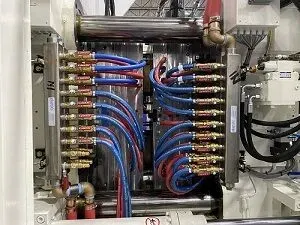
The layout of your cooling channels makes or breaks cycle time. I've seen shops run straight gun-drilled holes top to bottom and wonder why their bases come out warped. The base is the thickest part of most bottles. It needs its own circuit.
We typically run 8mm diameter channels for small bottles under 100ml. Bigger containers go 10mm or 12mm. Spacing from the cavity surface - 15mm to 20mm. Closer than that and you risk hot spots where the channel centerlines miss. Farther out and you're just heating coolant.
Water temperature depends on the resin. HDPE likes it cold, 10°C to 15°C. PET needs warmer, around 20°C to 30°C, or you get stress whitening. PP sits somewhere in the middle. I keep a cheat sheet taped inside my toolbox lid.
Baffle inserts in blind holes help. Bubblers work too. Just don't cheap out on the O-rings. Had a mold flood the press at a plant in Michigan last year. Shop floor looked like a swimming pool. One perished O-ring.
Venting
Blow molds trap air. The parison expands and pushes atmosphere out. If it can't escape, you get incomplete fill at the extremities. Pinch areas around handles. Deep lettering. The heel radius on bottles.
Standard approach is sintered vents in the problem spots. Porous metal inserts, usually bronze or stainless, pore size around 7 to 15 microns. Small enough to block plastic but big enough for air. We set them flush with the cavity surface and seat them with Loctite 638.
Some guys grind vent flats on the parting line. 0.02mm to 0.04mm deep, 3mm to 5mm wide, running to atmosphere. Works fine for simple shapes. Handles and deep embossing still need the porous plugs.
Vents clog. PVC and some additives are the worst. You're pulling molds for cleaning every 50,000 to 100,000 shots on bad resins. HDPE runs cleaner. PP is in between.
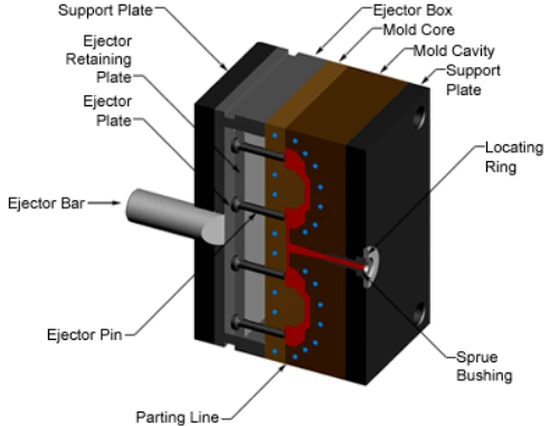
Parting Line Location
Where you split the mold determines where the witness line shows up on your bottle. Marketing people hate parting lines. Quality specs on cosmetic bottles sometimes call out 0.05mm max mismatch. That's tight. Your mold shop better have a good jig borer.
Asymmetric bottles are a headache. A lot of designers draw something organic looking and hand it to engineering. Now you're choosing between a parting line running down the face of the bottle or splitting the mold at an angle and fighting draft on every surface.
I ask for the 3D model before quoting now. Had too many projects where the pretty rendering didn't mention the undercut on the back panel.
Registration and Alignment
The blow mold halves need to hit the same spot every cycle. Leader pins and bushings are baseline. Tapered interlocks if the customer is running tight specs on wall thickness distribution. You're looking at ±0.1mm or better on the mold halves meeting up.
Wear shows up after 300,000 shots or so. The bushings start getting sloppy. Wall thickness on one side of the bottle creeps up while the other side thins out. QC catches it eventually when bottles start failing drop tests.
We spec bronze bushings on aluminum molds, hardened steel on steel. Replace the pins and bushings at refurbishment. Not worth skipping.
What Goes Wrong
Flash is the obvious one. Parting line opens up, plastic squeezes out, you're trimming waste and watching your scrap rate climb. Could be clamp tonnage. Could be worn parting surfaces. Could be blow pressure too high.
Thin spots happen when the parison isn't centered on the core rod or the blow mold halves aren't aligned. The plastic stretches more on one side than the other. You'll see it on wall thickness measurements. Bottles fail squeeze tests in one orientation but pass in another.
Orange peel texture shows up when the mold surface is too cold or the resin is too hot. Differential shrinkage against the cavity wall. Sometimes it's just old mold surfaces that need repolishing.
Stuck bottles mean your draft angles are too shallow or your cooling is insufficient. The plastic shrinks onto the core side instead of releasing to the blow mold. Ejector pins can help but they leave witness marks.
Blow molds aren't the complicated half of the IBM tooling. The parison molds handle the gate design, runner balance, all the injection headaches. The blow mold just has to form the shape, cool the plastic, let the air out, and release the part. Do those four things and you're running production. Miss any one and you're on the phone with your mold shop.