





What Are Orthodontic Brackets?
Orthodontic brackets are small metal or ceramic attachments bonded directly to each tooth to hold archwires that apply controlled pressure for tooth movement. These components serve as the anchoring points in braces systems, transferring force from the activated archwire to teeth through a slot mechanism that allows orthodontists to guide teeth into proper alignment over months or years of treatment.
Material Composition and Manufacturing
The material selection for orthodontic brackets directly impacts treatment effectiveness, durability, and patient comfort. Modern manufacturing techniques have revolutionized bracket production, particularly through metal injection molding (MIM manufacturing), which has become the dominant process for creating precise, consistent brackets at scale.
Stainless Steel Brackets
Stainless steel remains the most widely used material for orthodontic brackets, accounting for the majority of metal brackets in clinical use. Medical-grade stainless steel alloys offer high yield strength, excellent corrosion resistance, and biocompatibility essential for long-term intraoral use. The material's high modulus of elasticity provides the rigidity needed to transfer forces effectively from archwire to tooth structure.
Modern stainless steel brackets manufactured through MIM technology achieve slot dimensions with precision within micrometers, though research from 2024 indicates most bracket slots measure 2.6% to 10.4% oversized compared to manufacturer specifications of 0.022 inches. This dimensional accuracy matters because slot tolerances under 0.001 inch are required for controlled tooth movement according to bracket prescription values.
The cost-effectiveness of stainless steel brackets makes them accessible across all patient demographics. A typical set of metal brackets ranges from $3 to $5 per bracket, with complete treatment costs for traditional metal braces averaging $3,000 to $7,000 in the United States as of 2024.
Ceramic and Alumina Brackets
Ceramic brackets emerged in 1986 as an aesthetic alternative to metal brackets, utilizing polycrystalline or monocrystalline alumina materials. Polycrystalline transparent alumina brackets are manufactured through powder-injection molding, creating translucent attachments that blend with natural tooth color. These brackets resist staining and discoloration throughout treatment duration, though the elastic ties securing archwires may discolor between adjustment appointments.
The global orthodontic brackets market reached $2.10 billion in 2024 and is projected to grow at 7.4% CAGR through 2031, driven partly by increasing adult demand for aesthetic treatment options. Ceramic brackets typically cost 20% to 30% more than metal alternatives, reflecting the material's higher brittleness requiring slightly bulkier designs to prevent fracture.
Recent surface roughness studies using atomic force microscopy demonstrate that self-ligating ceramic brackets undergo less significant roughness changes over a 2-year treatment period compared to stainless steel brackets, potentially offering lower friction and better biocompatibility.
Titanium and Alternative Materials
Titanium brackets provide superior biocompatibility and corrosion resistance compared to stainless steel, making them suitable for patients with nickel sensitivities. However, titanium exhibits lower hardness than steel, presenting wear concerns during treatment. The material shows increased plaque accumulation and discoloration compared to stainless steel alternatives.
Plastic and polycarbonate brackets, introduced in the 1980s as aesthetic options, demonstrated significant limitations including extensive creep deformation, discoloration, low hardness, and tie wing fracture. Modern reinforced polycarbonate brackets with ceramic or fiberglass fillers address some early deficiencies but remain less common than metal or ceramic options.

Bracket Design and Components
Orthodontic brackets feature a sophisticated design integrating multiple functional elements that work together to facilitate precise tooth movement.
Slot Architecture
The bracket slot represents the most critical dimension in bracket design, typically manufactured in two standard sizes: 0.018 × 0.025 inch and 0.022 × 0.028 inch. This slot accommodates the archwire and determines the "play" between wire and bracket, directly influencing torque expression and rotational control.
The Lucchesi Sub-Slot Bracket, launched in 2024 by Ortho Shop America, features an additional sub-slot under the main slot that allows low friction and rapid tooth movement like self-ligating brackets during early treatment, while providing full wire engagement for optimum torque expression during later stages at the cost of a traditional twin bracket.
Base Design and Bonding
Bracket bases employ various surface treatments to achieve clinically adequate bond strength to tooth enamel. Manufacturing methods include soldered mesh, milled undercut, sandblasted, and chemically etched base designs. The bonding process involves acid-etching tooth enamel with phosphoric acid gel for 30 seconds to create microporosities visible only through electron microscopy, then applying composite resin adhesive cured with LED light.
Monoblock MIM brackets feature integrated bases with designed bumps that improve fit against tooth surfaces, enhancing bonding effectiveness. The mesh base design with 80-gauge mesh and ultrathin profile provides stronger adhesion through mechanical interlocking with bonding adhesive.
Wings, Hooks, and Auxiliary Features
Bracket wings provide the attachment points for ligatures (elastic or metal ties) that secure archwires within the slot. Twin brackets feature separate mesial and distal wings, while tube brackets guide wires without wing structures. Hooks on specific brackets (typically positions 3, 4, and 5 in the dental arch) allow attachment of elastic rubber bands for bite correction and additional force application.
Self-ligating brackets incorporate built-in clips or gates that hold archwires without elastic or metal ligatures. The BioQuick 5 system, representing FORESTADENT's fifth-generation design as of 2024, features a re-engineered clip with larger opening access that allows any scaler or probe to open the bracket. This design reduces chair time and minimizes friction during tooth movement.
The Biomechanics of Tooth Movement
Understanding how brackets facilitate tooth movement requires examining the biological response to orthodontic forces at the cellular and tissue level.
Periodontal Ligament Response
Each tooth anchors to the jawbone through its root, surrounded by the periodontal ligament (PDL), a thin connective tissue layer containing collagen fibers. When brackets and archwires apply pressure to a tooth, this force transmits through the crown to the root and surrounding structures. The applied pressure compresses the PDL on one side while stretching it on the opposite side.
This differential pressure initiates a biological cascade involving bone remodeling. On the compression side, specialized cells called osteoclasts break down bone tissue, while on the tension side, osteoblasts build new bone. This coordinated cellular activity allows the tooth to gradually shift through bone while maintaining structural support.
Force Application Principles
Orthodontic treatment success depends on applying the correct magnitude, direction, and duration of force. Insufficient force produces no movement, while excessive force can damage tooth structure, surrounding bone, or the PDL. The goal involves using light, continuous force to encourage controlled, safe movement over weeks and months.
When braces apply pressure to teeth, blood supply reduction to PDL fibers triggers inflammation and chemical factor release that stimulates the pain response. This explains the discomfort patients experience following bracket placement and periodic adjustments. The biological remodeling process cannot be rushed-attempting to move teeth too quickly risks root resorption, where the body begins absorbing the tooth root, potentially causing tooth mobility or loss.
Treatment Timeline Factors
Bone remodeling occurs at a specific biological rate that varies by patient age and bone density. Younger patients typically respond more quickly to orthodontic forces because their bones remain more malleable during development. The average orthodontic treatment spans 16 to 18 months, though complex cases may require 24 months or longer.
Patients generally notice visible changes within four to six weeks after initial bracket placement. Adjustment appointments occur every four to six weeks, allowing the orthodontist to modify archwire configuration, change wire diameter, or add bends to continue guiding teeth toward target positions.

Bracket Systems and Treatment Approaches
Different bracket systems offer varying approaches to orthodontic treatment, each with specific advantages for particular clinical situations.
Conventional Twin Brackets
Traditional twin brackets remain the most common bracket type, featuring two separate wings with spaces for elastic or metal ligatures. These brackets provide reliable performance across diverse treatment needs and offer the lowest per-unit cost. Patients can select colored elastic ligatures for personalization, making this option particularly popular among younger demographics.
The straightforward design allows orthodontists precise control over tooth positioning through wire bending and ligature adjustment. However, conventional brackets require more frequent adjustments compared to self-ligating alternatives and generate higher friction between wire and bracket slot during tooth movement.
Self-Ligating Systems
Self-ligating brackets eliminate elastic or metal ligatures by incorporating a built-in mechanism to secure archwires. These systems are classified as passive or active depending on how the wire sits within the slot. Passive self-ligating brackets allow the wire to move more freely within the slot, reducing friction and potentially accelerating tooth movement.
The KLOwen Orthodontics custom metal self-ligating solution, launched in 2024, represents the only custom SL bracket available, designed to deliver low friction and non-fatiguing ligation while maximizing control with full-size wires. Self-ligating systems extend adjustment intervals to 6 to 8 weeks due to reduced friction, decreasing the number of required office visits throughout treatment.
Lingual Brackets
Lingual brackets bond to the tongue-side surfaces of teeth, rendering the orthodontic appliance invisible from the exterior. The Brava Plus System, released by Brius in 2024, makes lingual orthodontics more accessible with engagement reportedly achievable in under 2 minutes per arch. A typodont contest at the 2024 American Association of Orthodontists Annual Session demonstrated engagement times as fast as 1 minute 4 seconds.
Lingual brackets address aesthetic concerns but present technical challenges including speech disruption during initial adaptation, difficulty with bracket placement due to indirect vision, increased plaque accumulation risk, and longer chair-side time. These brackets require specialized orthodontist training and typically cost significantly more than labial alternatives.
Clinical Applications and Case Selection
Orthodontic brackets address a comprehensive range of dental alignment and occlusion issues, with bracket type selection depending on treatment complexity, patient preferences, and clinical objectives.
Malocclusion Correction
Brackets effectively treat various malocclusions including overbites, underbites, crossbites, and open bites. According to the American Association of Orthodontists, orthodontic treatment ranks among the most common dental procedures, with nearly 1 in 7 people receiving treatment. The prevalence of dental malocclusions continues rising, contributing to the orthodontic brackets market's projected growth to $3.46 billion by 2031.
Complex cases involving severe misalignment, significant bite discrepancies, or multiple correction needs typically require traditional metal brackets due to their superior strength and precise control capabilities. The rigid connection between archwire and bracket provides orthodontists three-dimensional control over tooth movement including tipping, translation, rotation, intrusion, extrusion, and torque application.
Aesthetic Treatment Considerations
Adult orthodontic patients increasingly seek aesthetic treatment options that minimize appliance visibility during social and professional interactions. The global brackets market valued at $0.1 billion in 2024 is projected to reach $0.15 billion by 2033, driven partly by aesthetic bracket adoption among adult populations.
Ceramic brackets offer translucency and tooth-matching properties that significantly reduce visual prominence compared to metal brackets. Clear or tooth-colored ligatures further minimize appearance, though these elastic components require monthly replacement. Lingual brackets provide complete invisibility at a premium cost with technical trade-offs in treatment complexity and duration.
Pediatric and Adolescent Treatment
The optimal timing for orthodontic intervention typically falls between ages 9 and 14 when jaws and facial bones remain more malleable due to ongoing development. Early treatment capitalizes on growth potential to address developing issues before they become more severe, potentially reducing treatment complexity and duration.
Metal brackets remain the predominant choice for pediatric and adolescent patients due to their durability, cost-effectiveness, and ability to handle the mechanical stresses associated with active lifestyles. The option to select colorful ligatures transforms the appliance into a form of self-expression, improving patient acceptance and compliance.
Manufacturing Processes and Quality Control
The precision manufacturing of orthodontic brackets directly impacts treatment outcomes through dimensional accuracy, surface finish quality, and mechanical property consistency.
Metal Injection Molding Technology
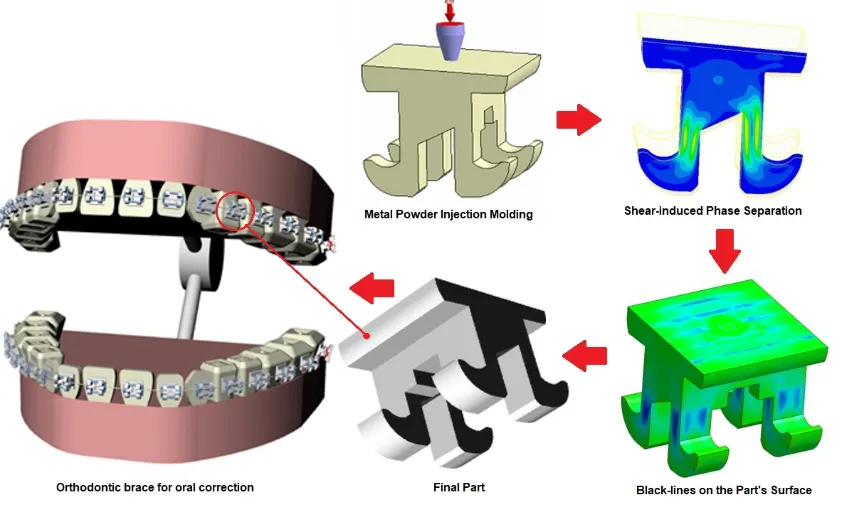
Metal injection molding has become the dominant manufacturing method for orthodontic brackets, combining the shape complexity of injection molding with the material properties of sintered metals. The MIM process offers design flexibility and cost-effective production for highly complex parts with exact dimensions and tolerances.
The process begins with mixing fine metal powder with thermoplastic binders to create feedstock. This material is injected into precision molds under high pressure, forming "green parts" with the desired bracket geometry. The molded components then undergo debinding to remove binders, followed by sintering in a vacuum furnace at temperatures approaching the metal's melting point. Sintering fuses the metal particles, producing brackets with the final mechanical properties.
MIM technology saves more material compared to casting (90% material loss) and milling (50% to 75% material loss), reducing production costs significantly. The process enables manufacturing of brackets with precise torque, angulations, and offsets that fulfill treatment specifications. However, comparative studies indicate MIM brackets average larger slot size deviations (up to 10.4% oversized) compared to CNC-machined brackets (as low as 2.6% oversized).
Computer Numerical Control Machining
CNC machining represents an alternative manufacturing approach that mills brackets from solid metal stock using computer-controlled cutting tools. This subtractive process offers potentially higher dimensional accuracy for critical features like slot size and parallelism. Research comparing MIM and CNC brackets found that while CNC-produced brackets showed less slot oversizing, both manufacturing methods produced slots significantly larger than manufacturer specifications of 0.022 inches.
The CNC process generates more material waste but provides flexibility for small-batch custom production. Some manufacturers combine approaches, using CNC for initial bracket body production followed by laser welding to attach additional components.
Quality Assurance and Standards
Orthodontic brackets must meet stringent regulatory standards including FDA approval in the United States and CE marking in Europe. Quality control measures include dimensional inspection using optical microscopy with 1-micrometer resolution, surface roughness analysis, bond strength testing, and corrosion resistance evaluation.
Manufacturers perform batch testing to ensure consistency across production runs. The removable color-coded identification dots on many bracket systems facilitate proper bracket selection during clinical placement while maintaining product traceability. Advanced imaging techniques including atomic force microscopy enable evaluation of nanoscale surface characteristics that influence friction, bacterial adhesion, and biocompatibility.
Post-Treatment Care and Maintenance
Proper bracket care throughout treatment duration proves essential for achieving optimal outcomes while minimizing complications such as decalcification, gingivitis, and bond failure.
Oral Hygiene Protocols
Plaque and tartar accumulation around brackets and archwires creates conditions favorable for cavity development and gum inflammation. Patients should brush teeth at least twice daily using a soft-bristled toothbrush and fluoride toothpaste, taking care to clean around each bracket and under wires. Flossing requires special technique or tools such as floss threaders to navigate between teeth and around orthodontic hardware.
An alcohol-free antibacterial mouthwash used twice daily helps reduce inflammation and bacterial load. Some orthodontists recommend interdental brushes designed specifically for cleaning between brackets and along wire segments where standard toothbrushes cannot reach effectively.
Dietary Restrictions
Certain foods pose risks to bracket integrity and should be avoided throughout treatment. Hard foods including nuts, ice, hard candies, and raw vegetables can break brackets or dislodge bonded attachments. Sticky foods such as caramel, chewing gum, and certain candies can pull brackets off tooth surfaces or become lodged around brackets where they promote bacterial growth.
When brackets detach from teeth, re-bonding becomes necessary but treatment timing gets disrupted. The orthodontist must remove any residual composite from the tooth surface using a tungsten-carbide bur, re-etch the enamel, and bond a replacement bracket. This process adds chair time and may extend overall treatment duration.
Managing Discomfort
Temporary discomfort typically occurs after initial bracket placement and following each adjustment appointment when archwires are tightened or changed. This discomfort results from the inflammatory response triggered by applied orthodontic forces and usually subsides within a few days.
Over-the-counter pain relievers provide effective symptom management. Acetaminophen (Tylenol) is preferred over NSAIDs like ibuprofen because research indicates NSAIDs block prostaglandins-hormone-like substances involved in the healing process-potentially interfering with tooth movement mechanics. Orthodontic wax can be applied over brackets or wire segments that irritate the inner cheeks or lips, providing a smooth surface that reduces tissue trauma.
Technological Innovations and Future Directions
The orthodontic brackets field continues evolving through materials science advances, digital technology integration, and biomechanics research that promises improved treatment efficiency and patient experience.
3D Printing and Customization
Additive manufacturing enables production of fully customized brackets tailored to individual patient anatomy. LightForce Braces utilizes 3D printing to create patient-specific brackets designed based on digital treatment planning. This customization optimizes tooth movement efficiency by accounting for each tooth's unique size, shape, and position.
The integration of 3D imaging, treatment planning software, and robotic wire bending creates comprehensive digital workflows that enhance precision while reducing manual error. In April 2023, LuxCreo launched the LuxAlign end-to-end system featuring iLux Pro Dental 3D printing, LuxAlign design software, and Direct Clear Aligner Material, demonstrating the convergence of digital technologies in orthodontics.
Smart Materials and Active Systems
Research into shape-memory alloys and temperature-sensitive materials continues advancing archwire technology that complements bracket function. Nickel-titanium wires exhibit unique properties where they remain limp and flexible when cold, allowing easy insertion through bracket slots, then stiffen at body temperature to deliver consistent light forces.
The Carriere InfiNiTi Loops, released by Henry Schein Orthodontics in 2024, utilizes nickel-titanium's shape memory properties to deliver consistent forces for up to 6mm of space closure. This system reduces required appointments and improves case hygiene for patients.
Biocompatibility Enhancements
Surface modification technologies aim to reduce bacterial adhesion on bracket surfaces while maintaining optimal force transfer characteristics. Silver-platinum coatings applied to bracket surfaces demonstrate effective antibacterial activity and biofilm resistance without compromising structural integrity. These coatings particularly benefit patients with poor periodontal health or high caries risk.
Advances in surface treatment methods including chemical etching, sandblasting, and nanotechnology-based modifications continue improving the balance between bond strength requirements and enamel preservation during bracket removal at treatment completion.
Frequently Asked Questions
How long do orthodontic brackets stay on teeth?
Treatment duration varies from 6 months to 30 months depending on case complexity, severity of misalignment, and patient age. The average orthodontic treatment with brackets spans 16 to 18 months. Younger patients often complete treatment faster due to more active bone remodeling during development years.
Can orthodontic brackets damage tooth enamel?
When properly bonded and removed by trained orthodontists, brackets do not permanently damage tooth enamel. The etching process creates microporosities only in the outermost enamel layer, and the bonding adhesive is carefully removed at treatment completion. However, inadequate oral hygiene during treatment can cause decalcification (white spot lesions) around brackets that may require remineralization therapy.
What happens if a bracket breaks or falls off?
Bracket detachment disrupts the designed force system and can delay treatment progress. Contact your orthodontist promptly for re-bonding. Save the bracket if possible, though a replacement may be needed. Avoid attempting to remove a partially detached bracket yourself, as this may damage tooth enamel. Temporary orthodontic wax can cover sharp edges until professional care is available.
Are ceramic brackets as effective as metal brackets?
Ceramic brackets provide equivalent treatment effectiveness to metal brackets for most orthodontic cases. The primary differences involve aesthetics, cost (20% to 30% higher), and slightly increased fragility requiring more careful food choices. Some complex cases may benefit from metal brackets' superior strength and smaller profile, but modern ceramic brackets handle the majority of treatment scenarios effectively.
Key Considerations
Orthodontic brackets represent precision-engineered devices that harness biological responses to achieve tooth movement and bite correction. The selection between metal, ceramic, or self-ligating brackets depends on treatment requirements, aesthetic preferences, and cost considerations. Manufacturing advances including MIM technology and 3D printing continue improving bracket quality and customization capabilities.
Successful orthodontic outcomes require collaboration between patient compliance with oral hygiene protocols, dietary restrictions, and wear schedules, combined with regular professional adjustments and monitoring. The global orthodontics market's projected growth to $38.21 billion by 2034 reflects increasing awareness of dental health's impact on overall well-being and expanding access to corrective treatments across age groups.
Whether considering treatment for yourself or a family member, understanding bracket function, material options, and care requirements provides the foundation for informed decision-making in pursuing orthodontic correction for improved dental health and smile aesthetics.