





Top 10 Wire EDM Machining Service Suppliers in 2026
Last year we lost a German aerospace bracket order. The drawing specified HAZ under 0.0005". Three suppliers quoted, we picked the cheapest one, first batch came back at 0.0015" HAZ. Entire shipment rejected. Rework plus air freight plus customer penalty cost us around $42,000.
That expensive lesson taught me something: Wire EDM supplier selection cannot be based on quoted price alone.
I've spent seven years in procurement and project management at ABIS, handling hundreds of Wire EDM outsourcing orders. This article covers the suppliers I've validated, the pricing structures that actually work, and some insider knowledge that most procurement teams learn the hard way.
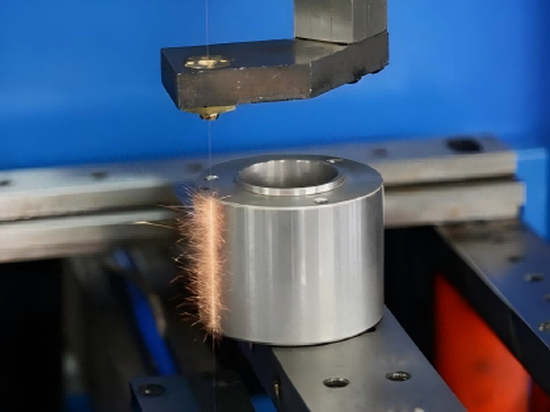
Wire EDM Process Types: The Cost Difference Nobody Tells You
Many buyers don't realize "Wire EDM" covers three fundamentally different processes. Send a slow-wire drawing to a fast-wire shop, you'll get an attractive quote and unusable parts.
Fast Wire (WEDM-HS)
Runs about $0.0008/mm² ($0.52/sq.in.), cuts 1,200 mm²/hour, delivers Ra 3.2+ μm surface and ±0.02mm tolerance. We call this "good enough to cut" internally. Fine for roughing, low-precision stampings, anything where finish doesn't matter.
Medium Wire
A Chinese innovation. Costs $0.0013-0.004/mm² ($0.84-2.58/sq.in.) or $11-21/hour. Gets you Ra 0.8-1.6 μm and ±0.01mm. Best value for money. 70% of our mold components use medium wire.
Slow Wire (WEDM-LS)
Costs ten times more, around $0.007/mm² ($4.52/sq.in.). But delivers Ra 0.1-0.4 μm mirror finish and ±0.002mm tolerance. Aerospace, medical, anything safety-critical requires slow wire.
A 2025 Chinese aerospace tender leaked actual contract prices: fast wire at ¥0.0062/mm², slow wire at ¥0.052/mm². That's roughly the floor price in China. Quotes below these numbers mean either corner-cutting on materials or a shop that takes orders without capacity to deliver.
Pricing by Number of Passes (Slow Wire)
| Passes | Price per mm | Typical Ra | Tolerance |
|---|---|---|---|
| 1 | $0.004 | 3.2 μm | ±0.05mm |
| 2 | $0.005 | 1.4 μm | ±0.025mm |
| 3 | $0.006 | 0.8 μm | ±0.01mm |
| 4 | $0.0075 | 0.4 μm | ±0.005mm |
From one pass to four passes, price increases 87%. Surface quality improvement is exponential. If your part actually needs Ra 0.4 μm, paying for four passes makes sense. If Ra 1.6 μm works functionally but the drawing says Ra 0.8 μm out of habit, you're burning 20% margin for nothing.
Industry rule most buyers miss:
Parts thinner than 20mm get priced as 20mm. Setup time, threading, calibration take the same effort regardless of thickness. Parts over 20mm priced at actual thickness.
Regional Cost Comparison: Where Your Money Goes
This data comes from actual quotes we collected over 18 months, not published rate cards.
HOURLY SHOP RATES BY REGION (2025-2026)
| Region | Budget | Standard | Premium |
|---|---|---|---|
| USA | $35-50 | $65-85 | $100-180 |
| Germany | €40-55 | €65-85 | €100-150 |
| UK | £35-50 | £55-75 | £90-130 |
| China (Slow) | $18-28 | $35-50 | $55-75 |
| China (Fast) | $4-7 | $9-14 | $18-25 |
| India | $12-20 | $25-40 | $45-65 |
US shops commonly quote by cut area rather than machine time:
| Cut Type | $/sq.in. | Effective $/hr |
|---|---|---|
| Single rough | 4-5 | ~$65 |
| Standard (2-3 pass) | 9-10 | ~$140 |
| Precision (4+ pass) | 12-16 | ~$200 |
The $9-10 per square inch figure appears repeatedly in Practical Machinist forum discussions as what experienced shops target. At 15 sq.in./hour cutting efficiency, that yields $150/hour effective rate. Quotes significantly below this raise quality questions.
Supplier Operating Costs: How to Validate Quotes
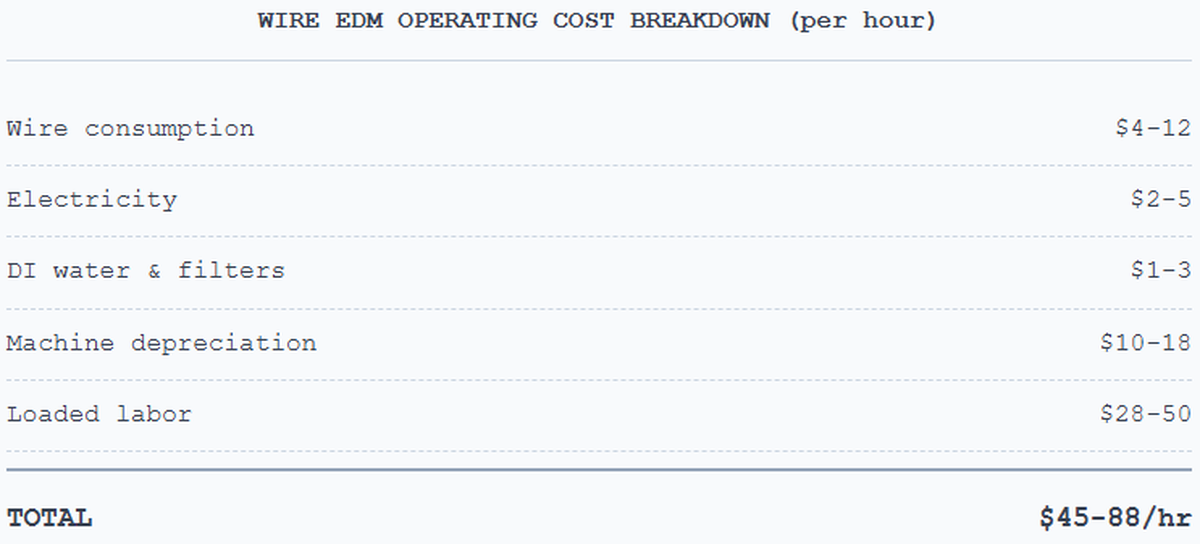
Wire alone consumes 0.5-1.2 lbs/hour at $5-6/lb for standard brass. High-performance coated wire costs double but cuts up to 100% faster. This tradeoff affects your part price depending on whether the shop optimizes for speed or wire cost.
If someone quotes you $25/hour for slow wire EDM in the US, either they're losing money on every job or the "slow wire" machine is actually medium wire with a creative label.
ROI Data: What Switching Suppliers Actually Delivers
These numbers come from documented case studies, not marketing claims.
Case 1: Hudson Technologies (Florida)
Switched from outsourcing to in-house Makino WEDM.
| Metric | Before | After | Delta |
|---|---|---|---|
| Annual wire cost | $10,450 | $4,539 | -$5,911 |
| Post-EDM polishing | 4-6 hrs/part | 0 | -100% |
| Weekly capacity | baseline | +27 hrs | +30% |
| Customer lead time | 12 weeks | 4 weeks | -67% |
Source: Methods Machine Tools case documentation
Case 2: Vanderhorst Brothers (California)
Brought EDM in-house after 30% scrap rate from previous supplier.
| Result | Impact |
|---|---|
| Wire consumption vs old equipment | -32% |
| Machine consolidation | 2→1 (same output) |
| 5-year wire savings | ~$32,500 |
| Scrap from EDM process | 0% (was 30%) |
Case 3: Diamond Innovations (Ohio)
Implemented automated Wire EDM cells with robotic loading.
| Metric | Result |
|---|---|
| Time per assembly | -60% |
| Shift coverage added | 2nd, 3rd, weekend |
| Part repeatability | ±0.0005"→±0.0002" |
Make vs. Buy Decision Framework
| Your Situation | Recommendation | Reasoning |
|---|---|---|
| <50 parts/month, irregular | Outsource | Capital doesn't justify utilization |
| 50-500 parts/month, steady | Calculate both | Run 24-month payback scenarios |
| >500 parts/month | In-house | ROI positive within 12-18 months |
| Prototype/development | Outsource | Speed and flexibility trump cost |
| ITAR/classified | US-only or in-house | Compliance limits options |
| Lead-time critical | Dual source | Supply chain resilience |
The 10 Suppliers Worth Evaluating
I've organized these by the scenarios where each performs best, not arbitrary ranking. Your requirements determine which fits.
Platform Networks
Xometry operates North America's largest manufacturing network with 10,000+ partner shops. Certification portfolio is comprehensive: ISO 9001, AS9100D, IATF 16949, ISO 13485, ITAR, CMMC Level 2. Instant quoting works for standard jobs. Complex geometries still need engineering review.
The tradeoff with platforms: you never know which shop actually makes your parts. Reorders might go to different facilities. For prototypes and low-volume this rarely matters. For production runs needing process consistency, it's a real concern.
Protolabs/HUBS is publicly traded (NYSE: PRLB, Q3 2025 revenue $135.4M), which means financial stability for supply chain risk management. Speed is their selling point. But Wire EDM tolerance only reaches ±0.020mm, signaling precision work isn't their strength. Good for prototype validation, not precision tooling.
Fictiv bridges domestic and international with facilities in Oakland, Phoenix, Guangzhou, Bengaluru, Mexico. Published specs claim ±0.0001" tolerance and 32 μin Ra, 95.4% on-time delivery. Global footprint enables prototyping domestically then shifting to Asia for production cost optimization.
Dedicated EDM Specialists
XACT Wire EDM runs 45+ machines across Wisconsin and Illinois, making them one of North America's largest pure-play Wire EDM operations. 24/7 three-shift operation with auto-threading. ±0.0001" tolerance, 16" max thickness, 30° taper capability. ISO 9001:2015 and ITAR.
When you need dedicated EDM focus rather than general manufacturing network access, specialists like XACT deliver more predictable results. You're talking directly to the operators running your parts.
Fathom Manufacturing has eight US facilities serving regulated industries. Client list includes Harley-Davidson, 3M, Medtronic. Certifications: ISO 9001, ISO 13485, AS9100D, ITAR, NIST 800-171. Rough cut ±0.002", trim pass ±0.0002", max thickness 15". Typical lead time 6-8 days.
Their compliance infrastructure is mature. If your customer requires AS9100 or ISO 13485 flowdown, Fathom reduces audit burden.
European Option
Get It Made serves UK and European buyers with engineer-reviewed quotes within 24 hours, not algorithmic instant pricing. This catches DFM issues before quoting completes. Tolerance ±0.012mm (±0.0005"), wire diameter 0.05-0.35mm. ISO 9001:2015. Strong in aerospace, defence, medical, motorsport.
For programs requiring English communication and European delivery, they reduce coordination overhead compared to Asian sourcing.
China-Based Suppliers
RapidDirect has the most complete certification portfolio among Chinese Wire EDM providers: ISO 9001, ISO 13485, ISO 14001, IATF 16949. Their platform connects 700+ vetted suppliers. Tolerance ±0.001" (±0.025mm), surface finish 16 μin Ra, lead times as fast as 1 day on simple parts. Trustpilot rating across 307 reviews provides third-party validation.
For cost-sensitive production where Western certifications remain mandatory, RapidDirect represents the current benchmark.
WayKen specializes in surface finish quality. Their published capability reaches Ra 0.1 μm, matching ultra-fine finishing that requires 5+ skim passes. 35,000 sq.ft. facility, 20,000+ parts/month capacity. ISO 9001 and IATF 16949. Pricing roughly 30% below European/American equivalents.
Best fit for appearance-critical parts like consumer electronics tooling.
3ERP is smaller but service-oriented. Quotes within 10 hours, ships within 7 days, claims 99% on-time delivery. Tolerance ±0.01-0.005mm, 4-axis EDM capability. ISO 9001:2015.
We've worked with them on rush orders. Communication is smoother than larger platforms, engineers talk directly. But capacity is limited for large batch orders.

ABIS Mold is where I work. Founded 1996, 100+ employees, core business is injection molds. Wire EDM is one process within our integrated manufacturing capability. Certifications: TS/16949, ISO 9001, ISO 14001. We produce 400+ mold sets annually, 60% exported to Europe and North America.
Our strength isn't standalone Wire EDM contract work. Margins are too thin on that. Our value is integrating EDM within complete tooling projects. If you need a mold solution from design through trial to production, Wire EDM is one step among CNC, EDM, polishing, assembly, and a dozen other operations. Consolidating these under one supplier eliminates coordination headaches and finger-pointing between vendors.
But if you only need Wire EDM machining services without mold requirements, the dedicated shops above probably fit better. Different tools for different jobs.
Junying Metal Manufacturing has 16 years experience across Wire EDM, Sinker EDM, and hole drilling EDM. Tolerance ±0.005" (±0.127mm) per ISO 2768. ISO 9001:2015. Sample lead time 7-10 days.
Positioned for value, suitable for industrial parts where tolerance requirements are moderate and you need reliability without premium pricing.
Supplier Comparison Matrix
| Supplier | Location | Best Tol. | Key Certifications | Lead Time |
|---|---|---|---|---|
| Xometry | USA (network) | ±0.0001" | ISO,AS9100D,ITAR,13485 | Days |
| XACT Wire EDM | Wisconsin/IL | ±0.0001" | ISO 9001, ITAR | 24/7 |
| Fathom | USA (8 sites) | ±0.0002" | ISO,AS9100D,13485,ITAR | 6-8 days |
| Fictiv | Global | ±0.0001" | ISO 9001 | 7 days |
| Protolabs/HUBS | USA | ±0.001" | ISO 9001, AS9100D | 5+ days |
| Get It Made | UK | ±0.0005" | ISO 9001 | 24hr quote |
| RapidDirect | China | ±0.001" | ISO 9001,13485,IATF | 1+ days |
| WayKen | China | ±0.005mm | ISO 9001, IATF | Days |
| 3ERP | China | ±0.005mm | ISO 9001 | 7 days |
| ABIS Mold | Shenzhen | Project | TS/16949,ISO 9001,14001 | Project |
| Junying | China | ±0.005" | ISO 9001 | 7-10 days |
Technical Issues That Kill Orders
These problems suppliers won't volunteer during quoting but will definitely affect your parts.
Wire Breakage
Most common quality issue. Every break leaves a scar on the part surface. I've seen suppliers deliver parts with three or four break marks, still trying to pass inspection.
Experienced operators troubleshoot in this order: flushing first, then power contacts, then electrical parameters. 90% of wire breaks trace to poor flushing. Debris accumulates in the cut zone, arc concentrates at one point, wire melts.
If a supplier says "this material breaks wire too easily, we can't do it," they probably lack experience. Competent shops handle tungsten carbide, titanium, superalloys without issue. Just slower.
Aluminum Handling
Aluminum Wire EDM is a nightmare. Chips float instead of sinking, contaminating the entire tank and filtration system. Aluminum reacts with water producing aluminum hydroxide, spiking conductivity. Worse, aerospace grades like 7075 and 2024 corrode rapidly if left sitting in the tank after cutting.
One forum veteran said he "hates Wire EDM aluminum." Not exaggerating. If your parts are aluminum, ask suppliers specifically about their aluminum handling procedures before quoting. Shops without experience will ruin your parts.
Thickness Limitations
Machines may spec 17" cutting capacity. Production reality differs.
A 20+ year veteran on Practical Machinist forums: "My machine will burn 17" thick material but I rarely burn anything thicker than 12" tool steel. You go thicker, you increase problems with flush, wire blow-off, accuracy, finish and speed. It gets glacial."
For 12" thick Hardox steel, feed rate drops to 0.005-0.010 ipm. Optimal thickness for balancing speed, accuracy, and finish is around 2". Above 4", every additional inch compounds problems.
If you have thick material requirements, state this explicitly during quoting. Don't discover capability limits after parts are scrapped.
Heat Affected Zone (HAZ) Control
Wire EDM creates a recast layer where material melted and resolidified with altered metallurgical properties. For fatigue-critical aerospace and medical parts, this layer must be characterized and controlled.
HAZ Depth by Cutting Condition
| Condition | HAZ Depth |
|---|---|
| Rough cut only | 0.025-0.038mm |
| Rough + 1 skim | 0.007-0.008mm |
| Rough + 2 skims | 0.0025-0.003mm |
| Multiple finish passes | <0.005mm |
If drawings specify HAZ limits, verify supplier capability before ordering. Some don't know what HAZ means. Some know but lack measurement equipment. Some have equipment but no experience with controlled HAZ work.
Removal methods include electropolishing (controllable to ±0.005mm stock removal), glass bead blasting at 40 PSI with fine media, or chemical milling for uniform removal.
Certification Requirements by Industry
| Industry | Required | Preferred | Notes |
|---|---|---|---|
| Aerospace | AS9100D | NADCAP AC7116 | NADCAP audit requires AS9100 first |
| Medical | ISO 13485 | FDA registration | FAI mandatory on all production |
| Automotive | IATF 16949 | Core Tools proficiency | APQP, PPAP, FMEA, MSA, SPC |
| Defense | ITAR registration | - | Penalties up to $1M per violation |
| General industrial | ISO 9001 | - | Foundation cert, doesn't indicate capability |

Supplier Qualification Checklist
Equipment Questions
What Wire EDM machines? Make, model, year?
Maximum workpiece thickness?
Taper cutting capability? To what angle?
Wire diameter range?
Capacity Questions
Current utilization percentage?
24/7 operation or single shift?
On-time delivery rate past 12 months?
Standard vs rush lead times?
Quality Questions
Defect rate past 12 months? How calculated?
CPK data on ±0.0002" tolerance production runs?
CMM equipment brand and model?
Calibration records current?
Red Flags During Site Visits
Expired calibration stickers on measuring equipment
Quality boards not updated recently
WIP parts sitting without contamination protection
Operators unable to explain jobs currently running
Dirty or discolored dielectric fluid
Significant coolant leaks around enclosures
How to Get Better Quotes
Provide complete information upfront: Material grade, heat treatment condition, dimensional tolerances, surface finish, quantity, delivery date, inspection report requirements, future volume potential. More detail means more accurate quotes and less back-and-forth.
Don't fixate on unit price. Factor in freight, taxes, payment terms, tooling amortization, engineering change handling, defect liability. Some suppliers quote low but bury costs in terms and conditions.
Request itemized quotes: Material, machining, inspection, packaging, shipping listed separately. This lets you judge each component's reasonableness and negotiate with leverage.
Maintain 2-3 qualified suppliers. Don't concentrate all orders with one shop, but don't constantly switch for price either. Stable relationships yield better pricing, faster response, higher priority when capacity is tight.
Consider total cost. A Chinese supplier saving $0.01/mm² means nothing if quality variability causes rework, or late delivery triggers customer penalties.
That $42,000 loss I mentioned at the start came from picking the lowest quote without understanding HAZ requirements. Expensive education. Wire EDM delivers precision no other process can match for certain geometries and materials. Capturing that precision requires suppliers who understand both the technology and your specific application needs.
Author works in procurement and project management at ABIS Mold Technology Co., Ltd. Data sources include Practical Machinist forums, supplier documentation, and project experience across aerospace, medical, and industrial tooling programs.