





Last quarter we took over a mould transfer from a European supplier-automotive interior trim, PA66-GF30, tolerances at ±0.08mm. The client's production team had been fighting dimensional instability for months. They'd already upgraded to a $12,000 pressurized water unit with ±0.2°C control accuracy. The problem persisted.
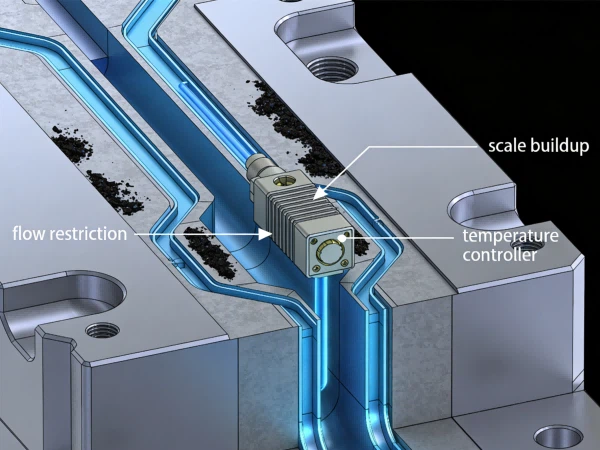
We pulled the mould and ran dye through the cooling circuits. Two of the six channels showed 60% flow restriction from scale. One circuit on the core side passed 32mm from the cavity surface at the gate area-nearly triple the recommended distance for glass-filled nylon. The temperature controller was doing exactly what it was supposed to do. The mould wasn't giving it anything to work with.
This is the conversation we end up having more often than we'd like. Mould temperature controller selection gets treated as a procurement decision disconnected from tooling design. Purchasing evaluates flow rates, heating capacity, control precision. Engineering signs off. Production installs the unit and expects it to solve thermal management for whatever mould happens to be in the machine. That's not how heat transfer works.

The Ceiling Nobody Talks About
A mould temperature controller can only remove heat as fast as the cooling circuit allows. Channel diameter, distance from cavity surface, circuit routing, flow turbulence-these determine the thermal extraction rate. The controller regulates supply temperature and flow. If the geometry limits how much heat reaches the coolant, the controller has nothing to regulate.
ENGEL's temperature control group puts the number at roughly 20% of reject mouldings tracing to temperature control errors (engelglobal.com). What that statistic doesn't break out is how many of those "errors" are actually design limitations. In the moulds we've audited over the past two years, equipment malfunction accounts for maybe one in five temperature-related quality issues. The rest come down to cooling circuits that were undersized, poorly positioned, or degraded through neglect.
We had a medical connector mould last year-POM, eight cavities, tight cosmetic requirements on the mating surfaces. The client specified an oil-based controller because their material supplier's datasheet recommended 95°C mould temperature. Oil units run quieter and the maintenance team preferred them. Fine. But POM doesn't need oil-based temperature control at 95°C. A pressurized water system handles that range with better thermal response and about 40% lower energy consumption. The real issue was that the original mould design had cooling channels routed around the ejector pins in a way that created dead zones on the cavity side. Switching from oil to water wouldn't have fixed that. Redesigning the circuit layout did.
What Actually Drives the Payback
Regloplas documents 50% pump energy reduction with variable frequency ∆T control at 20% speed reduction (regloplas.com). That's a real number from a reputable manufacturer. It's also a number that assumes your cooling circuit can utilize the flow rates the pump delivers. Scale buildup, undersized channels, excessive circuit length with too many bends-any of these constraints means the pump runs harder to push coolant through restrictions that shouldn't exist.
The fastest payback we've seen on temperature control optimization didn't involve buying new equipment. A cosmetics packaging client in Poland cut cycle time from 28 seconds to 16 seconds by descaling three circuits, replacing a drifted PT100 sensor, and rebalancing flow between the cavity and core sides. Total spend was under €2,000. Cycle time reduction on 2.4 million annual parts generated savings that recovered the investment in less than a week. The temperature controllers they were using-nothing special, standard water units from a Chinese supplier-worked fine once the cooling system was actually functioning.
P&G's Braun facility took the opposite approach, investing heavily in electronic flow monitoring across every cooling circuit on their Oral-B component moulds. They achieved documented reject rates below 0.05% (ptonline.com). But the Braun team also acknowledged that before implementing per-circuit monitoring, temperature control had been a "black box" for them. They suspected thermal variation was affecting dimensional consistency but couldn't diagnose which circuits were problematic. That's the real value of sophisticated temperature control technology-visibility into a process that most facilities treat as set-and-forget.

The Material Question
We get asked about water versus oil temperature controllers more than almost any other equipment question. The answer is boringly straightforward: use water whenever possible, pressurized water for engineering thermoplastics up to about 230°C, oil only when you genuinely need mould surfaces above that range. PEEK, PPS, certain high-temperature polyimides-those require oil. PA, PC, POM, ABS, everything in the commodity and standard engineering range-water handles it with better thermal conductivity, lower operating cost, and none of the contamination headaches.
The more interesting question is how material selection affects cooling circuit design, which then affects what the temperature controller needs to accomplish. Glass-filled compounds transfer substantially more heat into the mould than unfilled grades at equivalent shot volumes. A mould designed for unfilled PA66 will struggle thermally when production switches to 30% glass-filled PA66. The cooling circuits sized for the unfilled material can't extract heat fast enough. Cycle times extend or parts come out with residual stress from insufficient cooling.

We design for the most demanding material grade the tool will process. If there's any chance production will migrate from unfilled to filled compounds, the cooling system needs to accommodate that from day one. Retrofit modifications-adding circuits, installing conformal cooling inserts-run $5,000 to $15,000 and require taking the mould out of production. Building adequate thermal capacity into the original design adds maybe 10-15% to tooling cost. The math usually favors doing it right the first time.
The Maintenance Blind Spot
Nobody budgets for cooling system maintenance until something breaks. Quarterly descaling, flow rate verification, seal inspection-these tasks get pushed because production schedules are tight and the moulds are "running fine." Then gradually, over six to twelve months, cycle times drift upward. Quality metrics slip. Someone eventually pulls the tool and finds channels that look like the inside of an old water heater.
A 1/16-inch scale layer adds roughly 15% to cooling time. That accumulates slowly enough that operators attribute the longer cycles to material batch variation, ambient temperature changes, or machine wear. By the time the connection to cooling system degradation becomes obvious, you've eaten the cycle time penalty across thousands of production hours.
The facilities that avoid this trap treat cooling system maintenance the way they treat preventive maintenance on the injection machines themselves-scheduled, documented, non-negotiable. Flow testing every quarter. Descaling annually or when flow rates drop below baseline. Sensor calibration on an actual schedule rather than when readings start looking suspicious. These aren't expensive activities. They just require someone to own the responsibility.

Where We Come In
At Abis Mould, cooling system specification is part of the DFM scope on every program. We model heat flux distribution, size channels for the material and cycle time targets, and configure circuit routing to avoid the dead zones and flow restrictions that create problems in production. The temperature controller selection happens downstream-once we know what thermal conditions the mould can actually support.
For existing moulds with temperature-related quality issues, we can evaluate whether the constraint is equipment or geometry. Sometimes upgrading the controller makes sense. More often, the issue is a cooling circuit that needs modification or maintenance that's been deferred too long. Either way, the diagnosis starts with the mould, not the spec sheet on a new temperature control unit.
If you're planning a mould program with tight thermal requirements, or fighting temperature issues on existing tooling, our engineering team can walk through the specifics. The cooling system conversation is more productive when it happens early-but it's never too late to figure out what's actually limiting performance.