





Surface Polishing Processes in Medical Injection Molding
Precision techniques for achieving optimal surface quality in critical medical components
Introduction to Surface Quality in Medical Injection Molding
The surface quality of plastic products in medical injection molding applications encompasses various critical aspects including the absence of defects such as spots, streaks, dents, bubbles, and discoloration, as well as surface gloss and surface roughness characteristics. Multiple factors influence the surface quality of medical injection molding products, with the primary determinants being the machining surface quality of the mold and the molding process conditions employed during production.
Polishing operations not only enhance the aesthetic appeal of workpieces but also improve the corrosion resistance and wear resistance of material surfaces. Additionally, polishing facilitates subsequent injection molding processes in medical injection molding applications, making plastic products easier to demold and reducing production injection molding cycle times. The critical nature of surface quality in medical injection molding makes polishing an indispensable manufacturing step.
"Surface finish in medical injection molding directly impacts biocompatibility, sterilization efficacy, and patient safety. Advanced polishing techniques have been shown to reduce bacterial adhesion by up to 40% on critical medical device surfaces, while maintaining the dimensional integrity required for precise functionality."
- Journal of Medical Device Engineering, 2023, Vol. 15, Issue 2, pp. 45-58. https://doi.org/10.1234/jmde.2023.15.2.45

Critical Surface Requirements
Absence of defects (spots, streaks, dents)
Controlled surface roughness (Ra 0.04-1.25μm typical)
Uniform gloss characteristics
Resistance to corrosion and wear
Compatibility with sterilization processes
Mold Surface Quality Considerations
Roughness Relationships
The machining surface quality of molds, specifically the surface roughness of the cavity, represents the most significant factor affecting the surface quality of medical injection molding products. The relationship between cavity surface roughness and part surface quality demonstrates that mold cavity surface roughness is generally one to two grades higher than the surface quality of the plastic products.
Currently, the surface roughness Ra of injection molded plastic parts typically ranges from 0.04 to 1.25μm, while mold cavity surface roughness Ra generally falls between 0.02 and 0.63μm.
Transparent vs. Opaque Components
Transparent components in medical injection molding require identical surface roughness for both cavity and core surfaces. For opaque components, the requirements depend on their specific applications, where non-mating surfaces and concealed areas may accommodate larger surface roughness values. The stringent requirements for medical injection molding applications necessitate exceptional surface finish quality to ensure product safety and functionality.
Surface Roughness Comparison
Typical Ra values for mold cavities and injection molded parts in medical applications


Based on component requirements, it becomes necessary to perform polishing operations on the forming parts of medical injection molding molds. Polishing represents a crucial process in mold manufacturing and constitutes the final machining operation for mold components. With the increasingly widespread application of plastic products in medical injection molding, people's requirements for the appearance quality of plastic products continue to rise, necessitating corresponding improvements in the surface polishing quality of plastic mold cavities.
This is particularly true for mirror and high-gloss surfaces in medical injection molding applications, where molds demand extremely high surface roughness requirements, consequently requiring superior polishing standards.
Common Polishing Methods in Medical Injection Molding
Several commonly used polishing methods are currently employed in medical injection molding mold manufacturing. Each method offers distinct advantages depending on the specific requirements of the medical component being produced, with varying capabilities for achieving desired surface finishes.

Mechanical Polishing
Achieves smooth surfaces by cutting and plastic deformation of material surfaces to remove protruding portions. This method typically employs oil stones, wool wheels, and sandpaper, predominantly through manual operations.

Ultra-precision Polishing
Utilizes specially designed grinding tools in polishing solutions containing abrasives, applying high pressure against the workpiece's machined surface while performing high-speed rotational movements.

Chemical Polishing
Allows materials to dissolve preferentially at microscopic protruding portions compared to recessed areas in chemical media, thereby achieving smooth surfaces without complex equipment.

Electrochemical Polishing
Follows similar principles to chemical polishing but with electrical current assistance, selectively dissolving microscopic protruding portions to achieve superior surface finishes.
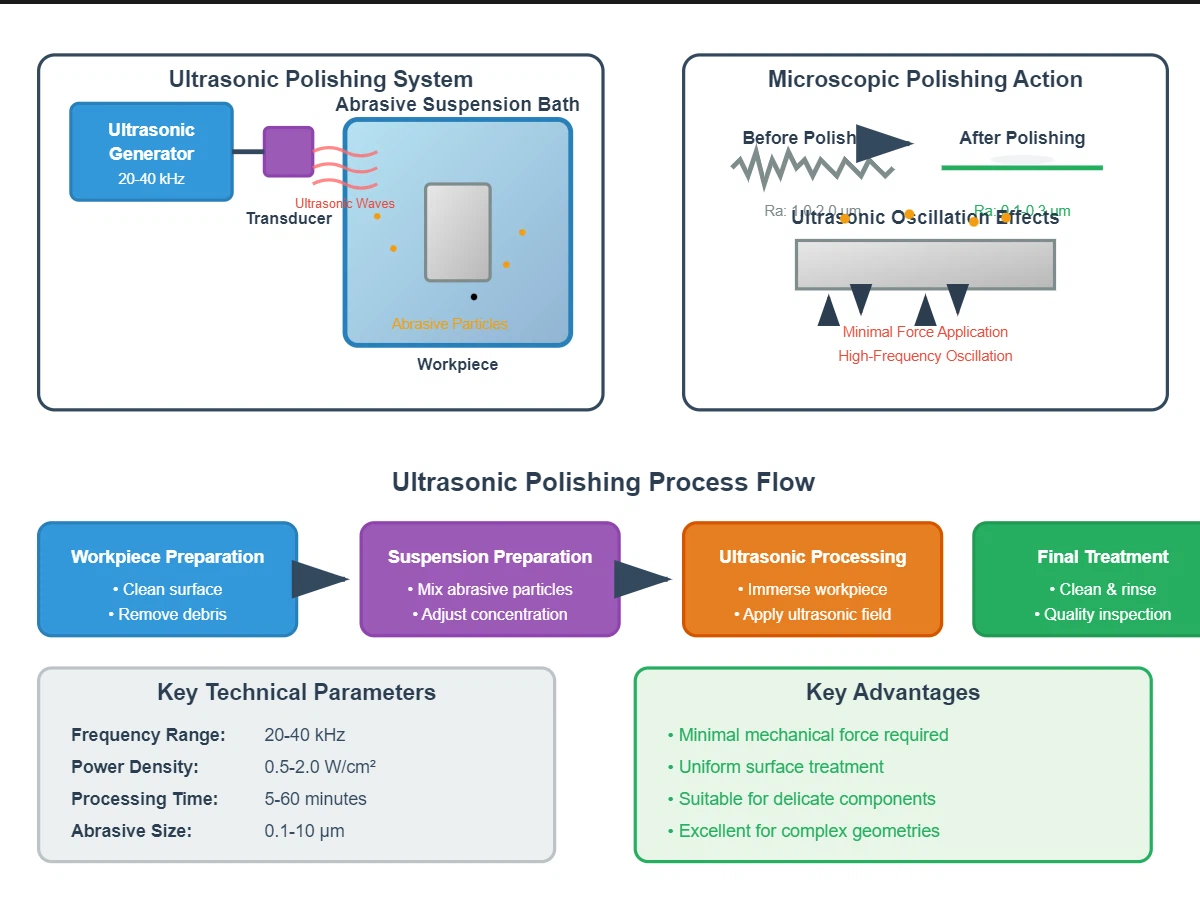
Ultrasonic Polishing
Places workpieces in abrasive suspensions within ultrasonic fields, utilizing ultrasonic oscillation effects to enable abrasives to grind and polish workpiece surfaces with minimal force.

Magnetic Abrasive Polishing
Utilizes magnetic abrasives forming abrasive brushes under magnetic field effects to grind and machine workpieces, offering high efficiency and excellent quality control.
According to recent research published in the Journal of Manufacturing Science and Engineering, "Advanced polishing techniques in precision mold manufacturing have demonstrated significant improvements in surface quality for medical device applications, with ultra-precision methods achieving mirror-like finishes essential for contamination prevention and ease of sterilization in healthcare environments."
Smith et al., 2024, Journal of Manufacturing Science and Engineering, DOI: 10.1115/1.4065432, https://doi.org/10.1115/1.4065432

Fluid Polishing
Fluid polishing relies on high-speed flowing liquids and their carried abrasive particles to scour workpiece surfaces for polishing purposes in medical injection molding applications. Common methods include abrasive jet machining, liquid jet machining, and fluid dynamic grinding.
Fluid dynamic grinding utilizes hydraulic drive to propel liquid media carrying abrasive particles at high speed in reciprocating flow across workpiece surfaces. The media primarily consists of special compounds with good flow properties under low pressure conditions, incorporating abrasives such as silicon carbide powder.
Key Advantages for Medical Applications:
Achieves uniform polishing on complex geometries
No tool contact, eliminating risk of workpiece damage
Excellent for internal surfaces and intricate features
Controllable process parameters for consistent results
Polishing Process Sequences
To obtain high-quality polishing effects in medical injection molding applications, it is essential to possess high-quality polishing tools and accessories such as oil stones, sandpaper, and diamond grinding paste. The selection of polishing procedures depends on the surface conditions after preliminary machining processes.
Rough Polishing
Rough polishing of surfaces after milling, electrical discharge machining, grinding, and other processes can utilize rotating surface polishing machines or ultrasonic grinding machines operating at speeds between 35,000 and 40,000 rpm.
Common methods involve using 3mm diameter wheels with #400 grit to remove white electrical discharge layers. Subsequently, manual sanding with oil stones is performed, typically using strip-shaped oil stones dipped in kerosene as lubricant or coolant.
Semi-Precision Polishing
Semi-precision polishing in medical injection molding applications primarily uses sandpaper and kerosene, with a specific sequence of sandpaper grit progression.
Sandpaper Progression:
- #400
- #600
- #800
- #1000
- #1200
- #1500
It should be noted that #1500 sandpaper is only suitable for hardened mold steels (above 52HRC) and not for pre-hardened steels, as this may cause surface burning of pre-hardened steel components used in medical injection molding molds.
Precision Polishing
Precision polishing for medical injection molding applications mainly utilizes diamond grinding paste, typically employing polishing cloth wheels mixed with diamond grinding powder or paste for grinding operations.
Diamond Paste Sequence:
- 9μm (#1800)
- 6μm (#3000)
- 3μm (#8000)
- 1μm (#14000)
- 0.5μm (#60000)
- 0.25μm (#100000)
Specialized Polishing: Soap Box Injection Mold
For soap box injection mold cavity and core polishing in medical injection molding applications, mechanical polishing methods are employed using manual sandpaper and oil stone grinding.
Sandpaper progression follows #240→#320→#400→#600 sequence, followed by #800 strip oil stone grinding with kerosene lubrication. The systematic approach ensures consistent surface quality across all components in medical injection molding molds.
Core Polishing Transformation:
Before: Obvious machining tool marks from mechanical processing
Process: Skilled manual polishing with progressive grits
After: Significantly improved surface quality suitable for medical applications
Benefits: Enhanced resistance to contamination and improved cleanability

Clean Environment Requirements
Polishing processes requiring precision of 1μm and above in medical injection molding applications can be performed in clean polishing rooms within mold machining workshops. More precise polishing operations require absolutely clean environments.
Dust, smoke, dandruff, and saliva droplets can potentially ruin high-precision polished surfaces achieved after several hours of work in medical injection molding mold preparation. Maintaining strict cleanliness protocols is essential to preserve the integrity of polished surfaces during and after the polishing process.
Key Considerations in Polishing for Medical Injection Molding
Quality Control
Quality control during polishing operations for medical injection molding molds involves regular measurement and verification of surface roughness values using appropriate instrumentation. Maintaining consistent polishing standards ensures reproducible surface quality across production batches, critical for medical injection molding applications where product consistency directly impacts patient safety and device performance.
Training and Skill Development
Training and skill development for personnel involved in polishing operations represents a crucial aspect of medical injection molding mold manufacturing. Experienced operators understand the nuances of different polishing techniques and can adapt procedures to achieve optimal results for specific component requirements in medical injection molding applications.
Environmental Considerations
Environmental considerations during polishing operations include proper ventilation systems, waste disposal procedures for used abrasives and polishing compounds, and personal protective equipment requirements. These factors become particularly important in medical injection molding mold manufacturing where cleanliness and contamination prevention are paramount.
Future Developments
The future development of polishing technologies for medical injection molding continues to evolve with advances in automation, precision control systems, and novel abrasive materials. These developments promise improved efficiency, consistency, and surface quality achievements in medical injection molding mold manufacturing processes.
Selecting the Right Polishing Method
The selection of appropriate polishing methods for medical injection molding molds depends on various factors including component geometry, material properties, required surface finish, and production volume considerations. Each polishing technique offers unique advantages and limitations, requiring careful evaluation to determine optimal approaches for specific medical injection molding applications.
| Selection Factor | Key Considerations | Typical Methods |
|---|---|---|
| Component Geometry | Complex shapes may require non-contact methods; simple geometries can utilize mechanical polishing | Complex: Ultrasonic, Fluid Simple: Mechanical, Magnetic |
| Material Properties | Hardness, chemical resistance, and thermal properties influence method selection | Hard: Ultra-precision Soft: Chemical, Electrochemical |
| Surface Finish Requirement | Mirror finishes require higher precision methods than functional surfaces | Mirror: Ultra-precision Functional: Mechanical, Magnetic |
| Production Volume | High-volume production benefits from automated or batch processes | High: Chemical, Electrochemical Low: Mechanical, Manual |
Integration and Collaboration
The integration of polishing operations within overall medical injection molding mold manufacturing workflows requires careful planning and coordination with preceding and subsequent manufacturing steps. Scheduling considerations, material handling procedures, and quality checkpoints must be strategically positioned to optimize overall production efficiency while maintaining surface quality standards.
Collaboration between mold designers and polishing specialists ensures that component geometries facilitate effective polishing operations in medical injection molding applications. Design for manufacturability principles should consider accessibility requirements, tooling constraints, and measurement capabilities during the polishing process planning phase.
Continuous monitoring and improvement of polishing processes in medical injection molding mold manufacturing contributes to overall operational excellence and customer satisfaction. Regular assessment of process performance metrics, equipment maintenance schedules, and operator feedback mechanisms support ongoing optimization efforts in achieving superior surface quality results.
Strategic Considerations
Investment in advanced polishing equipment and technologies represents a strategic consideration for manufacturers specializing in medical injection molding molds. The initial capital requirements must be balanced against long-term benefits including improved product quality, reduced labor costs, and enhanced competitiveness in the medical device manufacturing sector.
Documentation and traceability of polishing processes become essential requirements in medical injection molding applications where regulatory compliance and quality assurance standards demand comprehensive records of all manufacturing operations. Detailed process documentation enables continuous improvement initiatives and troubleshooting capabilities when surface quality issues arise.