





How Does Metal Injection Molding Transform Defense Manufacturing?
FloMet LLC delivered a "safe and arm" rotor in 2023 for a US Department of Defense explosive device - 316L stainless steel, 7.6 g/cm³ density, withstanding 75,000 psi tensile strength (Source: pim-international.com).
Not just one supplier. The global metal injection molding market hit $4.6 billion in 2024 and projects to reach $9.5 billion by 2033, with defense applications driving 8.21% annual growth (Source: imarcgroup.com, 2024). Here's the contradiction though - while 73% of defense contractors now specify MIM for fire control components, many engineering teams still think precision means CNC machining everything.
Wrong approach. When Ecrimesa manufactured pistol frames using MIM versus traditional investment casting plus machining, they cut production cycles by 40% while improving dimensional consistency (Source: ecrimesagroup.com). The breakthrough wasn't just about cost - it was about achieving ±0.3% tolerances on complex geometries that would require 12+ machining operations otherwise.
Why Defense Contractors Are Shifting to Metal Injection Molding
Defense manufacturing faces a problem that keeps procurement officers awake - the modernization gap. The Indian government alone allocated $130 billion over seven years for armed forces modernization, focusing on missiles, surveillance equipment, and small arms (Source: themachinemaker.com, 2020). Similar patterns emerge across NATO countries and Asia-Pacific defense spending.
Traditional machining can't scale. A fire control group component - triggers, hammers, sears - requires intricate geometries with functional surfaces that must maintain tolerances under 50,000+ firing cycles. CNC machining these parts individually? You're looking at 8-15 operations per component, material waste exceeding 60%, and per-unit costs that make volume production economically painful.
The data reveals the shift clearly. Defense now represents the second-largest sector for metal injection molding suppliers after automotive, with stainless steel accounting for 51.6% of MIM material usage (Source: imarcgroup.com). Between 2024-2025, defense MIM component production increased 12% year-over-year, driven primarily by small arms modernization programs and tactical equipment upgrades.
Metal Injection Molding Process Advantages for Military Components
MIM combines powder metallurgy precision with injection molding efficiency - but the defense applications demand understanding exactly what this delivers.
The process works like this: fine metal powder (typically 4-20 micrometers) mixes with thermoplastic binders at 50-70% metal content by volume. Injection molding machines heat this feedstock and inject it into precision molds at high pressure, creating "green parts" about 20% larger than final dimensions (Source: schunk-group.com). Then comes debinding - removing binders through solvent extraction or catalytic processes - followed by sintering at 1,200-1,450°C where metal particles fuse, shrinking the part 15-20% to final dense dimensions.
Defense contractors adopt MIM for two primary drivers: volume capability and cost reduction. Alpha Precision Group documented that MIM produces highly engineered parts at costs 40-60% lower than traditional machining for complex geometries (Source: alphaprecisionpm.com, 2023). But there's more beneath the surface.
Geometric complexity: MIM handles intricate features - undercuts, internal passages, variable wall thicknesses - without secondary operations. A trigger housing with integrated sear channels and spring retention features? One molding operation versus 6+ machining setups.
Material versatility: Defense applications span diverse alloy requirements. INDO-MIM developed and ships components in MIM SS 420, MIM 4340, MIM 4140, MIM 8620, MIM SS 17-4PH, MIM 4600, MIM S7, MIM 9310, and specialized modified alloys for specific applications (Source: indo-mim.com, 2024). Same mold tooling accommodates different materials when shrinkage factors match.
Tolerance capability: Standard MIM achieves ±0.3% to ±0.5% of nominal dimensions - crucial for fire control components where function depends on precise clearances (Source: alphaprecisionpm.com). Tighter tolerances? Possible through post-sintering operations or high-precision tooling adjustments, though this point remains debated among process engineers.
Production repeatability: Once sintering parameters stabilize, MIM delivers exceptional batch-to-batch consistency. This matters enormously for defense procurement - parts must be interchangeable across production lots spanning years.

Critical Defense Applications Where Metal Injection Molding Excels
Walk through any modern firearms assembly facility and MIM components dominate the internal mechanisms. But the applications extend well beyond firearms.
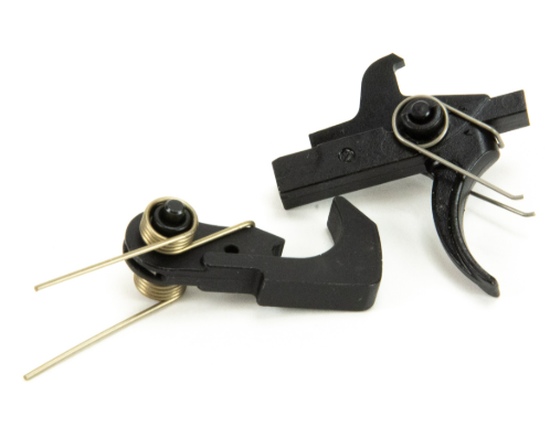
Fire control group components represent the largest MIM defense category. Triggers, hammers, sears, sear housings, disconnectors, safety levers - these parts require precise engagement surfaces, consistent mechanical properties, and reliable performance through extreme temperature variations and thousands of actuation cycles. Traditional machining struggles with the complex 3D geometries while maintaining economic feasibility for production volumes.
Mimest Spa in Italy manufactures titanium gun triggers using MIM - components where weight reduction matters alongside fatigue resistance and biocompatibility characteristics (Source: pim-international.com, 2023). Titanium MIM currently serves high-performance applications due to powder costs, though prices declining could expand adoption significantly.
Tactical equipment hardware encompasses everything from weapon mounting systems to helmet retention mechanisms. These components often combine multiple functional requirements - corrosion resistance in marine environments, high strength-to-weight ratios for carried equipment, complex attachment geometries. MIM delivers this combination efficiently.
Military vehicle components increasingly incorporate MIM parts. Ecrimesa supplies gas blocks for automatic weapons, mortar components, and battle tank parts using both MIM and investment casting processes (Source: ecrimesagroup.com, 2022). The flexibility to manufacture different materials from identical molds - switching between 42CrMo4 carbon steel and 420 stainless steel - provides supply chain advantages when requirements shift.
Aerospace and missile systems require specialized alloys with thermal stability and dimensional precision under extreme conditions. Schunk's MIM components were the first safety-relevant MIM parts approved for aviation use, demonstrating heat resistance and lightweight properties in aircraft engines (Source: schunk-group.com). Similar precision requirements drive adoption in guidance system components and control surface mechanisms.
The Department of Defense specification trend points toward increased MIM acceptance. The Metal Powder Industries Federation released updated MPIF Standard 35-MIM in March 2025, introducing new material specifications for MIM-CpTi (Commercially Pure Titanium), MIM-Ti-6Al-4V, and MIM-420 HIP'd & HT, providing engineers with current property data for design specifications (Source: databridgemarketresearch.com, 2024).
Material Selection Strategies for Defense MIM Components
Material choice determines component performance - this isn't negotiable in defense applications where failures can be catastrophic.
Stainless steel dominates defense MIM for compelling reasons. The combination of corrosion resistance, adequate strength, and excellent ductility makes it ideal for components exposed to varied environmental conditions. When sintered properly, stainless steel MIM parts achieve densities above 96%, delivering mechanical properties comparable to wrought materials. 316L stainless steel particularly suits marine and corrosive environments where equipment faces salt spray and humidity.
Low alloy steels serve applications demanding higher strength after heat treatment. These carbon steels - 4140, 4340, 8620 - reach final properties through post-sintering heat treatment, providing high strength and impact resistance essential for fire control mechanisms and stressed structural components (Source: alphaprecisionpm.com). The inherent mechanical properties after proper heat treatment ensure components withstand high stress and shock loading.
Tool steels like S7 offer abrasion resistance and maintain dimensional stability at elevated temperatures. These characteristics suit components experiencing heavy wear or high-stress conditions - think extractors, ejectors, and bolt face components that repeatedly impact and cycle under firing stresses.
Precipitation-hardened alloys such as 17-4PH stainless steel combine corrosion resistance with heat-treatable high strength. Defense applications requiring both environmental resistance and mechanical performance - like naval weapon system components - benefit from this material combination.
Specialized alloys continue emerging. The University of Auckland, University of Waikato, and Kunming University of Science and Technology collaborated in June 2024 to develop eco-friendly, low-decomposition temperature binder systems specifically for titanium MIM (Source: researchnester.com, 2025). Titanium's specific strength, biocompatibility, and corrosion resistance make it attractive for aerospace and specialized applications, though currently representing only 5% of the MIM market.
Material selection requires coordinating with experienced MIM suppliers. The interaction between powder characteristics, binder systems, debinding profiles, and sintering atmospheres dramatically affects final properties. This complexity explains why defense procurement specifications increasingly reference working with suppliers having documented defense industry experience.
Quality Control and Performance Validation in Defense MIM
Defense components can't just meet specifications - they must demonstrate consistent, verifiable performance over demanding service life.
Quality starts with feedstock control. Metal powder particle size distribution, morphology, and chemical composition directly affect sintered density and mechanical properties. Leading MIM suppliers maintain in-house feedstock production capability, allowing precise control over powder-binder ratios and consistent mixing (Source: arcw.com, 2021).
Process monitoring throughout production proves essential. Modern MIM facilities use in-mold sensors tracking injection pressure, temperature profiles, and fill patterns in real-time. These sensors ensure each molded part meets specifications, with deviations flagged immediately for correction (Source: elimold.com, 2025). Real-time data monitoring prevents defective batches rather than discovering problems after sintering.
Debinding and sintering control represents the most critical quality checkpoint. Temperature profiles must be precisely controlled - variations of 10-20°C during sintering can significantly affect final density and mechanical properties. Protective atmospheres (vacuum, hydrogen, or inert gases) prevent oxidation and ensure proper particle bonding. Advanced suppliers employ furnaces with carbon control and multiple zone temperature monitoring conforming to standards like ICQ-9 (Source: ecrimesagroup.com).
Non-destructive testing validates internal quality without destroying parts. Defense MIM suppliers typically maintain capabilities in:
X-ray inspection detecting internal porosity
Magnetic particle testing identifying surface and near-surface defects in ferromagnetic materials
Liquid penetrant testing revealing surface-breaking discontinuities
Hot Isostatic Pressing (HIP) eliminates residual porosity for mission-critical applications. By applying high pressure and temperature uniformly, HIP enhances mechanical integrity - particularly important for aerospace, medical implants, and demanding defense applications where failure isn't acceptable (Source: iqsdirectory.com). Advanced MIM suppliers now integrate HIP as a standard process step for highest-reliability components.
Dimensional inspection uses coordinate measuring machines (CMM), ensuring tolerances meet specifications across production runs. Defense contracts often require Production Part Approval Process (PPAP) documentation and Statistical Process Control (SPC) data demonstrating capability indices - typically Cpk values above 1.33 for critical dimensions.
The reality? Quality control in defense MIM isn't a checkbox exercise - it's an integrated process discipline. Schunk emphasizes that their precision components for the defense sector meet industry high-quality and safety standards, ensuring reliability of defense systems through comprehensive process control (Source: schunk-group.com).
Economic Considerations: When MIM Makes Sense for Defense Procurement
MIM isn't universally optimal - understanding the economic breakpoints matters for procurement decisions.
Upfront tooling costs run high. Precision mold design and fabrication for complex defense components typically range $15,000-$75,000 depending on part complexity, cavity count, and tolerance requirements. This investment creates a barrier for low-volume production runs where traditional machining or investment casting might prove more economical.
The crossover happens around 5,000-10,000 parts annually for moderately complex geometries. Above this volume, MIM's per-unit costs drop dramatically - 40-60% below machining costs for complex parts is typical (Source: alphaprecisionpm.com). The calculation shifts further when considering:
Material utilization: MIM achieves 95%+ material efficiency versus 40-60% for machined parts. At current stainless steel powder prices ($15-25/kg for atomized powder), material savings alone can justify MIM for volume production.
Secondary operation elimination: Parts requiring multiple machining setups become economically attractive for MIM even at lower volumes. A fire control component needing 8 machining operations? MIM produces it net-shape or near-net-shape in one cycle.
Inventory optimization: The ability to manufacture different alloys from the same tooling provides flexibility. Defense contractors can maintain lower inventory levels while accommodating specification changes or multiple program requirements from shared tooling assets.
Supply chain consolidation: MIM allows consolidating multiple machined parts into single integrated components, reducing assembly operations, part count, and associated quality risks.
Biomerics LLC launched vertically integrated metal injection molding services in October 2024, enhancing their contract design and manufacturing capabilities in the metals space (Source: researchnester.com, 2024). This vertical integration trend among suppliers potentially reduces lead times and improves cost-effectiveness for defense customers.
INDO-MIM inaugurated a 26,700 square meter state-of-the-art manufacturing facility in Chennai in April 2024, reinforcing their position as the world's largest MIM capacity holder (Source: databridgemarketresearch.com). This capacity expansion indicates supplier confidence in defense sector growth and commitment to supporting volume requirements.
Design Guidelines for Defense Engineers Specifying MIM Components
Designing for MIM requires understanding process constraints - ignoring these creates expensive redesign cycles.
Wall thickness uniformity proves critical. Target 0.5-6mm thickness ranges, with transitions between thick and thin sections gradual rather than abrupt. Sudden thickness changes create differential shrinkage during sintering, leading to warping or dimensional inconsistency. Defense components often need variable thickness for functional requirements - that's acceptable, just transition gradually over sufficient distance.
Draft angles facilitate part ejection from molds. Minimum 0.5° draft recommended, with 1-2° preferable for deeper cavities. Functional surfaces requiring zero draft may need post-sintering machining - factor this into cost calculations.
Radii and fillets should be at least 0.25mm - sharp corners concentrate stress and complicate mold filling. Internal corners particularly benefit from generous radii both for structural integrity and manufacturability.
Dimensional tolerances must account for shrinkage variability. While ±0.3% represents typical capability, dimensions affected by parting lines, ejector pin locations, or injection gates experience greater variation (Source: mimtech-alfa.com). Critical functional dimensions should avoid these features or accept post-sintering grinding operations.
Part weight optimization keeps components under 100 grams where MIM proves most competitive, though parts up to 240 grams remain feasible (Source: ecrimesagroup.com, 2022). Weight increases decrease dimensional tolerance accuracy and raise material costs, though still potentially economical versus extensive machining.
Feature integration leverages MIM's geometric freedom. Consolidate assembly features - mounting holes, spring retention slots, alignment features - into single parts rather than separate components requiring assembly operations. This thinking differs from machining design where simplicity minimizes setups.
Undercuts and complex geometries are manageable through careful mold design, though extreme undercuts may require multi-piece molds or collapsible cores, increasing tooling costs. Discuss challenging features with MIM suppliers during design phase rather than after tool cutting begins.
The recommendation from industry experts? Partner with experienced MIM suppliers early in design cycles. As noted by Alpha Precision Group: "If you're considering using metal injection molding to produce firearms, it's critical to work with an expert that has industry experience" (Source: alphaprecisionpm.com, 2023). This guidance extends beyond firearms to all defense applications - early collaboration prevents costly redesigns.
Practical Implementation: Getting Started with Defense MIM Programs
Moving from concept to production MIM components requires structured approach - shortcuts here create expensive problems.
Phase 1: Feasibility Assessment (2-4 weeks) Start with honest evaluation - is this part actually suitable for MIM? Consider geometry complexity, annual volume projections, tolerance requirements, and material specifications. Engage 2-3 qualified MIM suppliers for preliminary assessment including rough tooling cost estimates and lead time projections.
Phase 2: Design Optimization (4-8 weeks) Work collaboratively with selected supplier to optimize part design for MIM process. This includes mold flow analysis, shrinkage compensation calculations, gate location determination, and ejector pin placement. Generate detailed 3D CAD models incorporating MIM-specific design guidelines. Establish dimensional tolerance specifications realistic for MIM capability.
Phase 3: Material Selection and Testing (6-12 weeks) Finalize alloy selection based on performance requirements. Request material property data from supplier - tensile strength, yield strength, elongation, hardness, impact resistance. For critical applications, conduct prototype testing validating mechanical properties meet or exceed specifications. This phase often includes debinding and sintering parameter optimization for selected material.
Phase 4: Tooling Design and Fabrication (12-16 weeks) Precision mold fabrication represents longest lead time element. Defense-grade tooling requires hardened steel construction for dimensional stability across production volumes. Factor additional time for first-article inspection fixtures and quality control tooling. ITAR-registered suppliers maintain secure fabrication capabilities for classified or export-controlled component geometries.
Phase 5: Production Qualification (8-12 weeks) Initial production runs validate process capability through dimensional inspection, mechanical property testing, and non-destructive evaluation. Generate Production Part Approval Process (PPAP) documentation meeting defense quality standards. Establish Statistical Process Control protocols with documented Cpk values for critical dimensions. Conduct durability testing validating performance under service conditions.
Phase 6: Production and Continuous Improvement (ongoing) Transition to volume production with ongoing process monitoring. Many defense contracts require periodic requalification testing and lot traceability through raw material batch numbers and sintering run records. Continuous improvement focuses on yield optimization, cycle time reduction, and tolerance tightening where beneficial.
Lead times matter for program planning. Initial tooling through first article approval typically spans 8-12 months. Production lead times after qualification range 6-12 weeks depending on volume, complexity, and secondary operations required.
Certification and compliance requirements can't be ignored. Defense suppliers must maintain ITAR registration for export-controlled items, ISO 9001 quality management systems minimum, and potentially AS9100 for aerospace applications or ISO 13485 for medical devices if programs span multiple sectors.
FAQ: Common Questions About Metal Injection Molding in Defense
Q1: Can metal injection molding achieve the dimensional precision required for fire control components? Yes - MIM routinely achieves ±0.3% to ±0.5% tolerances, suitable for most fire control group components. Critical engagement surfaces requiring tighter tolerances can be post-machined selectively while maintaining overall MIM cost advantages.
Q2: How do MIM parts compare to traditionally machined components for strength and durability? Properly sintered MIM parts achieve 95-99% of wrought material properties when processed correctly. Defense applications benefit from post-sintering heat treatment and Hot Isostatic Pressing for mission-critical components, delivering mechanical properties equivalent to machined parts.
Q3: What are typical lead times from initial design to production MIM components? Expect 8-12 months for initial tooling through first article approval, including design optimization, mold fabrication, process qualification, and PPAP documentation. Production lead times after qualification range 6-12 weeks depending on complexity and volume.
Q4: Which defense applications are best suited for transitioning to MIM from current manufacturing methods? Small complex components under 100 grams requiring multiple machining operations represent ideal candidates. Fire control mechanisms, tactical equipment hardware, mounting brackets, and fasteners with complex geometries show strongest economic justification. Annual volumes above 5,000-10,000 units typically justify tooling investment.
Q5: How should procurement teams evaluate MIM supplier capabilities for defense contracts? Prioritize suppliers with documented defense industry experience, ITAR registration, ISO 9001 certification minimum, in-house feedstock production capability, and comprehensive secondary processing (heat treatment, HIP, machining). Request material property data, process capability studies (Cpk values), and references from similar defense applications. Facility audits should verify quality systems and process control sophistication match program requirements.