





Two-color injection mold design points
1. Material compatibility principle
The encapsulation between hard rubbers of different materials must meet the following conditions:
1. The two materials must have a molding temperature difference (melting point), at least 30 degrees or more; the molding temperature of the base material must be higher than that of the covering material;
2. The encapsulation (color separation) area of the hard rubber covering material is as small as possible to avoid the risk of cracking caused by the shrinkage and shrinkage of the larger material itself;
3. The shrinkage rate of the hard rubber covering material should be small, and the non-crystalline or semi-crystalline plastic material is used, and the shrinkage rate is usually 0.4~0.6%.
Green: excellent fusion, yellow: poor fusion, red: no fusion 2. Two-color injection molding machine type
Two-color mold is a production method that uses two-color injection molding machine and two-color injection mold to injection mold two different plastics into one product. The structure of the two-color mold varies greatly with the injection molding machine. At the same time, with different plastic parts, there are many differences in the structure of the two-color mold.

Before designing a two-color mold, you first need to determine the type and specifications of the customer's two-color injection molding machine. There are many types of two-color injection molding machines, and the common ones are mainly the following seven categories.
1. The barrel horizontal parallel two-color injection molding machine
The main injection nozzle and the auxiliary injection nozzle of the injection molding machine are located on the fixed side and are parallel in the horizontal direction. The movable mold side is equipped with a rotating worktable, which can be purchased and installed according to actual needs, or a non-standard turntable can be designed according to actual needs. This type of injection molding machine is a more commonly used model in Asia. The horizontal parallel two-color injection molding machine is shown in Figure 13-1.
2. Two-color injection molding machine with vertical and parallel barrels
The main nozzle and the auxiliary nozzle are both located on the fixed side and are parallel in the vertical direction. The movable mold side is equipped with a rotating worktable, which can be installed according to actual needs.
3. L-type two-color injection molding machine
The main nozzle and the auxiliary nozzle of the L-type two-color injection molding machine are 90 ゜, and the auxiliary nozzle is located on the opposite side of the operation. The movable mold table is equipped with a rotating table, which can be purchased and installed according to actual needs. L-type two-color injection molding machines are mostly used in European two-color molds. The L-type two-color injection molding machine is shown in Figure 13-2.
4. H-type two-color injection molding machine
The main nozzle and the auxiliary nozzle of the H-type two-color injection molding machine are
90 ゜, and the auxiliary nozzle is located on the sky side. The movable mold table is equipped with a rotating table, which can be purchased and installed according to actual needs. L-type two-color injection molding machines are mostly used in European two-color molds.
5. Balanced two-color injection molding machine
The main nozzle and the auxiliary nozzle of the balanced two-color injection molding machine are 180 ゜, and the auxiliary nozzle is located on the side of the movable mold. The middle base of the injection molding machine is equipped with a rotating worktable. The mold can rotate 180゜ on the middle rotating worktable, which is similar to a laminated mold. The plastic parts are ejected by an oil cylinder on the middle rotating worktable. This kind of injection molding machine is expensive and rare, and it is mostly used for large two-color plastic parts. See Figure 3.
6. Vertical two-color injection molding machine
The main nozzle and the auxiliary nozzle of the vertical injection molding machine are parallel and perpendicular to the ground. The fixed mold is fixed on the upper worktable, and the movable mold is equipped with a rotating worktable. The mold needs to be designed as a single-piece two-color mold. Mainly used for the molding of small two-color plastic parts.
7. Multi-color injection molding machine
In addition to the main nozzle, the multi-color injection molding machine is equipped with multiple auxiliary nozzles, and the angle of each nozzle is different, which can form multi-material plastic products.
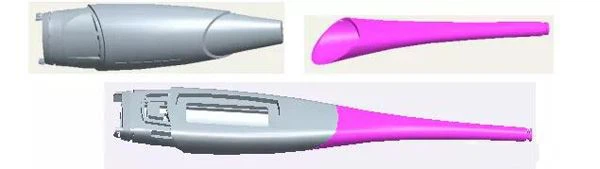
Among the above two-color injection molding machines, the most common are the first four. The sixth vertical two-color injection molding machine is also very common in small plastic parts injection molding, such as electric toothbrushes, electronic watches and other industries.
Two-color injection molding machines can be divided into two categories according to different mold design styles and mold structures. The two-color injection molding machines in Japan and my country (including Taiwan Province) represent the Asian style, and both have two parallel injection systems. For example, the first, second, and sixth categories above. The mold structure of the first and second two-component injection molding machines can be an integral mold structure, or can be designed separately into a structure of two mold bases. Type 6 vertical two-component injection molding machine needs to be designed with a body structure.
3. Shrinkage setting problem
Regarding the setting of the shrinkage rate of the two-color mold, and the key to the problem of whether to set the shrinkage rate for the material for the second injection, there is no more uniform rule at present. It depends on the material used for the second injection and the glue position relative to the entire product. Depends on the structure.
1. If both injections are made of the same material, and the product's external dimensions are more stringent, it is best to set the shrinkage rate for both injections, and the shrinkage rate is the same. However, it is necessary to consider the impact on the second injection when the plastic part after the first injection is used as the cavity of the second injection; for two materials with similar shrinkage rates, the same shrinkage rate can also be used to simplify the mold Design, such as using ABS to overmold the PC material.
2. When TPR is used as an integrally enclosed body, the shrinkage rate of TPR is calculated at 1.0% in all directions. Because the primary material has supported the contour of the product, the secondary material will not shrink more. Only a reasonable determination of the shrinkage rate can ensure the dimensional accuracy of the TPR secondary injection plastic parts. The key is to continuously accumulate experience and accurately determine the shrinkage center.
2. If the proportion of the plastic part in the second injection molding is not large in the entire plastic part, the shrinkage rate of the second injection molding product is the same as that of the first injection design; if the second injection molding material is soft rubber, plastic The part itself is very small, and the soft rubber usually has the same shrinkage rate as the hard rubber.
