





Structure analysis of injection mould for cosmetic cream bottle cap
Cosmetic packaging material mold is a relatively special mold. The requirements for cosmetics packaging bottles and caps are exquisite and beautiful appearance, unique hand and texture, and ingenious and meticulous design. Cosmetic cream bottle cap products are the most widely used in cosmetic packaging. This article takes the cosmetic cream bottle cap as an example to introduce the key points of its mold design in detail. The product picture of cosmetic cream bottle cap is shown in Figure 1. The maximum size of the external shape is ø65.66 mm X 12.90 mm, the average wall thickness is 2.31 mm, and the mass of the plastic part is 14.7 grams. The material of the plastic part is ABS, and the shrinkage rate is 1.0055. The plastic part itself must not have weld marks, bubbles, deformation, Chromatic aberration, burrs and other various injection defects.
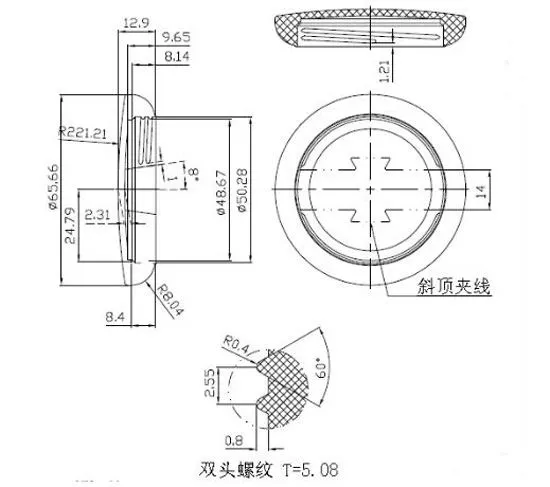
The cosmetic cream bottle cap is embodied in the mold design. There are many things to pay attention to. First of all, in the appearance of the plastic part, no small gate marks are allowed on the outer surface of the plastic part, the back of the product with the general design of the gate, or The inner surface of the bottle cap is covered by a gasket or other parts. The appearance of the decorative ribs, LOGO and other specific decorative features must be beautiful. The appearance of the etching is uniform, and the polished surface has no defects such as reflective ripples. The parting surface clamping line segment difference of the appearance must be controlled below 0.03mm. The acute angle must be clear, and the arc R of the corner must be uniform. During injection molding, there should be strict control standards for black spots and other defects in the appearance of plastic parts. Figure 3 shows the design standard of the cosmetic mold for the casing.
Most cosmetic cream bottles are round, and some are designed to be deformed based on the round shape. Another feature of plastic parts is that they are small in size, and most of them have internal threads. Multi-threaded threads are often used inside cosmetic cream bottles, which have the advantage of fast opening and closing speed, which can be tightened or unscrewed without having to twist more than 2 turns. Material selection, in order to pursue the texture of plastic parts, sometimes the local wall thickness of plastic parts is thicker.
The market demand for cosmetic cream bottle caps is very large, and the production batch is huge. Therefore, the mold design is generally a multi-cavity mold. Under the current technical conditions, the number of cavities can reach from 2 to 124. This set of mold design cavity is arranged in 1 out of 8, divided into two rows, linear arrangement, see mold design drawing 2.
It can be seen from Figure 1 that the top of the outer surface of the plastic part is a circular arc curved surface, and the side is a circular arc rotating curved surface. The internal thread is an intermittent thread, and the type is a double-start thread. According to the size and structural characteristics of the plastic part, the internal intermittent thread needs to be designed as an inclined top demoulding. The gate is a three-plate mold point gate, and the mold structure is an inverted mold.
Because the mold structure is a fine nozzle three-plate mold, the gate is on the top surface of the inner side of the plastic part, the mold structure is a flip-chip mold, the mold base is a non-standard mold base 4050, and the mold is divided into 4 times. The 4 templates of the 4 sub-types are respectively limited by 4 plugs and screws. The plug screw 5 restricts the movement of the nozzle plate; the plug screw 14 restricts the movement of the upper mold core fixing plate; the plug screw 18 restricts the movement of the inclined slider fixing plate; the plug screw 6 restricts the mold opening stroke of the A plate.
In the first step of opening the three-plate mold, the runner aggregate must be separated from the plastic part. Therefore, when the mold is opened for the first time, the nozzle plate is separated from the upper mold core fixing plate, and the nozzle material is pulled off. In the second mold opening, the nozzle plate peels the nozzle material from the nozzle hook 3. The third parting is that the fixed plate of the inclined slider is separated from the fixed plate of the upper mold core, and the inclined slider completes the double-threaded demolding. The last mold opening is when the parting surface is opened and the plastic part is taken out.
Another feature of the cosmetic cream bottle cap mold is that the plastic part is a small diameter round product, and the cavity is a single round cavity inlay. In order to improve the life of the mold, the cavity material needs to be heat treated to above HRC50. Excessive multi-cavity molds can improve the processing accuracy of the cavity, so that the dimensional tolerance of each cavity is controlled within 0.015 to ensure the interchangeability of the cavity. The machining accuracy of the mold blank also needs to be improved, and the tolerance of the center distance between each cavity is controlled within ±0.015.
Each cavity needs to be designed with a water transport circuit and a high temperature rubber ring is used to ensure that the mold does not leak water during injection. The water-carrying circuit of the circular insert is generally opened on the circumference of the insert, and can also be opened on the top of the insert to make the water-carrying circuit as even as possible.
ABIS MOLD TECHNOLOGY CO.,LTD
Daisy Wang (Sales Engineering)
M: +86-150 1652 6799
E: daisy@abismold.com
A: Building B#,YingKeli Industrial Part, LongDong Community, LongGang District, Shenzhen, China 518116
WhatsApp: +86 136 8261 9739
Skype: daisymold@outlook.com