





Intelligent sweeping robot face shell injection mold
The product of the intelligent sweeping robot surface shell is shown in Figure 1. The maximum size of the product is 384.90 mm x ø316.00mm x 130.80 mm, the average thickness of the plastic part is 2.00 mm, the material of the plastic part is PP, the shrinkage rate is 1.018, and the quality of the plastic part is 512.64 gram. The technical requirements for plastic parts are that there must be no defects such as peaks, dissatisfaction with injection molding, flow lines, pores, warpage deformation, silver lines, cold materials, jet lines, etc.
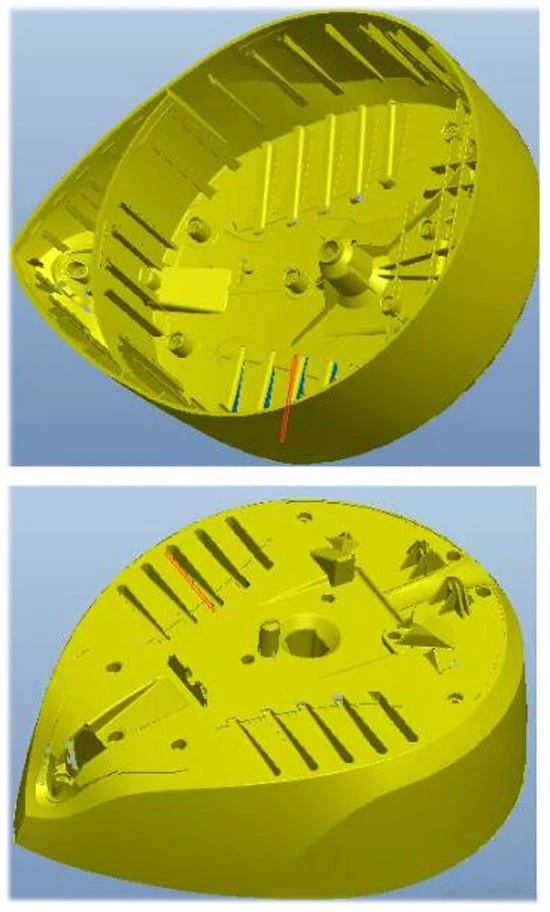
It can be seen from Figure 1 that the structure of the plastic part is a closed shell, and the appearance is like a peach. The top surface of the plastic part has bone position, column position, convex shape and groove. The round bones on the back of the plastic part form a deep wall, and there are multiple deep ribs along the circumference. There are also multiple bones in the center of the inner top. Therefore, the difficulty of mold design lies in the ejection of the plastic part.
The mold design cavity ranking is 1 out of 2. The mold design drawing is shown in Figure 2. Due to the large size of the plastic part itself, the mold is a large mold with a 2 out of ranking. The mold pouring system adopts a hot runner system and is a large mold at the same time. The mold base is a non-standard mold base with a size of 75108. The mold cores of the two cavities are designed separately, which is convenient to separate two machine tools for processing at the same time.
The four corners of the mold core are positioned between the front and rear mold cores to facilitate accurate mold clamping. Due to the large size of the mold core, the deep cavity and the depth of the fine frame, the lower frame of the mold core and the matching of the frame are more difficult, so on the two sides of the mold core away from the reference angle, the inclination of 3 ゜ is designed to cooperate with the fine frame of the front and back molds. . Cancel the slope at the matching mouth of the die core and the fine frame. The purpose of this is to facilitate the machining of the die core by using the vertical edge as the machining reference, such as the centering of the die core during EDM. Six locking blocks 13 are designed on the edge of the mold base B board, and the milling grooves are fixed on the B board with screws. The locking block 13 is matched with the wear-resistant plate on the inclined surface of the A plate at an 8 ゜ inclined surface.
The plastic part is a large-size deep-cylinder plastic part, and the back mold has a deep bone position, which makes it difficult to eject the plastic part. Especially the semi-circular deep wall bone position has greater tightening force on the back mold. The material of the plastic part is PP. This material has poor rigidity. When the packing force is large, it is easy to cause whitening or top-through, and it may also cause large deformation of the plastic part. In summary, if the ejector pin is directly designed to eject, the plastic part cannot be ejected effectively.
Under normal circumstances, the ejection of plastic parts from the mold, whether it is a single or multi-element ejection mechanism, the ejection action is completed at one time. However, due to the special shape of the plastic part or the need for production automation, if the plastic part is difficult to be removed from the mold cavity or poor demolding is caused by a single ejection action, it is necessary to add another ejection action to successfully eject the plastic part. out. For plastic parts with thin walls and deep cavities or complex shapes, sometimes in order to avoid excessive stress on the plastic parts once ejected, a second ejection is also used to disperse the ejection force and ensure the quality of the plastic parts. According to the above analysis, this set of mold plastic parts must be ejected twice. The secondary ejection mechanism is usually that part or all of the demolding components are first released from the plastic part together, and then some of the ejected components are stopped while the other part of the components continue to be ejected from the plastic part.
There are many mechanisms for secondary ejection. In Europe, the HASCO standard secondary ejection component Z169 is commonly used. The specifications and dimensions are shown in Figure 4. The customer for this set of molds is an Italian customer, and Z169/40 is selected for the secondary ejection. It is divided into two layers. The upper side is designed with push block and thimble, and the bottom of the thimble board is designed with straight top and thimble. When ejecting, first the two layers of ejector plates act at the same time to demold the parts that are difficult to demold, and then the center ejector pin ejects the upper ejector plates to achieve demoulding of the plastic parts.
The secondary ejector mechanism of HASCO adopts mechanical action to eject, which is reliable in operation and long in service life. Regardless of the size of the mold, a secondary ejection device is designed and designed in the center of the mold.
ABIS MOLD TECHNOLOGY CO.,LTD
Daisy Wang (Sales Engineering)
M: +86-150 1652 6799
E: daisy@abismold.com
A: Building B#,YingKeli Industrial Part, LongDong Community, LongGang District, Shenzhen, China 518116
WhatsApp: +86 136 8261 9739
Skype: daisymold@outlook.com