





Injection mold for output pallet
The output end pallet product is shown in Figure 1. The maximum size of the product is 142.00 mm x 72.41 mm x 6.90 mm, the average thickness of the plastic part is 1.60 mm, the material of the plastic part is ABS+PEBA, the shrinkage rate is 1.005, and the quality of the plastic part is 15.60 Grams. The technical requirements for plastic parts are that there must be no defects such as peaks, dissatisfaction with injection molding, flow lines, pores, warpage deformation, silver lines, cold materials, jet lines, etc.
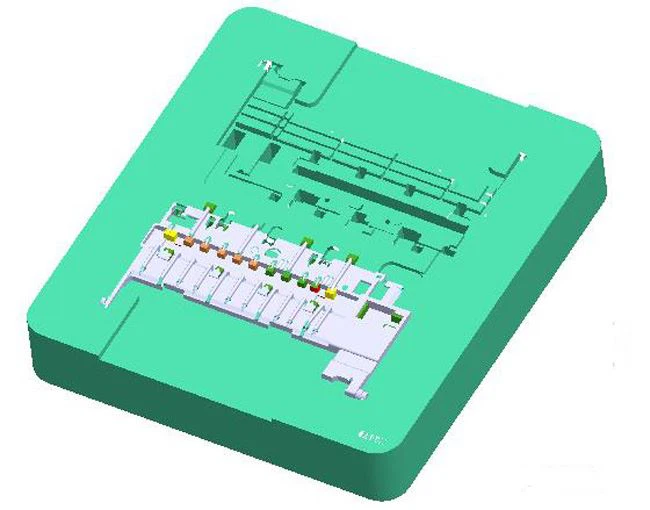
It can be seen from Figure 1 that the plastic part structure is a flat tray, and the plastic part structure and 3D mold design drawing are shown in the attached 3D drawing. The plastic material is composed of ABS+PEBA. PEBA material is a block copolymer prepared from polyether and polyamide blocks. Their unique performance is attributed to their unique phase separation structure. There is a hard phase, which mainly includes polyamide blocks, and a soft phase, which mainly includes polyether blocks. Because these two blocks are linked together by esters. It is a material that can withstand more than 150,000 cycles without damage, even if the temperature is as low as -40°C, no cracks can be seen. PEBA material has good low-temperature impact resistance; at the same time, it has good elasticity, which leads to its excellent impact performance at extremely low temperatures.
The output pallet is the output pallet of a Japanese brand printer, and the printed paper is output through the top of the pallet. Therefore, there are special technical requirements for the printer pallet, that is, the surface must not have factors that hinder the movement of the paper, and there must be no deformation, the warpage of both ends to the top surface cannot exceed 0.3, and the ends to the bottom surface cannot be warped, as shown in Figure 1. Top The raised bones on the surface support the paper, not the reinforcing ribs. The size must be accurate and the shape conforms to the direction of movement of the paper. The level difference between the front and rear molds on the parting surface is controlled below 0.03. A special fixture is designed for the inspection of plastic parts, as shown in Figure 3.
The structure of the plastic part is flat, without various core pulling and complicated mold structure. In view of the actual situation of plastic parts, the mold design cavity rank is 1 out 2. The mold design drawing is shown in Figure 2. The gating system adopts a three-plate mold with fine nozzles and three-point glue feeding. The mold design specification book is shown in Figure 4.
The mold base adopts DCI3335 standard mold base, and the panel code mold part is milled to 30mm thin, which is convenient for mold code fixation. The four sides of the mold base are designed with a slope positioning block to provide positioning for the mold; the mold base is designed with positioning pins to increase the rigidity of the mold base. The mould core steel adopts Japanese mould steel NAK80, and the standard mould parts adopt Japanese MISUMI standard. In order to ensure the mold life of 500,000 times, a bushing 3 is designed on the outside of the sprue bushing 2, which is convenient for replacement and maintenance. The code mode of the mold adopts the V-shaped block code mode. This code mode is particularly suitable for the code mode of large and medium-sized molds. It can be coded quickly and has the characteristics of high safety. After the mold bears the weight of the V-shaped block (there is no V-shaped groove on the rear mold), the code mold only needs to tighten 8 bolts, which can realize fast code mold.
Both the AB board and the nozzle board are designed with corresponding cooling water transportation. The front and rear mold cores are fully cooled through multiple direct water cooling circuits. The plastic part is ejected by a thimble, and the travel switch 9 detects the return of the ejection system.
ABIS MOLD TECHNOLOGY CO.,LTD
Daisy Wang (Sales Engineering)
M: +86-150 1652 6799
E: daisy@abismold.com
A: Building B#,YingKeli Industrial Part, LongDong Community, LongGang District, Shenzhen, China 518116
WhatsApp: +86 136 8261 9739
Skype: daisymold@outlook.com