





Double-threaded nut automatic unthreading injection mould
The product diagram of the double-threaded nut is shown in Figure 1. The maximum size of the product is 29.00 mm x 29.00 mm x 32.00 mm, the average thickness of the plastic part is 5.15 mm, the material of the plastic part is PP, the shrinkage rate is 1.018, and the quality of the plastic part is 11.20 grams . The technical requirements for plastic parts are that there must be no defects such as peaks, dissatisfaction with injection molding, flow lines, pores, warpage deformation, silver streaks, cold materials, jet lines, etc. In addition to dimensional tolerances, plastic parts also need to ensure the dimensional accuracy of their triangular threads to meet assembly requirements.
The product diagram of the double-threaded nut is shown in Figure 1. It can be seen from the figure that the plastic part has a simple structure, similar to two polygonal nuts overlapping each other. Therefore, to form an undercut in the shape of the plastic part, it is necessary to design the Hough slider for molding. There is no continuity between the two sections of thread inside the plastic part, and the middle is separated by 2mm. The plastic part needs to be threaded off from both ends. The specifications of the two internal threads are both inch thread PT1/2. The basic feature of the plastic part is that the threads at both ends are exactly the same. Therefore, when determining the mold opening plan, one end of the plastic part is unthreaded in the front mold, and the other end The thread is unthreaded in the back mold.
Since the shape of the plastic part needs to be formed by the design of the Hough slider, the choice of the mold opening direction of this set of molds can also be designed by laying down the plastic part. At this time, the threaded core is on the slider. Because the slider threading mechanism is complicated, this mold design solution for threading is not selected.
There are many types of thread-removing mold structures. The power source of the automatic unthreading mechanism is to use the mold opening force to unthread, including the mold opening force to drive the rack to drive the gear to unthread and the screw rod to unthread; the hydraulic cylinder drives the rack to reciprocate, and the gear to make the thread core Rotate to achieve internal thread demolding; cycloidal hydraulic motor unthreading uses a variable-speed motor to drive the gear, and the gear drives the thread core to achieve internal thread demolding; the cycloidal hydraulic motor can also be used to drive the sprocket through the chain to finally drive the threaded core Unthreading; general motor drive is mostly used in the case of a large number of threads.
When housing products are unthreaded, their ranking generally depends on the size and shape of the product. For single-cavity molds, the threaded part needs to be arranged in a position where the unthreading mechanism is easy to be arranged. For multi-cavity molds, the threaded parts of the plastic parts need to be arranged according to a certain regularity. Motors and hydraulic motors often use plastic parts to arrange their threads in a circle. Bottle caps and nut plastic parts are small in size, and are mostly multi-cavity threading molds. There are two types of linear and circular arrangements when threading.
The significant difference between the unthreading of casing products and the unthreading of bottle caps is:
1) For large casing plastic parts, the mold opening direction is determined by the casing itself, and the thread is only a small structural element of the plastic part. Therefore, the thread-removing mechanism must obey the structural characteristics of the housing mold. The movement of the unthreading mechanism is isolated from the movement of the rest of the mold. For example, the threading mechanism and the plastic part ejection are carried out in isolation. At this time, the threading is mostly used to drive the rack and pinion by the oil cylinder.
2) Nuts and bottle caps are unthreaded. The unthreading mechanism is related to the ejection mechanism and the mold opening movement of the mold, and the mold must have a certain degree of mold opening stability. It is necessary to prevent the screw teeth from being damaged during the mold opening movement.
Use cycloid hydraulic motor or electric motor to unthread, not limited by the number of thread turns. It should be noted that the travel switch must be designed to effectively control the two extreme positions of the thread core after mold opening or closing. The final position of the thread core must be connected to electrical contacts to start the mold closing or injection process. Through this electrical control technology, only the time when the thread core is unthreaded can be determined, and it has nothing to do with the opening and closing of the mold.
When the power source adopts the cylinder to unthread, the molds of European and American customers will also require cylinders with a limit switch to accurately set the thread core exit distance.
Comparing various thread-removing mechanisms, the oil cylinder plus rack and pinion has stable thread-removing performance and accurate return, but the operating efficiency of the oil cylinder is low, and the injection cycle will be lengthened. Usually the pumping force of the oil cylinder is used to unthread the thread, and the pulling force of the oil cylinder needs to be calculated. With the help of mold opening force, it is convenient and concise to use rack and pinion or screw rod to unthread, and the mold size can be reduced. With the help of mold opening force to unthread the mold, the mold opening force is huge at the moment of mold opening, which is mainly to overcome the static friction force. It is necessary to pay attention to the rigidity of the mold base, and the positioning between the mold plates of the mold base is good, and the moving mold plate is a good guide mechanism. The rack should be designed with a 3-sided guide mechanism and have sufficient strength.
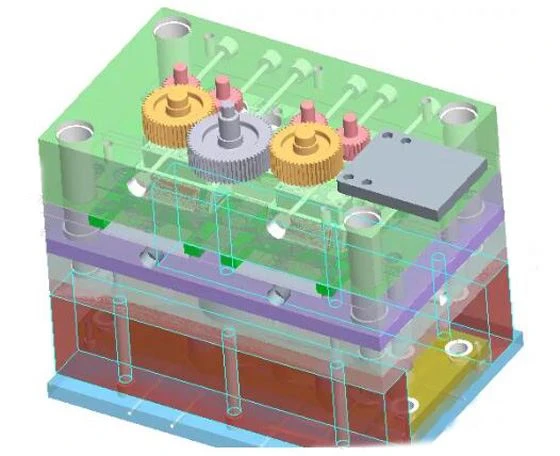
The cavity layout of the mold design is 1 out. 4. The front and rear molds are designed with independent thread-removing mechanisms. The thread-removing mechanism of the front and rear molds is used for thread-removing by hydraulic motors. In the front mold unthreading mechanism, the cycloidal hydraulic motor drives the sprocket, and then drives the sprocket coaxial with the gear 17 through the chain 25, so that the gear 17 (the number of teeth is 60, the module is 2) rotates and drives the meshing The gear 16 (the number of teeth is 50, the module is 2) rotates, and the speed is increased. The gear 16 respectively drives the two front mold thread cores (the number of teeth is 25, the module number is 2) to rotate, and the thread is released. During the rotation of the thread core, the tail retreats into the thread sleeve. The internal thread of this thread sleeve has the same specification parameters as the internal thread of the plastic part. The whole process of unthreading adopts 2-stage transmission.
The thread of the back mold adopts the same unthreading method as the thread of the front mold. The gating system is designed with a latent gate in the middle of the Hough slider. The two sliders are driven by oblique guide posts. Cooling inserts are designed inside the threaded cores of the front mold and the rear mold, and cooling water is designed to ensure normal injection molding. If the thread core of the unthreaded mold is not designed to cool and transport water, the mold will heat up after a period of injection molding, and the thread core will easily burn to death due to high temperature, resulting in abnormal production.
ABIS MOLD TECHNOLOGY CO.,LTD
Daisy Wang (Sales Engineering)
M: +86-150 1652 6799
E: daisy@abismold.com
A: Building B#,YingKeli Industrial Part, LongDong Community, LongGang District, Shenzhen, China 518116
WhatsApp: +86 136 8261 9739
Skype: daisymold@outlook.com