





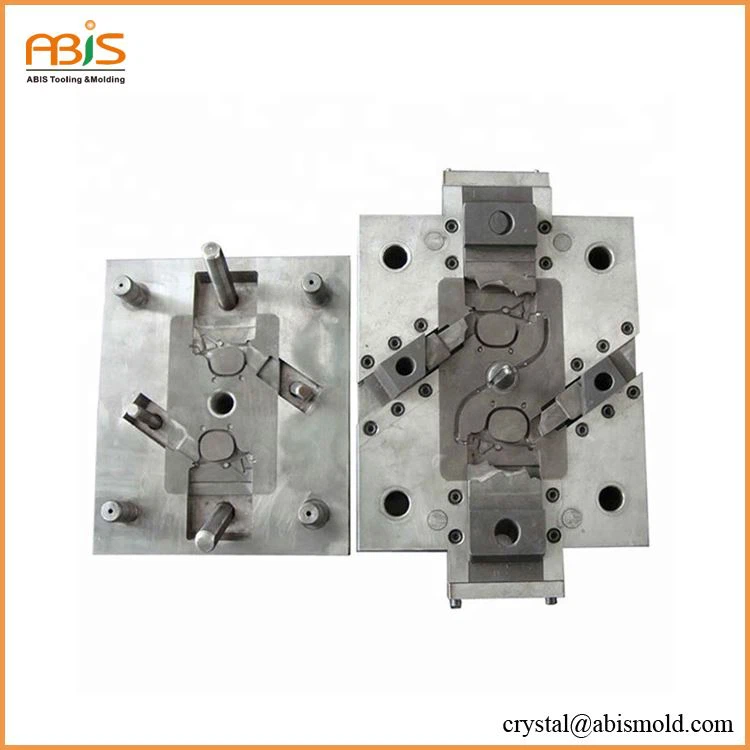
ABIS Mold Technology Co., Ltd. is one of the leading manufacturers and suppliers of die casting mold for aluminum parts in China. Please feel free to buy high quality die casting mold for aluminum parts made in China here from our factory. Welcome to view our website for more information.
Mold|Tooling Details
Shaping Mode: Die casting
Mould material: H13 steel core&45 steel frame
Mould base: LKM, HASCO, DEM etc
Cavity: Single&Multi-cavity
The hardness of steel:46~56HRC
Runner system: Hot Runner|Cold Runner
Quality control:ISO9001, GB/T 19001-2008 certification
Applied software: Pro-E, Solidworks, UG, CAD, etc
Mould check: Water leak
Mould life:500K shots-1000K shots
Lead time:3-5 weeks
Package: Wooden case
Why Choose ABIS
1.Founded in 1996, Cover an area of 10000 sqm Plant; Provide OEM/ODM Service
2.Certified by ISO90001, SGS, CE,UL etc
3.Over 20 years experience in Mold Design&Mold|Tooling making, including parts Production
4.Integrating R&D, QC System & Marketing Sales
5.Onestop Service of Custom mold design from Initial drawing design, Material selection assistance, Mold structure/Mold flow analysis, Trial & mass production to Final mold assembly & shipment.
Project process&Control
1.Quote within 24 hours by engineer team
1)Based on 2D/3D drawing, or sample, Even idea or concept
2)Primary DFM can be offered at the same time if necessary
2.PO details confirmation
with a professional sales team in every detail
3.DFM Report Issued
4.2D & 3D Mold design
5.Mold Building
6.Sample & Mold approval
7.Mold-check & Package & Delivery
8.After service to ensure smoothly run mold
QC Control
1.Mould Design Control: Design a review checklist before submitting it to the customer. We will not start the steel purchasing work until get your written approval on our mold drawing.
2.Incoming quality control: all-steel material and outsourcing standard components will be checked to ensure that they are in accordance with the BOM(QTY and material/components name specified)
3. In-process quality control: all the machining and assembling process is under control, we have QC team to check and supervise the tolerance and processed surface to satisfy the requirements.
4.Final quality control: within 3 days of the completion of the plastic mold, we will have a thorough check for the main size of the molded plastic sample and mold to ensure that the critical or full dimension (if required) is within tolerance.
5.Mould Pre-Shipment Final Inspection: Free-fumigation three-plywood case packing; make sure the mold is conformity to the approved mold drawing. The spare components and easily broken components and the electrode (if required) are packaged, as well as the mold drawing and some certificated.
ABIS mold company have over 120 employees with professional designer team & engineers team to offer services and solutions from design to finish product.
Two molding rooms Press machine range from 80T to 1600T.
400+ molds capacity each year, and 65% exported (mainly to Europe and North America).
We are focuced on plastic injection mold and molding, develope products and also provide stamping/ punching, blowing molds, die casting molds, as well as the secondary process.


Die Casting Technology
Die casting represents one of the most efficient and precise metal forming processes in modern manufacturing, particularly when producing aluminum components with complex geometries and tight tolerances. The die casting mold for aluminum parts serves as the heart of this sophisticated manufacturing system, determining not only the dimensional accuracy but also the surface quality and production efficiency of cast components. As a leading die casting manufacturer understands, the mold design directly impacts product quality, cycle time, and overall manufacturing costs.
The fundamental principle of die casting involves injecting molten aluminum under high pressure into a precision-machined steel mold cavity. This high pressure die casting process typically operates at pressures ranging from 1,500 to 25,000 PSI, ensuring complete cavity filling and excellent surface finish. The mold, consisting of two halves (fixed and movable dies), must withstand these extreme pressures while maintaining dimensional stability across thousands of production cycles.
Die Casting Process Parameters
1,500 - 25,000
44-48
150-250°C
Critical Components of Aluminum Die Casting Molds
The architecture of a die casting mold comprises several essential elements working in harmony. The cavity insert defines the external geometry of the part, while core pins create internal features such as holes and undercuts. The runner system, including the sprue, runners, and gates, channels molten aluminum from the injection point to the cavity. Any reputable aluminum die casting supplier will emphasize that proper runner design ensures uniform filling and minimizes turbulence, crucial for achieving high-quality castings.
The ejection system represents another vital component in die casting mold design. Ejector pins, sleeves, and plates work together to remove the solidified part from the mold cavity without damage. The cooling system, consisting of strategically placed water channels, maintains optimal mold temperature throughout the die casting cycle. Temperature control directly affects solidification rates, dimensional accuracy, and cycle time efficiency.

Industries We Serve - Proven Aluminum Die Casting Mold Applications
From automotive chassis brackets and EV battery enclosures to 5G housings, LED lamp bodies, power-tool gearboxes, and electronics heat sinks, ABIS has shipped aluminum die casting tooling into 30+ countries. Customers looking for an experienced chassis structure part die manufacturer rely on us for flatness control across large structural frames. For thermal-management projects, we build CNC aluminum cooler lid molds with conformal cooling and Be-Cu local inserts for cold-plate and EV battery-cover applications. When single-cavity output can't hit target volume, we engineer multi cavity aluminum die casting molds with balanced 2- or 4-cavity runner systems that hold shot-to-shot variation inside statistical control. We also build aluminum injection mold frames for hybrid metal/plastic assemblies - one supplier, the full tooling package.
Send your 2D/3D drawing (or even just a sample) - you'll have a DFM report and quotation back within 24 hours.
Materials and Heat Treatment for Die Casting Molds

The selection of mold materials significantly impacts die casting performance and longevity. H13 tool steel remains the industry standard for aluminum die casting molds due to its excellent combination of hot hardness, thermal fatigue resistance, and machinability. Premium H13 steel undergoes specialized heat treatment processes, achieving hardness levels between 44-48 HRC for optimal performance. A professional custom die casting factory typically employs vacuum heat treatment to minimize distortion and ensure uniform properties throughout the mold components.
Surface treatments further enhance mold performance in die casting applications. Nitriding creates a hard surface layer that resists erosion from molten aluminum flow, while PVD coatings provide additional protection against soldering and wear. These treatments can extend mold life by 200-300%, making them essential investments for high-volume die casting parts bulk order production scenarios.
Tight Tolerance Aluminum Casting - ±0.01mm Where It Matters
Industry-standard die casting sits around ±0.1mm. That's not good enough for sealing surfaces, bearing bores, or mating interfaces - and it's why rework kills margin on cheap tooling. ABIS delivers die casting parts with tight tolerance aluminum ±0.01mm on critical features by combining cavity machining to ±0.005mm (Makino high-speed MC), planned secondary CNC finishing on 5-axis centers, and full Zeiss CMM verification against your GD&T drawing.
Our tooling is also alloy-specific. As a specialized china aluminum alloy die casting mold supplier, we design cavity geometry, gate velocity, and shrinkage compensation around your intended alloy - ADC12, A380, A360, AlSi9Cu3, or AlSi10Mg. A mold optimized for thin-wall ADC12 electronics housings will not behave the same when cast with A380 structural brackets, which is why generic aluminium die casting moulds from lowest-quote shops so often come back needing rework. Our china aluminum die casting mold programs are engineered right the first time - and we back that with mold-life guarantees written into the PO.
Mold Material Comparison

Surface Treatment Options for Die Casting Molds
| Treatment Type | Process | Benefits | Expected Life Extension |
|---|---|---|---|
| Nitriding | Diffusion of nitrogen into surface | Increased surface hardness, improved wear resistance | 100-150% |
| PVD Coating | Physical vapor deposition | Excellent anti-soldering properties, low friction | 200-300% |
| Carburizing | Carbon diffusion treatment | Deep case hardness, improved fatigue strength | 150-200% |
| Chrome Plating | Electroplated chromium layer | Good corrosion resistance, easy release | 50-100% |
Design Principles for Aluminum Die Casting Molds
Effective die casting mold design requires careful consideration of numerous factors affecting part quality and production efficiency. Wall thickness uniformity prevents differential cooling rates that cause warping and internal stresses. Draft angles, typically 1-3 degrees per side, facilitate part ejection while minimizing wear on mold surfaces. The die casting process demands precise calculation of shrinkage allowances, accounting for aluminum's volumetric contraction during solidification.
Gate design profoundly influences die casting quality outcomes. The gate location determines flow patterns, affecting air entrapment and solidification sequences. Multiple gate configurations exist, including edge gates, fan gates, and tangential gates, each suited to specific part geometries. Advanced die casting simulations help optimize gate placement, predicting potential defects before mold construction begins.
Key Design Considerations
Uniform wall thickness (2-4mm typical for aluminum)
Proper draft angles (1-3° per side)
Shrinkage allowances (1-1.5% for aluminum alloys)
Strategic gate placement to avoid air entrapment
Adequate fillets and radii (minimum 1mm)
Effective venting (0.02-0.05mm gap)
Accessible ejection points
Optimal cooling channel placement

Wall Thickness Considerations
Maintaining uniform wall thickness throughout the part design prevents uneven cooling and reduces internal stresses that can cause warping or cracking in aluminum die cast components.

Gate Design Variations
Different gate configurations serve specific purposes, from edge gates for simple parts to fan gates for large surfaces and tangential gates for cylindrical components.
Manufacturing Process for Die Casting Molds
Creating precision die casting molds involves multiple sophisticated manufacturing steps. Initial rough machining removes bulk material using high-speed CNC milling centers, followed by heat treatment to achieve required hardness levels. Semi-finishing operations bring dimensions closer to final specifications, while leaving appropriate stock for finishing passes. Any ISO certified die casting operation maintains strict process controls throughout mold manufacturing.
EDM (Electrical Discharge Machining) technology enables creation of complex cavity details impossible with conventional machining. Wire EDM produces precise contours and sharp corners, while sinker EDM creates deep cavities and intricate textures. The die casting industry increasingly adopts high-speed machining for finishing operations, achieving surface roughness values below Ra 0.4 micrometers. Final polishing, often performed manually by skilled craftsmen, ensures optimal surface quality for precision die casting parts production.
Design & Engineering
Computer-aided design (CAD) modeling and simulation to optimize mold geometry, cooling channels, and gating systems before manufacturing begins.
Rough Machining
High-speed CNC milling removes bulk material from tool steel blocks, creating approximate mold geometry while leaving sufficient stock for subsequent operations.
Heat Treatment
Controlled heating and cooling processes to achieve desired hardness (typically 44-48 HRC for H13 steel) and relieve internal stresses from machining.
EDM Operations
Electrical Discharge Machining creates complex cavities, fine details, and precise features that cannot be achieved with conventional machining methods.
Finishing & Polishing
Precision grinding and manual polishing achieve final dimensions and surface finishes, with critical areas often polished to Ra 0.4 micrometers or better.
Assembly & Testing
Mold components are precision assembled, followed by trial runs to verify performance, dimensional accuracy, and overall functionality before production use.

Thermal Management in Die Casting Molds
Temperature control represents a critical factor in die casting success. Proper thermal management ensures consistent cycle times, prevents premature solidification in thin sections, and minimizes thermal fatigue in mold components. Conformal cooling channels, following part contours, provide superior temperature uniformity compared to traditional straight-drilled channels. The die casting process typically maintains mold temperatures between 150-250°C for aluminum alloys.
Advanced die casting operations employ thermal imaging to monitor mold temperature distributions during production. This data enables real-time adjustments to cooling parameters, optimizing quality and productivity. Some facilities offering die casting OEM service integrate oil temperature controllers for precise thermal management, maintaining temperature variations within ±2°C across the mold surface.
Cooling System Comparison
Traditional Straight Cooling
Simple to manufacture
Lower initial cost
Limited temperature uniformity
Not suitable for complex geometries
Conformal Cooling
Superior temperature uniformity
Faster cycle times (15-20% reduction)
Ideal for complex part geometries
Higher initial manufacturing cost

Thermal Imaging in Die Casting
Thermal imaging technology allows operators to visualize temperature distribution across the mold surface, enabling precise adjustments to cooling systems and ensuring uniform solidification of aluminum parts.
Quality Control and Validation Procedures
Comprehensive quality assurance protocols ensure die casting molds meet exacting specifications. Coordinate measuring machines (CMMs) verify dimensional accuracy to tolerances of ±0.01mm or better. Surface roughness testing confirms appropriate finish levels for different mold areas. A professional establishment providing die casting quotation services includes detailed quality documentation demonstrating mold compliance with customer requirements.
The die casting prototype sample phase validates mold performance before full production commences. Initial samples undergo extensive testing, including dimensional verification, mechanical property evaluation, and microstructural analysis. X-ray inspection reveals internal porosity or inclusions, while pressure testing confirms part integrity for sealed components. This validation process ensures the die casting mold produces parts meeting all specifications consistently.
Dimensional Inspection
Coordinate Measuring Machines (CMM) verify critical dimensions to tolerances of ±0.01mm, ensuring mold components meet exact specifications before assembly.
Surface Analysis
Surface roughness testing (Ra measurements) and profilometry ensure appropriate finishes for different mold areas, from functional surfaces to cosmetic regions.
Material Testing
Hardness testing, microstructure analysis, and chemical composition verification confirm mold materials meet required specifications for performance and durability.
Trial Runs
Prototype production runs validate mold performance under actual operating conditions, checking for proper filling, ejection, and part quality consistency.
Non-Destructive Testing
X-ray inspection and ultrasonic testing identify internal defects in both mold components and cast parts without damaging the materials.
Documentation Review
Comprehensive documentation verification ensures all design requirements, material specifications, and process parameters have been properly implemented.

Maintenance Strategies for Die Casting Molds
Proactive maintenance extends die casting mold life significantly while ensuring consistent part quality. Daily cleaning removes aluminum residue and applies appropriate mold release agents. Weekly inspections identify early signs of wear or damage, enabling timely corrective actions. Any zinc die casting wholesale operation understands that similar maintenance principles apply across different alloy systems.
Preventive maintenance schedules for die casting molds typically include periodic dimensional checks, surface refinishing, and component replacement. Major overhauls, performed every 50,000-100,000 shots depending on complexity, involve complete disassembly, inspection, and refurbishment. Maintaining detailed maintenance records helps predict component failure patterns, optimizing replacement timing and minimizing unplanned downtime.
Recommended Maintenance Schedule
| Maintenance Task | Frequency | Purpose |
|---|---|---|
| Clean mold surfaces | Daily | Remove aluminum residue and prevent buildup |
| Inspect for visible wear | Daily | Identify early signs of damage or excessive wear |
| Check cooling system | Weekly | Ensure proper flow and temperature control |
| Lubricate moving parts | Weekly | Prevent galling and ensure smooth operation |
| Dimensional inspection | Monthly | Verify critical dimensions and cavity integrity |
| Major overhaul | 50,000-100,000 shots | Complete disassembly, repair, and refurbishment |
Mold Life Extension Tips
Maintain Clean Cooling
Regularly flush cooling channels to prevent mineral buildup and ensure consistent temperature control.
Use Proper Release Agents
Select release agents compatible with both the mold material and aluminum alloy being cast.
Optimize Temperature
Avoid excessive temperature fluctuations that cause thermal fatigue and cracking.
Replace Wear Components
Proactively replace ejector pins, sleeves, and other high-wear items before failure.
Document Everything
Maintain detailed records of maintenance, repairs, and performance to identify patterns.
Expected Mold Life
With proper maintenance, aluminum die casting molds can achieve:
Simple molds:500,000+ shots
Complex molds:250,000+ shots
Advanced Technologies in Modern Die Casting
The die casting industry continuously adopts innovative technologies enhancing mold performance and part quality. Vacuum-assisted die casting reduces air entrapment, producing parts with superior mechanical properties and reduced porosity. Semi-solid metal casting combines advantages of forging and die casting, achieving exceptional mechanical properties in aluminum components. The magnesium die casting process benefits from similar technological advances, though requiring modified mold designs accommodating magnesium's unique characteristics.
Simulation software revolutionizes die casting mold development, predicting filling patterns, solidification sequences, and potential defects before physical mold construction. These tools reduce development time and costs while improving first-time success rates. Companies offering cheap die casting service increasingly rely on simulation to optimize designs without expensive trial-and-error iterations.

Vacuum-Assisted Die Casting
This technology removes air from the mold cavity before and during injection, significantly reducing porosity in cast aluminum parts. The result is improved mechanical properties and better surface finish, particularly beneficial for pressure-tight components.

Semi-Solid Metal Casting
By processing metal in its semi-solid state, this technology combines the advantages of casting and forging. It produces parts with superior mechanical properties, reduced shrinkage, and improved dimensional accuracy compared to traditional die casting.

Process Simulation
Advanced software tools simulate mold filling, solidification, and cooling processes, allowing engineers to identify and correct potential issues before mold construction. This reduces development time and improves first-pass yield.

Additive Manufacturing
3D printing technology enables production of complex mold inserts with conformal cooling channels that would be impossible with conventional machining, dramatically improving cooling efficiency and reducing cycle times.
Flexible OEM & ODM Programs - Your Engineering, Our Execution
Bring us a finished drawing and we'll run it as a pure aluminum die casting mold OEM build, conforming to your drawing control and PPAP process. Bring us only a concept, competitor sample, or performance target and our engineers take it through full aluminum die casting mold ODM development - DFM, mold-flow simulation, design, tooling, T0/T1 sampling. Most casting aluminum parts ODM projects we handle reach first-article approval in one or two trials instead of the industry-typical three to five, because front-end simulation catches gate, vent, and shrinkage issues before steel is cut.
IP stays with you. Pricing stays transparent. Tooling build is tracked with weekly progress photos. That's why several European and North American brands have kept ABIS as their primary aluminum die casting mold supplier for 5+ years.
Start a confidential project review - nancy@abismold.com / WhatsApp +86 17727582624.
Authority Citation
"Modern die casting technologies, particularly advanced simulation and thermal management systems, have enabled significant improvements in aluminum part quality and production efficiency. When combined with optimized mold design and materials, these technologies can reduce total production costs by 15-20% while improving part performance and consistency."
From "Advances in Die Casting Technology for Lightweight Metals"
Journal of Manufacturing Science and Engineering, 2023
(https://www.asme.org/publications-submissions)
Economic Considerations and Cost Optimization
Understanding die casting economics helps manufacturers make informed decisions about mold investments. Initial mold costs vary significantly based on complexity, size, and required production volumes. A comprehensive die casting price list typically includes factors such as cavity quantity, material specifications, and surface treatment requirements. Multi-cavity molds increase upfront costs but reduce per-piece prices for high-volume production.
The total cost of ownership for die casting molds extends beyond initial purchase price. Maintenance costs, expected production volumes, and part complexity all influence long-term economics. Strategic partnerships with experienced suppliers ensure optimal mold designs balancing initial investment with operational efficiency. Modern die casting facilities employ sophisticated cost modeling tools, accurately predicting total production costs including mold amortization, material consumption, and processing expenses.
Cost Factors in Die Casting Mold Production

Short-Term Cost Optimization
Long-Term Cost Optimization
Why Global Buyers Choose ABIS as Their China Aluminum Die Casting Mold Manufacturer
Sourcing teams benchmarking china aluminum mould manufacturers typically evaluate three things: engineering depth, build quality, and after-sales responsiveness. ABIS delivers on all three because we're vertically integrated - design, steel, CNC, EDM, heat-treatment coordination, and trial-shot under one roof since 1996. No re-farming. No finger-pointing between subcontractors. No surprise costs mid-build.
What that means for you in hard numbers:
- 29 years specialized as an aluminum die casting mold manufacturer, 400+ molds built per year, 65% exported to Europe and North America
- 500K–1,000K shot mold life, H13 premium steel, ISO9001 / SGS / CE / UL documentation delivered with every shipment
- 24-hour quotation, free DFM, weekly progress photos - responsiveness fragmented china aluminum mold suppliers rarely match
- One-stop scope: from a single china aluminium mold making suppliers engagement to full program management including casting, CNC finishing, anodizing, and assembly
Whether you're sourcing a new aluminum die casting mold china program, consolidating existing aluminum mould manufacturers from china, or escalating from a failed aluminum mould manufacturers ltd relationship, talk to us first. As experienced china aluminum mould suppliers and a direct die casting mold company - not a trading middleman - we protect margin and timeline for the full life of your tooling.
Ready to move? Send your drawing now for a 24-hour quote. First-time customers also receive a complimentary mold-flow simulation report (value ~USD 300) on qualifying projects.
Beyond the Casting Die - Full Tooling Support
A production-ready die cast mold program rarely ends at the cavity itself. ABIS supplies matched trimming dies, replacement die casting mold parts (ejector pins, sleeves, core pins, slide blocks, inserts, sprue bushes, shot sleeves - the standard parts of a casting mold that keep uptime high), and painting-masking tooling for anodize and powder-coat lines, which also ranks us among reliable china painting masking mould manufacturers. Buyers who initially search narrow terms like die cast mould often find one ABIS relationship replaces three or four separate vendors - and that's before we talk pricing.
Ask for our full capability PDF - it's the fastest way to see if we fit your supply base.
This is Nancy here, I have 6 years experience as a mold designer and 3 years working as a project manager.Welcome to contact with me anytime:
Nancy zhang(International sales)
ABIS Mold Technology Co.,Ltd.
Tel:0086-75589984896
Phone/WeChat/WhatsApp:+86 17727582624
Email:nancy@abismold.com
Web:www.abismold.com
Add:B Building, YingkeLi Area, Longdong Community, Longgang District, ShenZhen, China 518116.
We are focuced on plastic injection mold and molding, and we developed some types of electronic products with customers and ourselves, and we also provide stamping/ punching, blowing molds, die casting molds, as well as the secondary process.
Hot Tags: die casting mold for aluminum parts, China, Shenzhen, manufacturers, suppliers, factory


